TL;DR: A 2026 study in Social Psychology found that a female professor and a male professor produced almost identical obedience in a modern Milgram-style replication, suggesting professional authority mattered more than the authority figure’s gender.
Key Findings
- Authority gender: 88% of participants obeyed every instruction from a female professor, versus 90% with a male professor.
- Lab sample: 80 volunteers completed a modern, safety-limited Milgram-style obedience procedure.
- Online extension: Nearly 800 Polish internet users imagined the same scenario and again showed no average obedience shift by authority gender.
- Sexism result: Higher ambivalent-sexism scores predicted more willingness to obey, regardless of whether the authority figure was male or female.
- Main caveat: The in-person study was small, and hypothetical online obedience cannot fully reproduce laboratory pressure.
Source: Social Psychology (2026) | Grzyb et al.
Milgram-style obedience experiments test whether people will follow instructions that appear to harm another person. The classic version used escalating electric shocks, a learner in another room, and an experimenter who pushed the participant to continue.
Researchers asked a narrower question: does obedience change when the authority figure is a woman rather than a man?
Professional Authority Overrode Gender Cues
The study focused on the person giving commands. Past replications had tested the gender of the participant and the gender of the learner, but not the gender of the experimenter directing the procedure.
Two plausible predictions pointed in opposite directions. A male professor might command more obedience because men are often granted higher status in public settings.
A female professor might also command obedience if warmth or approachability made participants more willing to cooperate.
The result supported neither gender-stereotype explanation. The title of professor appeared to carry the authority signal.
That distinction is clinically and socially relevant because obedience research is often used to explain harmful compliance in institutions.
The question is not only who gives the order. It is which role gives the order legitimacy.
The Lab Replication Used 80 Volunteers
Researchers recruited 80 volunteers for a modified laboratory obedience test. The setup was safety-limited: participants did not proceed to the extreme voltage levels associated with the original Milgram studies.
The safety limit is important. The modern procedure was designed to preserve the decision point, not to recreate the full distress of the original 1960s experiments.
The procedure still preserved the core structure:
- Teacher role: the real participant read memory items and controlled the shock generator.
- Learner role: an actor in another room responded through audio and expressed pain as errors accumulated.
- Professor role: a male or female authority figure issued standardized verbal prompts when the participant hesitated.
The session ended if a participant refused after four consecutive commands or reached the tenth button on the generator.
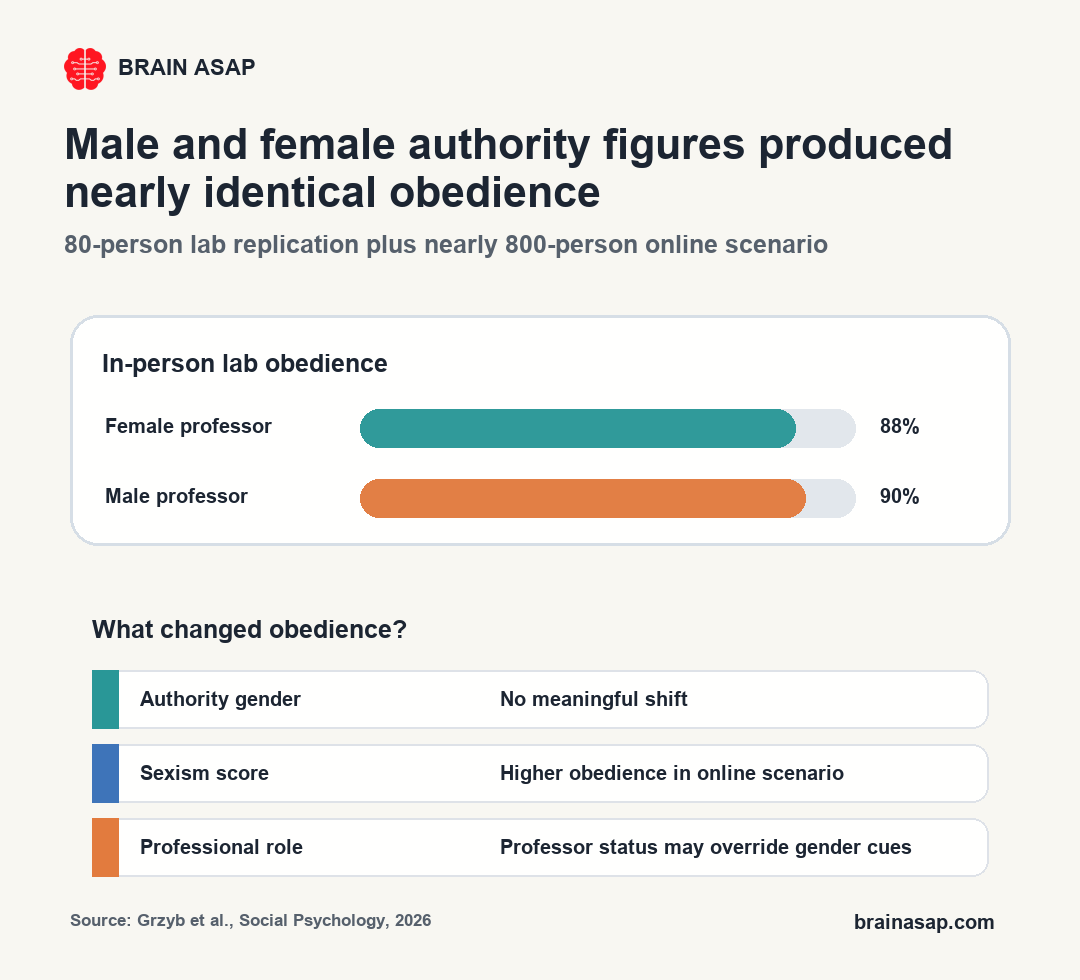
Obedience Was 88% With a Female Professor and 90% With a Male Professor
The main result was simple. 88% of participants obeyed every instruction from the female professor. 90% obeyed every instruction from the male professor.
That two-point difference was not statistically meaningful. The authority figure’s gender also did not change secondary measures, including how many verbal prompts were needed or where the few disobedient participants stopped.
This is a useful null result. It suggests the social role of a recognized professor can dominate visible gender cues during a structured obedience task.
The Online Scenario Added Sexism and Hierarchy Measures
Because the lab obedience rate was high, researchers added an online study with nearly 800 Polish internet users. Participants imagined the same shock-generator scenario with either a male or female professor and reported when they would stop.
The online study again found no average obedience shift by authority gender. Participants were similarly willing to continue in the imagined scenario whether the professor was male or female.
The more revealing result involved ambivalent sexism. Participants with higher sexism scores reported more willingness to obey, but the association appeared across both authority-gender conditions.
The likely explanation is hierarchy. Ambivalent sexism often travels with stronger acceptance of traditional social ranks.
In this setting, respect for a professor’s command may have outweighed resentment toward a woman in authority.
The Finding Is About Role Power, Not Gender Equality Everywhere
The result should not be stretched into a broad claim that gender never shapes leadership. This was a specific obedience setup in Poland, with an academic authority figure and a controlled laboratory script.
Other authority roles could behave differently:
- Corporate authority: a manager or executive might trigger different gender assumptions.
- Military authority: command, uniform, and rank may change how people respond.
- Cross-national settings: countries with wider gender gaps may show different patterns.
The online scenario also cannot reproduce the pressure of standing in a room while another person appears distressed. Stated willingness and live behavior are related but not identical.
That is why the laboratory and online studies answer slightly different questions. The lab study tested behavior under controlled pressure.
The online study added a larger sample and sexism measures, but it measured imagined stopping points.
Obedience Research Needs These Null Tests
Null results are valuable when they test a common assumption. It would be easy to assume that male authority automatically produces stronger obedience in a Milgram-style setting.
This study found little support for that assumption.
The tighter interpretation is that institutional role clarity may make personal characteristics less important. When the command comes from someone explicitly introduced as a professor, the role itself can carry the compliance pressure.
Future studies could test whether the same pattern holds for corporate executives, military officers, physicians, teachers, or algorithmic decision systems. Each role carries a different kind of legitimacy.
The finding is more unsettling, not less. The danger in obedience studies is not only the personality of the person giving orders.
It is the social structure that turns an instruction into an accepted command.
Citation: DOI: 10.1027/1864-9335/a000575. Grzyb T, Dolinski D, Cantarero K. Authority Knows No Gender: Gender Effects in Exerting Obedience in Milgram’s Experiment. Social Psychology. 2026.
Study Design: Modified in-person Milgram-style obedience replication plus an online hypothetical obedience scenario.
Sample Size: 80 lab volunteers and nearly 800 Polish internet users in the online extension.
Key Statistic: Full obedience was 88% with a female professor and 90% with a male professor in the laboratory study.
Caveat: The lab sample was small, and hypothetical online scenarios cannot fully match real in-person pressure.