TL;DR: A 2026 medRxiv preprint found that adults with multiple sclerosis showed accelerated long-term forgetting (ALF), meaning unusually steep memory loss over days despite normal early recall, on two verbal memory tests.
Key Findings
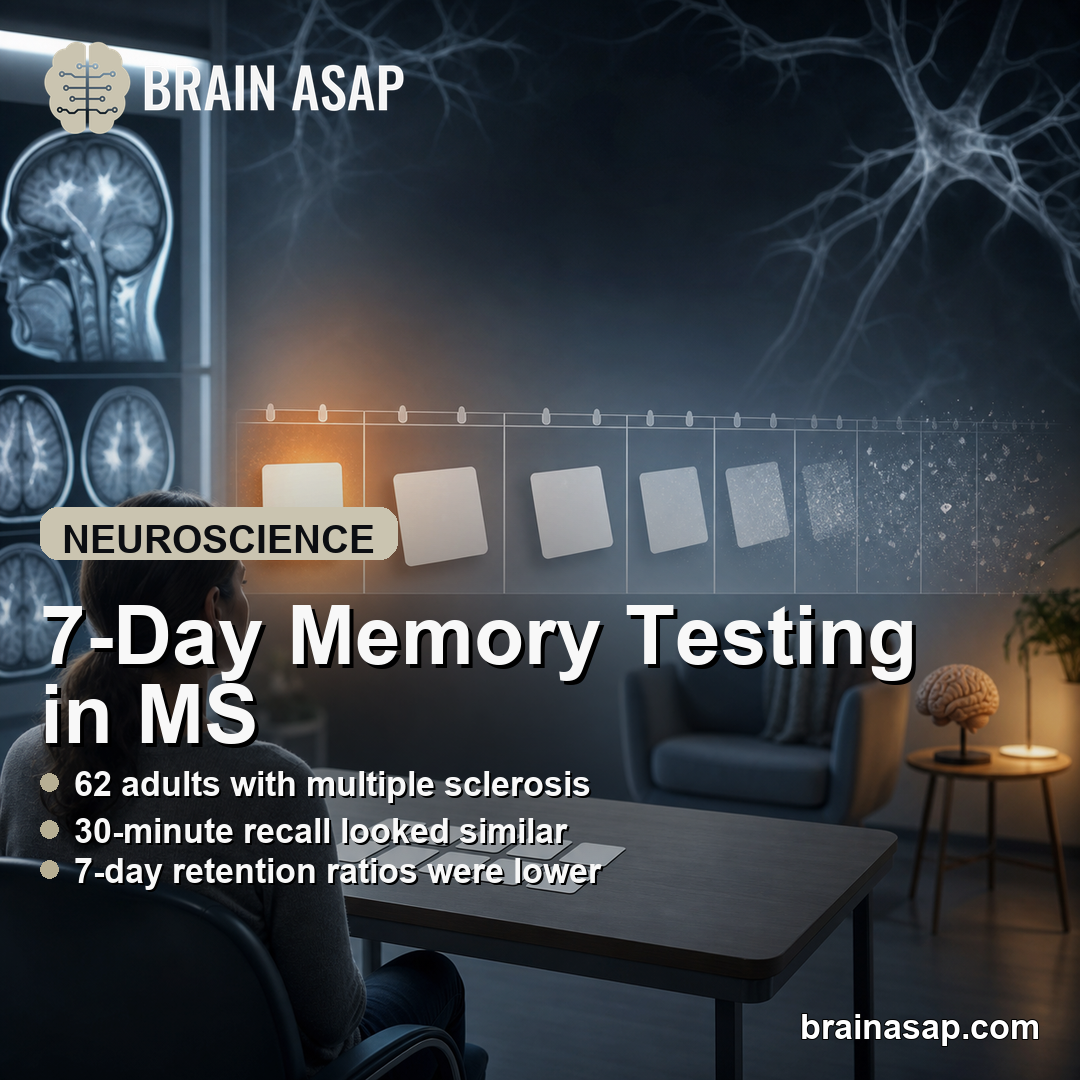
- The long-delay test was the key contrast: researchers compared 62 adults with multiple sclerosis and 65 matched controls using word-list and story-memory tasks.
- Early learning looked similar: 30-minute recall did not differ significantly between the multiple sclerosis and control groups.
- Seven-day recall diverged: the multiple sclerosis group recalled less after 1 week on both the RAVLT word-list test and the WMS-IV story-memory test.
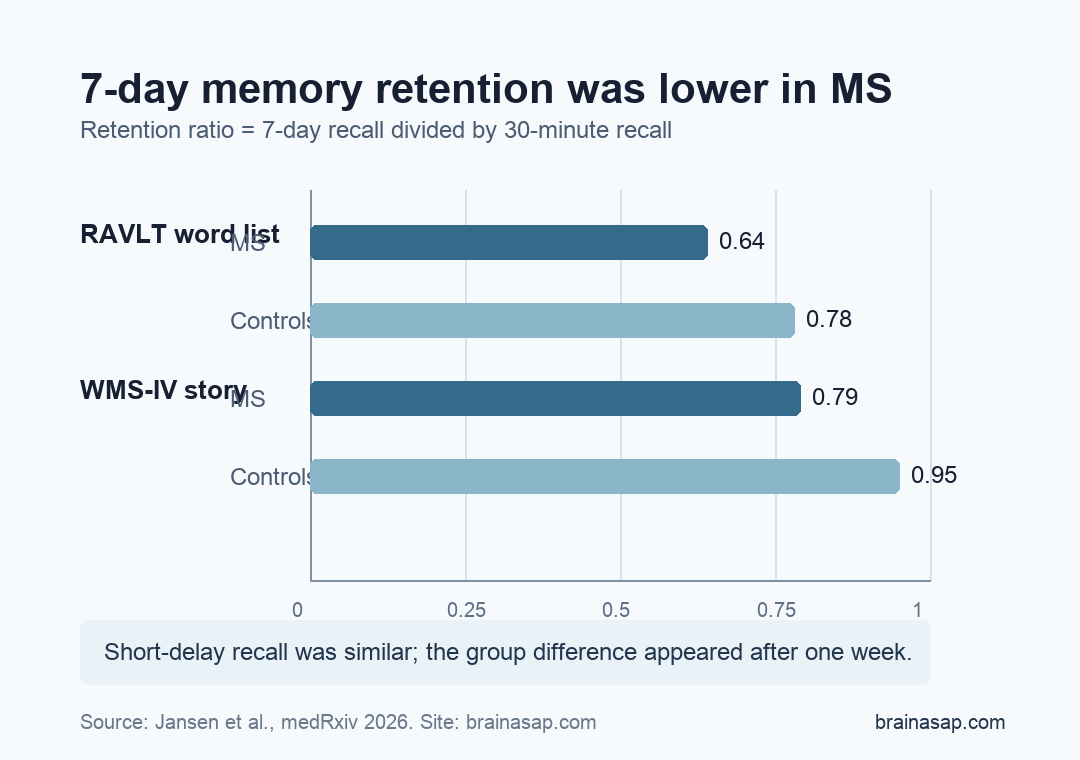
- Retention ratios were lower: the RAVLT 7-day/30-minute ratio was 0.64 in multiple sclerosis versus 0.78 in controls, and the WMS-IV ratio was 0.79 versus 0.95.
- The combined ALF score was a moderate marker for subjective memory impairment, with AUC 0.735, sensitivity 0.727, and specificity 0.725.
Source: Jansen et al. tested whether a 7-day memory delay could reveal objective memory problems in multiple sclerosis that shorter clinical memory tests might miss.
Multiple Sclerosis Memory Testing Added a 7-Day Delay
Many cognitive screens ask what someone remembers after minutes, not days. This study focused on accelerated long-term forgetting, or ALF, a pattern where initial learning and short-delay recall can look adequate while memory drops more sharply over a longer interval.
Researchers tested 62 adults with multiple sclerosis and 65 healthy controls matched by age, sex, and education. The multiple sclerosis group was mostly relapsing-remitting, with a mean age of about 37 years and relatively low average disability.
The team used two verbal memory measures:
- RAVLT: Rey Auditory Verbal Learning Test, a word-list memory task.
- WMS-IV Logical Memory: a Wechsler Memory Scale story-recall task.
- ALF quotient: the 7-day recall score divided by the 30-minute recall score, so lower values mean more forgetting after the short-delay point.
The quotient is useful because a person can learn normally during the first testing session and still lose more information than expected over the next week.
Early Recall Was Similar, but 7-Day Recall Was Lower
The groups did not differ meaningfully on initial learning. They also had similar 30-minute recall on both memory tests.
The separation appeared at 7 days, when both memory tests showed lower recall in the multiple sclerosis group:
- RAVLT word list: 50.75% recall in multiple sclerosis versus 61.23% in controls.
- WMS-IV story recall: 40.06% recall in multiple sclerosis versus 45.60% in controls.
The retention ratios made the pattern clearer. For the RAVLT, the multiple sclerosis group had a mean ratio of 0.64, compared with 0.78 in controls. For WMS-IV Logical Memory, the ratio was 0.79 versus 0.95.
- Word-list memory: the multiple sclerosis group lost more of the 30-minute RAVLT performance by the 7-day retest.
- Story memory: the same delayed-loss pattern appeared on the WMS-IV Logical Memory subtest.
- Clinical implication: a standard short-delay test could miss a memory problem that becomes visible only after a longer delay.
Fatigue and Disease Features Tracked With Lower Scores
The study also asked which patient factors were linked to lower ALF scores. These regression analyses were exploratory, so they should be read as signals for follow-up rather than a clinical prediction rule.
Fatigue was one of the strongest recurring correlates. Higher Fatigue Impact Scale scores were linked with lower RAVLT retention and lower WMS-IV retention.
For WMS-IV, the fatigue model had an adjusted R-squared of 0.276, meaning fatigue explained a meaningful share of variation in that story-memory quotient.
Other variables also mattered for WMS-IV retention, including everyday memory complaints, attentional difficulty ratings, Expanded Disability Status Scale (EDSS) score, longer time since diagnosis, and older age.
- Symptom burden: fatigue and self-reported memory problems moved with lower long-delay retention.
- Disease burden: higher EDSS disability scores were associated with lower WMS-IV retention.
- Time and age: longer disease duration and older age were also linked with lower WMS-IV retention.
These associations do not prove cause. They suggest delayed memory testing may sit closer to the lived cognitive complaints some patients report than a brief same-day test does.
The ALF Score Moderately Flagged Subjective Memory Problems
Researchers then combined the two ALF quotients and tested whether the score could distinguish patients who reported subjective memory impairment from those who did not.
The combined score separated the groups moderately, with an AUC of 0.735.
AUC, or area under the receiver operating characteristic curve, summarizes how well a marker separates two groups; 0.5 is chance and 1.0 is perfect separation.
At the chosen cut-off of 0.71, the combined ALF score had 0.727 sensitivity and 0.725 specificity.
Sensitivity means the share of people with subjective memory impairment who were correctly identified. Specificity means the share without that complaint who were correctly excluded.
- Not a standalone diagnostic test: the discrimination was too modest to use alone.
- Useful clinical clue: the score may help explain why some patients feel forgetful even when short-delay testing looks normal.
- Research value: longer-delay recall could become an objective outcome in studies of multiple sclerosis cognition.
Why Short Tests Can Miss the Problem
Short-delay memory tests emphasize learning and early retrieval. ALF emphasizes whether the memory trace remains accessible over a longer interval.
That distinction is important in multiple sclerosis because cognitive symptoms are often mixed with fatigue, mood, sleep, and neurological disability. A patient may perform well enough in the clinic and still notice that conversations, instructions, or appointments fade more than expected over the next few days.
The study did not show that every person with multiple sclerosis needs a 7-day memory test. It did show that normal 30-minute recall does not rule out a measurable long-delay memory problem.
Main limitation: this was a preprint and the ALF protocol needs replication in independent clinical samples. The analysis also excluded people with low Montreal Cognitive Assessment (MoCA) scores, higher depression scores, missed delayed testing, or central-nervous-system-active medication, so the findings may not represent every multiple sclerosis clinic population.
In multiple sclerosis, memory testing that stops at 30 minutes may underestimate forgetting that appears across days.
Citation: DOI: 10.64898/2026.04.21.26351393. Jansen et al. Accelerated long-term forgetting as an objective marker of subjective memory impairment in multiple sclerosis. medRxiv. 2026.
Study Design: Matched case-control verbal memory study with immediate, 30-minute, and 7-day recall testing.
Sample Size: 62 adults with multiple sclerosis and 65 matched healthy controls were included in the final analysis.
Key Statistic: RAVLT retention was 0.64 in multiple sclerosis versus 0.78 in controls; WMS-IV retention was 0.79 versus 0.95.
Caveat: The manuscript is a preprint, and the 7-day ALF approach needs further validation before it can guide routine clinical decisions.