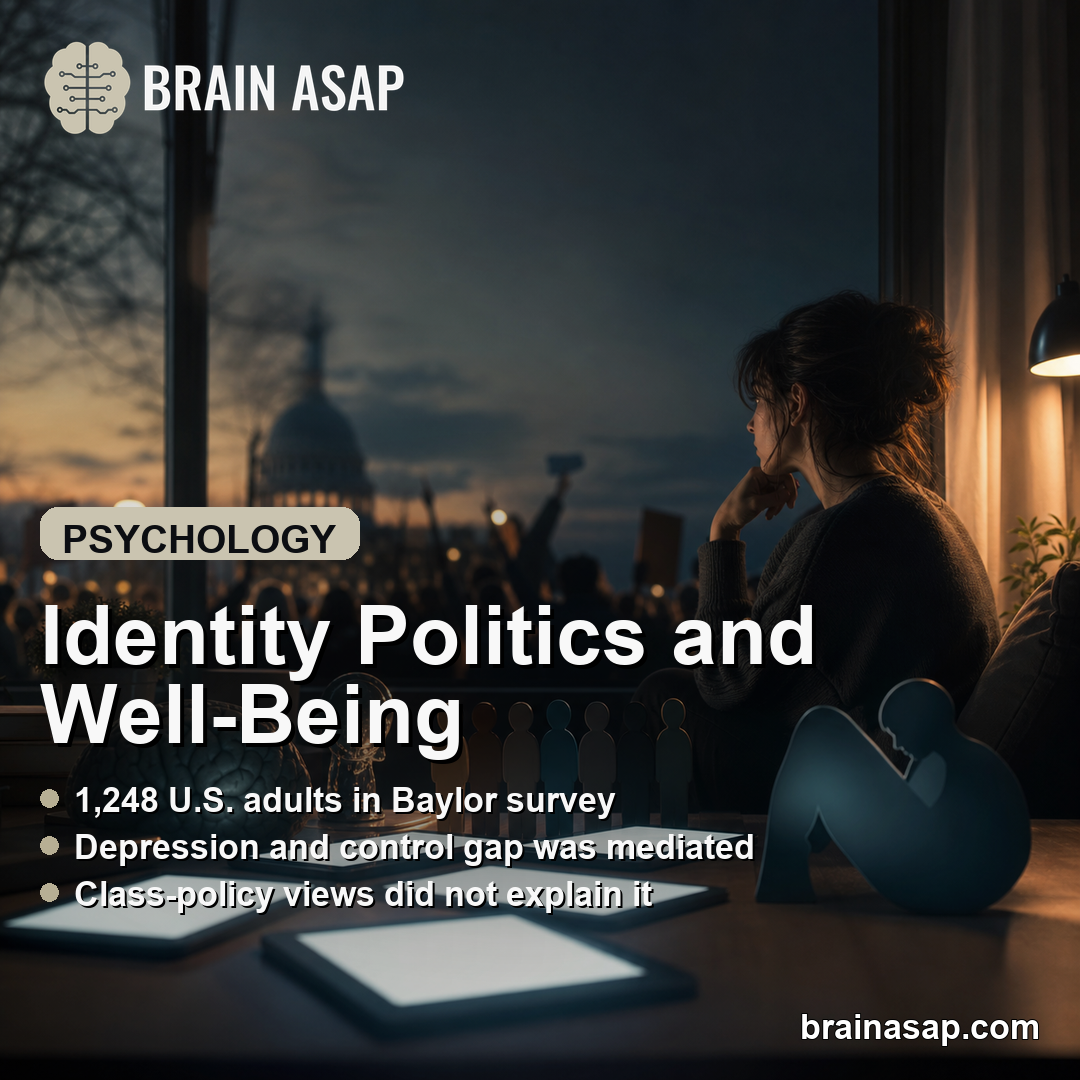
TL;DR: A 2024 study in Sociological Forum found that identity-politics measures statistically explained much of the link between progressive ideology and lower self-reported well-being in the 2021 Baylor Religion Survey.
Key Findings
- Well-being gap: Progressive ideology was associated with more depression, more anxiety, and lower sense of control.
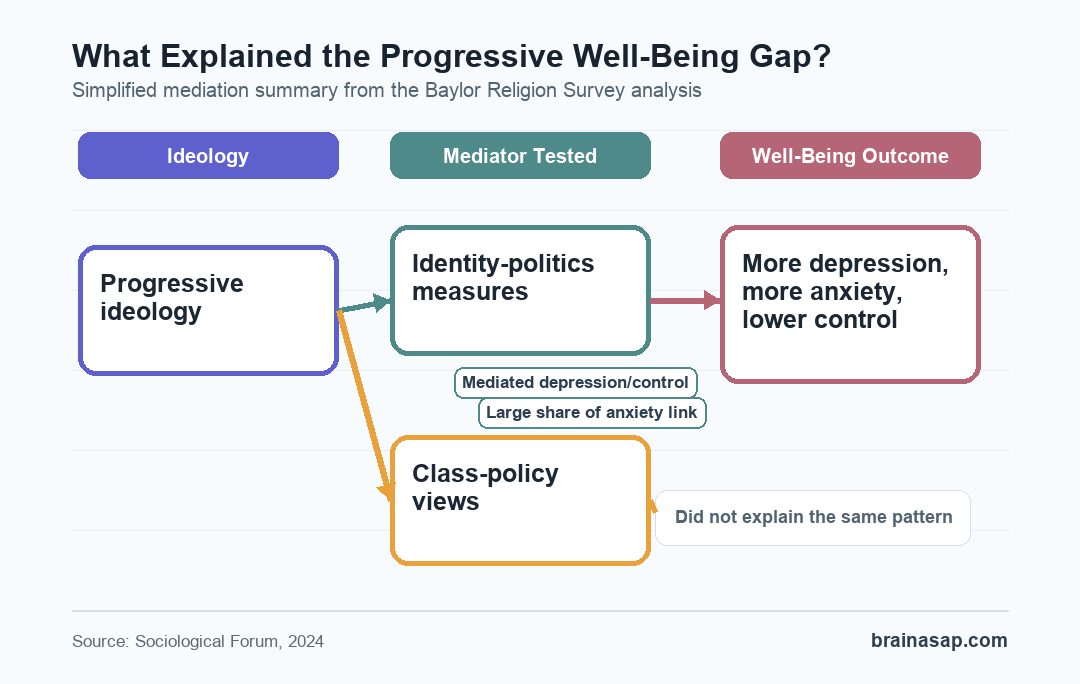
- Identity-politics measures: Racial-inequality protest willingness and support for sexual-minority protections accounted for much of that association.
- Economic-progressive contrast: Class-based policy views, such as support for public goods, did not explain the same well-being pattern.
- Control mechanism: The paper argued that identity politics can focus attention on external social forces, which can lower perceived personal control.
- Main caveat: The survey was cross-sectional, so the study cannot determine whether identity politics lowers well-being or lower well-being predicts identity-politics engagement.
Source: Sociological Forum (2024) | Yancey
Identity politics means political action organized around shared social identities, such as race, gender, or sexual orientation. In this study, the term was measured through specific survey items, not through a broad accusation about a political group.
George Yancey analyzed whether those identity-politics measures helped explain a documented mental-health pattern: progressive respondents often report lower well-being than conservative respondents. The analysis focused on depression, anxiety, and sense of control.
Identity-Politics Measures Accounted for the Well-Being Link
The study used data from the 2021 Baylor Religion Survey, a U.S. adult survey weighted for population representation. The main analysis used 1,248 respondents, with an additional missing-data analysis that included 1,131 respondents.
General progressive ideology was associated with lower well-being. Respondents who identified as more progressive reported more depression, more anxiety, and lower personal control.
The statistical relationship changed when Yancey added two identity-politics variables:
- Racial-inequality protest willingness: whether respondents were willing to join protest activity aimed at racial inequality.
- Sexual-minority rights support: whether respondents supported stronger legal protections for sexual minorities.
After those variables entered the models, progressive ideology no longer independently predicted depression or lower sense of control. For anxiety, the identity-politics measures accounted for a large share of the association, although not all of it.
Class-Based Progressive Views Did Not Show the Same Pattern
The paper also tested a different kind of progressive politics: support for class-based public goods. These measures included views about government spending for health care and college.
Those economic-progressive views did not explain the well-being gap. Respondents who supported more public goods, but were not high on the identity-politics measures, looked more similar to the rest of the population on the well-being outcomes.
This contrast is the main interpretive point. The association was not simply about being politically left, supporting redistribution, or favoring a larger welfare state.
The pattern was more specific:
- Ideology alone: progressive identity was linked with lower well-being before adding the mediator variables.
- Identity politics: social-identity protest and rights measures explained much of that link.
- Class politics: public-goods preferences did not perform the same explanatory role.
Sense of Control Was a Key Well-Being Outcome
The study did not treat well-being as one vague feeling. It measured depression, anxiety, and sense of control.
Sense of control means how much people believe they can solve problems and influence their own lives.
Yancey argued that identity politics can direct attention toward powerful external forces, including systemic discrimination and institutional inequality. That focus can be politically mobilizing, but it can also reduce a person’s perceived control.
The paper’s proposed mechanism can be summarized in three steps:
- Social-identity focus: political attention centers on group identity and collective disadvantage.
- External-force emphasis: distress is interpreted partly through institutions, systems, and structural barriers.
- Lower control: people report less personal ability to solve problems or shape outcomes.
The analysis cannot prove that this sequence occurred. It shows that the measured identity-politics variables were statistically tied to both ideology and well-being outcomes in the same survey.
The Design Cannot Settle Cause and Effect
The main limit is directionality. Cross-sectional survey data are measured at one time point, so they cannot establish which factor came first.
Several explanations remain possible. Identity-politics engagement could contribute to lower well-being by increasing attention to injustice.
Lower well-being could also make identity-politics frameworks more appealing. A third factor could affect both political engagement and self-reported mental health.
Yancey explicitly framed the finding as an association, not proof of harm. A stronger test would use longitudinal data, experimental exposure, or repeated surveys that track whether changes in identity-politics engagement precede changes in depression, anxiety, or control.
Sample and measurement choices matter too:
- Survey measures: identity politics was represented by a small number of specific items.
- Self-reported symptoms: depression and anxiety were survey responses, not clinical diagnoses.
- Political context: the 2021 survey captured a specific U.S. political moment after years of intense public conflict about race, policing, gender, and sexuality.
The Useful Question Is What Kind of Politics Affects Control
The study is most useful when read as a question about psychological pathways, not as a claim that one ideology is inherently unhealthy. People can engage identity-based politics for reasons that are moral, strategic, or personally meaningful.
The narrower finding is that identity-politics measures accounted for a well-being gap that class-policy measures did not. For mental-health research, that points to a measurable difference between types of political engagement.
If future work confirms the pattern, researchers would still need to separate several possibilities: exposure to injustice, perception of injustice, activism demands, social-media environments, and preexisting distress.
Each could change depression, anxiety, or control in a different way.
The interpretation should stay limited to the measured association. Political well-being research should not treat “progressive” as one psychological category.
The specific content of political attention, especially whether it centers on identity, grievance, and controllability, appears to matter.
Citation: DOI: 10.1111/socf.12966. Study authors et al. Yancey G. Identity Politics, Political Ideology, and Well-being: Is Identity Politics Good for Our Well-being? Sociological Forum . 2024.
Study Design: Cross-sectional analysis of the 2021 Baylor Religion Survey.
Sample Size: 1,248 weighted U.S. adult respondents, with a supplemental missing-data analysis of 1,131 respondents.
Key Statistic: Identity-politics measures accounted for the progressive-ideology association with depression and lower sense of control, and much of the anxiety association.
Caveat: The study documents associations and mediation patterns, not a proven causal effect of identity politics on mental health.