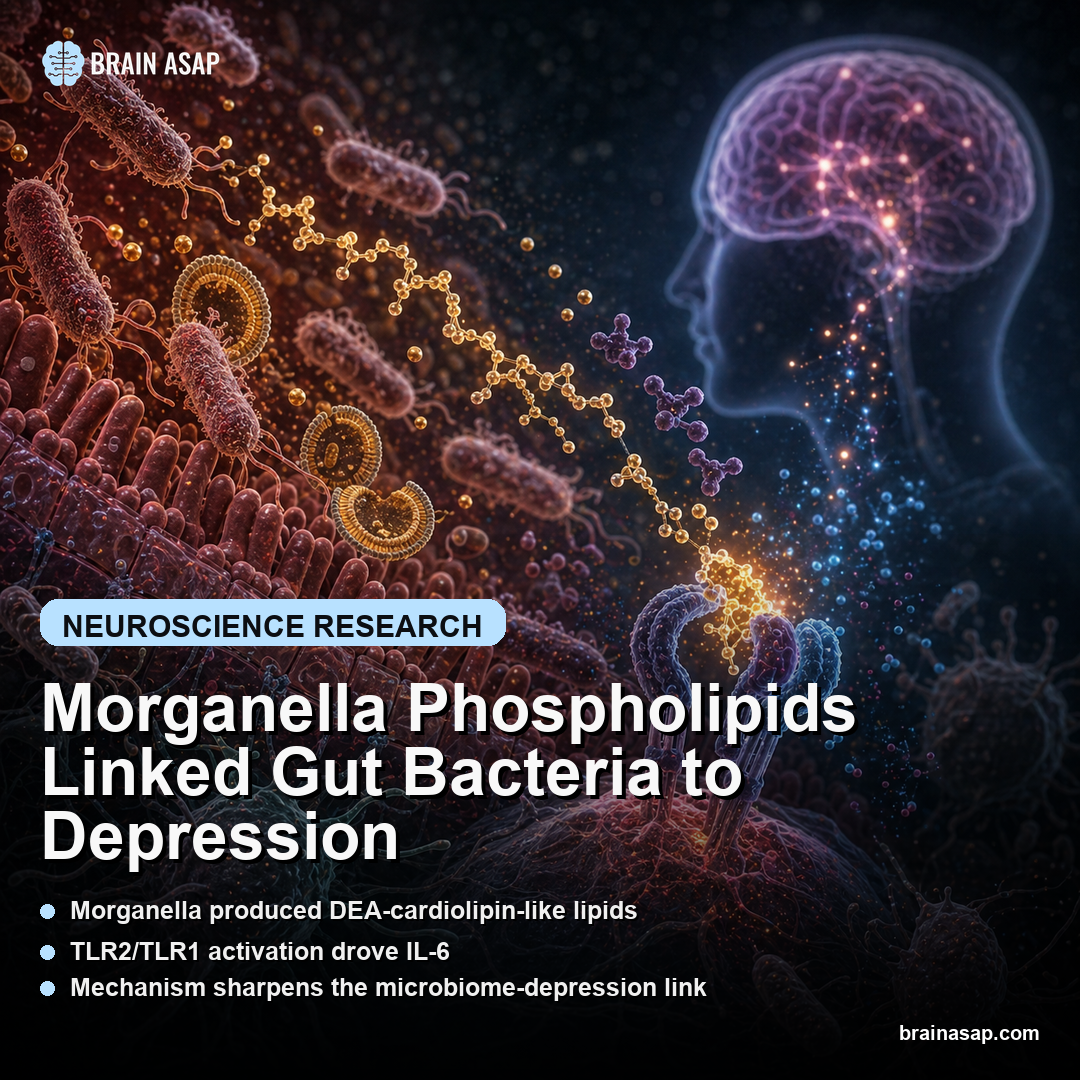
TL;DR: A 2025 study in Journal of the American Chemical Society found that a depression-linked gut bacterium now has a concrete inflammatory mechanism: Morganella morganii can make unusual phospholipids that activate TLR2/TLR1 and drive IL-6.
Key Findings
- Morganella got a molecule: The paper moved beyond a microbiome correlation by isolating pro-inflammatory metabolites made by M. morganii.
- DEA replaced central glycerol: The active molecules resembled cardiolipins, but diethanolamine replaced the normal central glycerol.
- Four MmDEACL lipids emerged: Bioassay-guided fractionation identified four related Morganella DEA-cardiolipin molecules, labeled MmDEACL-1 through MmDEACL-4.
- TLR2/TLR1 carried the immune readout: The molecules required TLR2 in mouse dendritic cells and TLR2/TLR1 in human monocyte-derived dendritic cells.
- IL-6 was the clearest cytokine readout: Researchers focused on IL-6 because the Morganella lipids produced a stronger IL-6 readout than TNF-alpha in their assays.
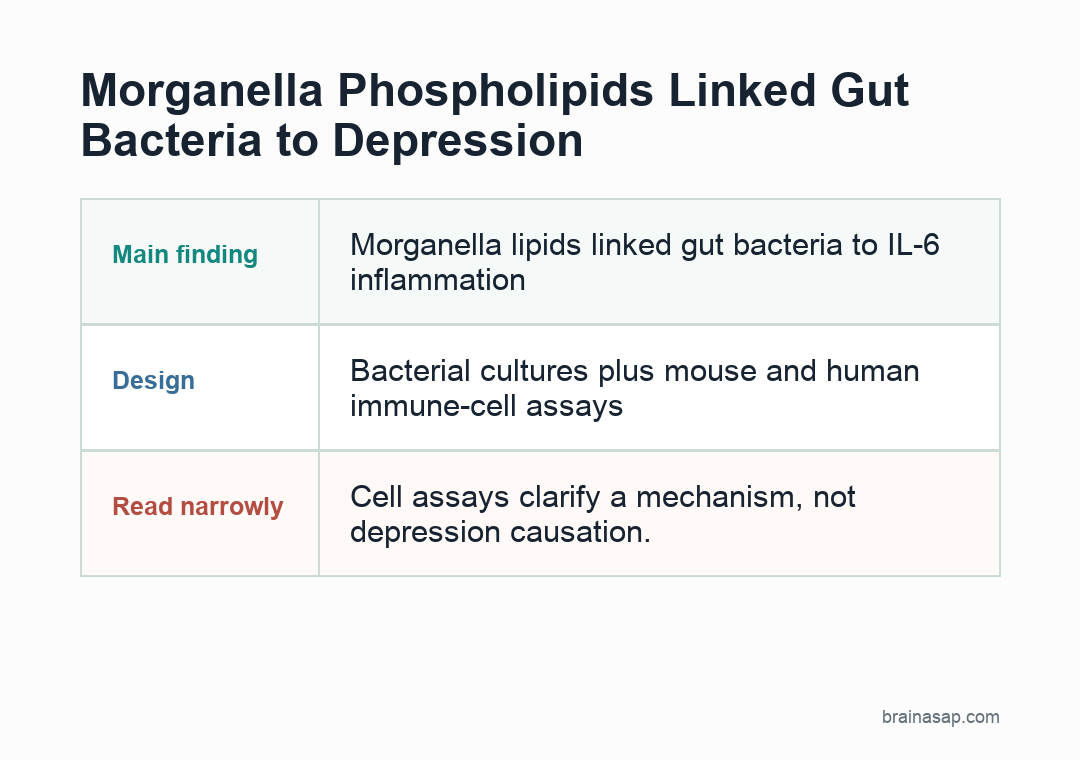
Source: Journal of the American Chemical Society (2025) | Bang et al.
The gut-brain axis is often framed vaguely: microbes shift, mood shifts, and the mechanism disappears somewhere between the intestine and the brain.
This JACS paper is more satisfying because it follows the trail down to a specific chemical family.
Morganella morganii, a bacterium previously linked to major depressive disorder, produced lipids that pushed immune cells toward inflammation.
The Gut-Brain Claim Finally Got a Molecule
Microbiome papers can be maddening because the statistical readout is often much clearer than the biology.
Study details:
- Morganella got a molecule: The paper moved beyond a microbiome correlation by isolating pro-inflammatory metabolites made by M. morganii
- DEA replaced central glycerol: The active molecules resembled cardiolipins, but diethanolamine replaced the normal central glycerol
- Four MmDEACL lipids emerged: Bioassay-guided fractionation identified four related Morganella DEA-cardiolipin molecules, labeled MmDEACL-1 through MmDEACL-4
- TLR2/TLR1 carried the immune readout: The molecules required TLR2 in mouse dendritic cells and TLR2/TLR1 in human monocyte-derived dendritic cells
A bacterium appears more often in people with a condition, but that does not tell us whether the microbe is important, whether illness reshapes the gut, or whether diet, medication, inflammation, or another hidden variable explains both.
This paper starts from that problem. Prior work had reported a likely causal connection between M. morganii prevalence in the gut microbiome and major depressive disorder.
Bang and other researchers asked the next test: what could this bacterium actually make that would plausibly connect the gut to immune signaling relevant to depression?
Researchers did not identify another vague “microbial imbalance.” It was a specific family of unusual phospholipids.
Morganella Made a Cardiolipin-Like Immune Trigger
The team used bioassay-guided fractionation, a practical chemical detective method.
They separated bacterial extracts, tested which fractions made immune cells release cytokines, then kept purifying the active material until the responsible molecules came into focus.
The active fraction resolved into four related molecules the authors called MmDEACLs: Morganella-derived diethanolamine cardiolipin-like lipids. The chemical story separated into three steps:
- Fractionation: the team purified bacterial extracts until the inflammatory activity resolved.
- Structure: the active molecules resembled cardiolipins with an unusual diethanolamine center.
- Immune readout: the lipids activated TLR2/TLR1 and drove IL-6.
In a conventional cardiolipin, glycerol sits in the middle. In these Morganella molecules, diethanolamine, or DEA, took that position .
That made the lipids chemical hybrids: part normal bacterial phospholipid biology, part environmental chemical intrusion. DEA is not a natural nutrient.
The paper describes it as an industrially produced micropollutant used across industrial, agricultural, and consumer-product contexts.
The striking idea is that a gut bacterium may incorporate that outside chemical into its own phospholipid machinery.
The authors are careful here.
They did not prove where the DEA entered the system in people, or that everyday DEA exposure directly produces depression.
The specific result is that Morganella cultures produced DEA-containing cardiolipin-like molecules, and those molecules were immunologically active.
The reason is it turns an abstract microbiome association into a testable chain.
If the molecule is real, measurable, and inflammatory, future work can ask whether it appears in human samples, tracks symptoms, changes with exposure, or responds to microbiome-directed interventions.
TLR2/TLR1 Translated the Lipid Into IL-6
The immune receptor work is the backbone of the paper. In mouse bone-marrow-derived dendritic cells, the inflammatory activity required a functional TLR2 receptor.
In human monocyte-derived dendritic cells, CRISPR/Cas9 regulation pointed to a TLR2/TLR1 requirement. The receptor pair is important because Toll-like receptors are not mood sensors.
They are innate immune pattern detectors.
The paper’s claim is that these unusual lipids look enough like an immune-relevant microbial readout to make dendritic cells respond.
The cytokine readout centered on IL-6.
The authors followed IL-6 during isolation because the Morganella lipids produced a stronger IL-6 readout than TNF-alpha in their assays.
That is a meaningful bridge to depression biology, where IL-6 signaling has been repeatedly implicated, including by Mendelian-randomization work cited by the paper.
Why This Does Not Make Depression a Single-Bacterium Disease
The tempting overread is obvious: Morganella causes depression. The paper does not establish that. Major depressive disorder is heterogeneous, and inflammation is only one route into depressive biology.
The stronger interpretation is narrower and more helpful. A depression-linked bacterium can make a specific inflammatory molecule, and that molecule activates a receptor-cytokine pathway with existing relevance to depression.
That is not the whole disease. It is one plausible biological path through it.
The study also relies heavily on chemical isolation and immune-cell assays, not a clinical trial.
It shows a mechanism with human relevance, but it does not show that lowering Morganella, blocking MmDEACLs, or reducing DEA exposure improves depression symptoms.
The helpful Target Is the Molecule, Not the Microbiome Hype
The clinical value of this paper is not that everyone should chase a new probiotic or panic about a single gut organism.
The value is that it gives researchers a concrete object to measure.
The field can now look for Morganella-derived DEA cardiolipins rather than waving at the microbiome as a whole.
That is a different kind of gut-brain pathway. It is not “your gut affects your mood” as a wellness slogan. It is a chemical route: bacterium, lipid, innate immune receptor, cytokine.
The next clinical step would be measurement, not treatment.
Researchers would need to ask whether MmDEACL-like molecules appear in stool, blood, or gut samples from people with inflammatory depression phenotypes, and whether they track with IL-6, symptom course, medication exposure, diet, or environmental DEA exposure.
This also separates cause from passenger.
Morganella could be making a consequential molecule, or it could bloom in a gut environment already shaped by inflammation, stress, diet, and treatment.
The molecule gives the field a way to test those alternatives instead of arguing about broad microbiome associations.
If that route holds up in human cohorts, depression research gets a sharper tool.
Instead of treating inflammation as a broad background fog, scientists can ask whether a particular microbial lipid helps explain why some patients carry an inflammatory form of depression.
Negative findings also become more informative.
If Morganella abundance rises without the lipid readout, the bacterium may be less important than the chemistry it sometimes produces.
If the lipid appears without symptoms, the pathway may need another immune or vulnerability context.
Either way, the study moves the field toward falsifiable chemistry instead of mood-microbe storytelling.
That is exactly the kind of specificity gut-brain research has needed.
It gives the next study a target, a receptor, and a cytokine, not just a genus name.
The narrower claim is much stronger for mechanistic follow-up in human cohorts and assays.
Citation: DOI: 10.1021/jacs.4c15158. Bang Bang et al. Unusual Phospholipids from. Morganella morganii . Linked to Depression. Journal of the American Chemical Society . 2025;147(4):2998-3002. Journal of the American Chemical Society. 2025.
Study Design: Mechanistic chemical-biology study using bioassay-guided fractionation, NMR/MS structural analysis, mouse dendritic-cell assays, and human monocyte-derived dendritic-cell receptor testing.
Sample/Model: M. morganii M11 cultures; murine bone-marrow-derived dendritic cells; human monocyte-derived dendritic cells with TLR expression regulation.
Key Statistic: Four MmDEACL molecules were identified, and IL-6 induction depended on TLR2 in mouse cells and TLR2/TLR1 in human dendritic-cell assays.
Caveat: Single-study evidence; interpret with the source design and sample.