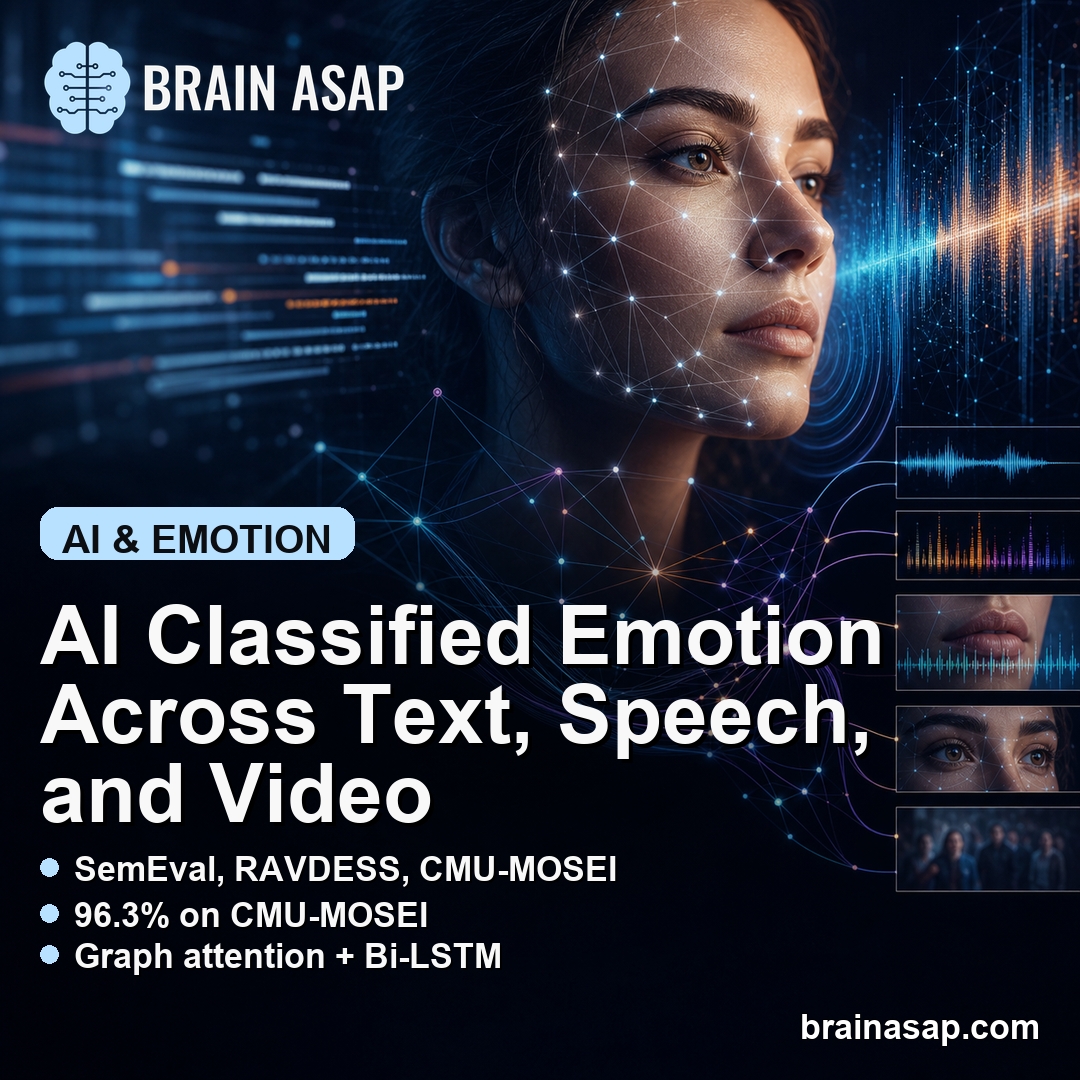
TL;DR: A 2026 study in PLOS One reported that an artificial intelligence model combining enhanced graph attention with bidirectional long short-term memory classified emotion from text, speech, facial cues, and video benchmarks with its strongest performance on the CMU-MOSEI multimodal dataset.
Key Findings
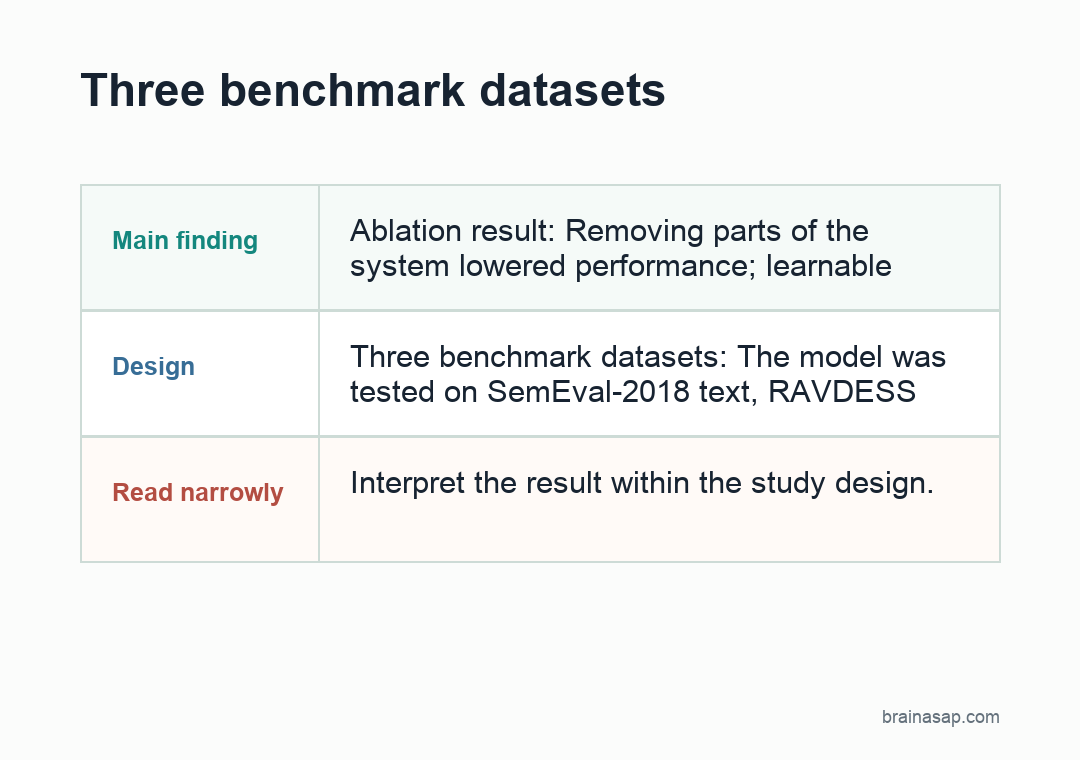
- Three benchmark datasets: The model was tested on SemEval-2018 text, RAVDESS speech-and-face emotion data, and CMU-MOSEI text-audio-video clips.
- SemEval text score: On the 11-class English text task, the model reached 62.4% accuracy and a 71.7% F1-score.
- RAVDESS emotion score: On audio-visual emotion recognition, the model reached 87.9% overall accuracy, with 76.2% facial emotion accuracy and 85.7% speech emotion accuracy.
- CMU-MOSEI score: On the multimodal video dataset, the model reached 96.3% accuracy and a 96.1% F1-score, above the listed baselines.
- Ablation result: Removing parts of the system lowered performance; learnable edge weights contributed 3.9 percentage points on SemEval-2018 and 5.1 points on CMU-MOSEI.
Source: PLOS One (2026) | Dong et al.
Artificial emotion recognition tries to infer affective state from cues such as words, voice, facial movement, and video context. The technical challenge is that those inputs do not carry emotion in the same way or on the same time scale.
Dong and co-researchers tested a model built to handle that mismatch. It used graph attention to represent relationships among emotional features and a bidirectional sequence model to keep surrounding context visible.
E-GAT and Bi-LSTM Combined Graph Structure With Sequence Context
The model joined an Enhanced Graph Attention Network (E-GAT) with bidirectional long short-term memory (Bi-LSTM). E-GAT treated emotional features as connected graph elements rather than isolated tokens or frames.
Bi-LSTM added sequence context by reading information forward and backward through the input. In plain terms, an emotion label could depend on what came before and after a word, vocal cue, or visual signal.
- Graph layer: The E-GAT component modeled relationships among emotional features, including nonlinear interactions across signals.
- Sequence layer: The Bi-LSTM component kept temporal context in view, which matters for speech, video, and sentence-level emotion.
- Learnable edge weights: The model adjusted feature connections during training instead of relying only on fixed distance rules.
That design makes the study relevant to psychology-facing AI. Emotion-aware systems can be used in chatbots, remote screening tools, virtual assistants, and human-computer interaction, but only if performance survives across modalities and datasets.
Three Emotion Datasets Tested Text Audio and Video
Researchers tested the model on SemEval-2018, RAVDESS, and CMU-MOSEI. The three datasets cover different emotion-recognition problems, so the study was not limited to one narrow benchmark.
SemEval-2018 used English tweets labeled across 11 emotion categories, including anger, disgust, fear, joy, optimism, sadness, surprise, and trust. RAVDESS used speech and facial emotion performances from 24 professional actors.
CMU-MOSEI added a larger multimodal setting. It included 32,285 YouTube video clips with text, audio, and visual information mapped into five sentiment or emotion-intensity categories.
- Text-only task: SemEval-2018 tested whether the system could classify emotional language from written social-media text.
- Audio-visual task: RAVDESS tested whether speech and face information could be handled together.
- Text-audio-video task: CMU-MOSEI tested whether the model could integrate multiple streams in a more natural video setting.
CMU-MOSEI Had the Highest Multimodal Accuracy
The strongest benchmark score came from CMU-MOSEI. The proposed model reached 96.3% accuracy and 96.1% F1-score, compared with 85.8% accuracy and 85.4% F1-score for the listed MultiMAE baseline.
On RAVDESS, the model reached 87.9% overall emotion accuracy. Speech emotion accuracy was 85.7%, and facial emotion accuracy was lower at 76.2%, suggesting that the model performed best when channels were integrated rather than judged in isolation.
SemEval-2018 was the hardest benchmark. The model averaged 62.4% accuracy across 11 emotion categories, with higher accuracy for trust and optimism than for disgust and sadness.
Ablation Tests Separated Attention Sequence and Edge Weights
Ablation testing asked whether each component added measurable value. The full model outperformed three stripped-down variants on both SemEval-2018 and CMU-MOSEI.
The clearest component effect came from learnable edge weights. Compared with a fixed-edge baseline, learnable edge weights added 3.9 percentage points of accuracy on SemEval-2018 and 5.1 points on CMU-MOSEI.
- Enhanced attention: E-GAT improved accuracy by 3.7 percentage points on SemEval-2018 and 3.9 points on CMU-MOSEI.
- Bidirectional context: Bi-LSTM added 1.4 points on SemEval-2018 and 1.9 points on CMU-MOSEI.
- Learned feature links: Adaptive edge weights had the largest ablation gain in the reported comparison.
Robustness tests also looked beyond clean benchmark conditions. Cross-corpus transfer from RAVDESS to CMU-MOSEI reached 79.2% accuracy, and speaker-independent RAVDESS testing reached 82.5% overall accuracy.
Mental Health Monitoring Claims Need Clinical Validation
The discussion connected the model to mental health monitoring because emotion recognition can support longitudinal tracking and remote screening. That use case is plausible, but the study itself was a benchmark AI experiment, not a clinical trial.
Several limits keep the interpretation narrow. SemEval-2018 was text-only, the semi-supervised pseudo-labeling experiment did not improve performance, and mixed or ambiguous emotions were not directly tested.
- Clinical gap: Benchmark accuracy does not prove that the system can detect depression, anxiety, crisis risk, or treatment response in patients.
- Dataset gap: The datasets contain labeled emotion examples, not continuous clinical monitoring data from real care settings.
- Fairness gap: Low-resource multilingual testing reached only 51.3% accuracy for Spanish and 50.7% for French, so language transfer remains weak.
The defensible claim is technical: graph attention, sequence context, and learnable feature links improved performance on several emotion-recognition benchmarks. Clinical use would require separate validation with patient consent, privacy protections, and outcomes that matter in care.
Citation: DOI: 10.1371/journal.pone.0339946. Dong et al. Enhanced graph attention network by integrating Long Short-Term Memory for artificial emotion representation in multi-modality datasets. PLOS One. 2026;21(4):e0339946.
Study Design: Benchmark machine-learning study of emotion recognition across text, audio-visual, and multimodal datasets.
Sample Size: Three public datasets, including SemEval-2018, RAVDESS, and 32,285 CMU-MOSEI video clips.
Key Statistic: The proposed model reached 96.3% accuracy and 96.1% F1-score on CMU-MOSEI.
Caveat: The study tested labeled benchmark datasets, not clinical mental health monitoring in real patients.