TL;DR: A 2025 study in PNAS found that sLC35F2 emerged as the high-specificity transporter for queuine and queuosine, linking gut-derived micronutrients to tRNA modification and the cell’s protein-translation machinery.
Key Findings
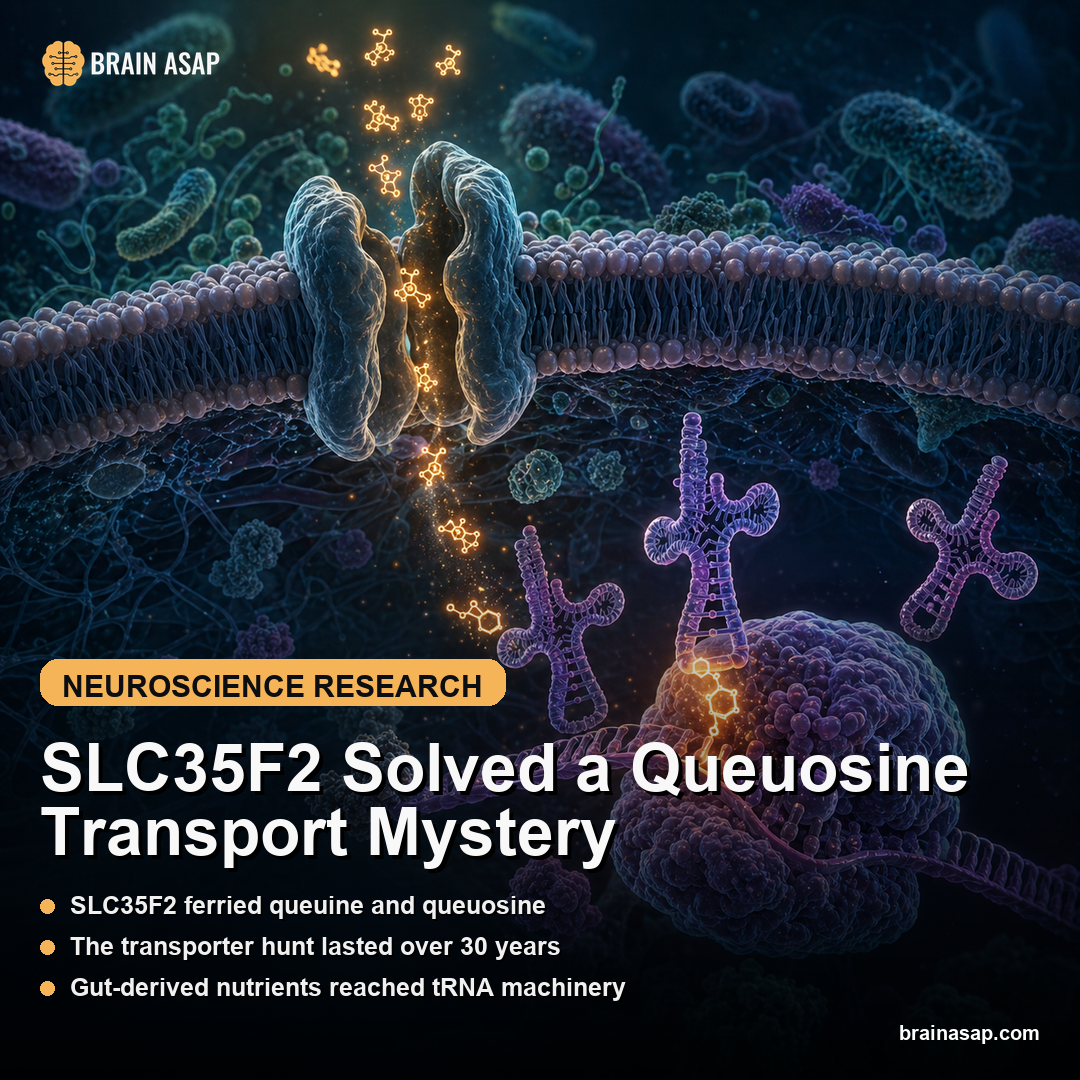
- 30-year transporter mystery: Scientists had suspected a selective queuine transporter for more than three decades.
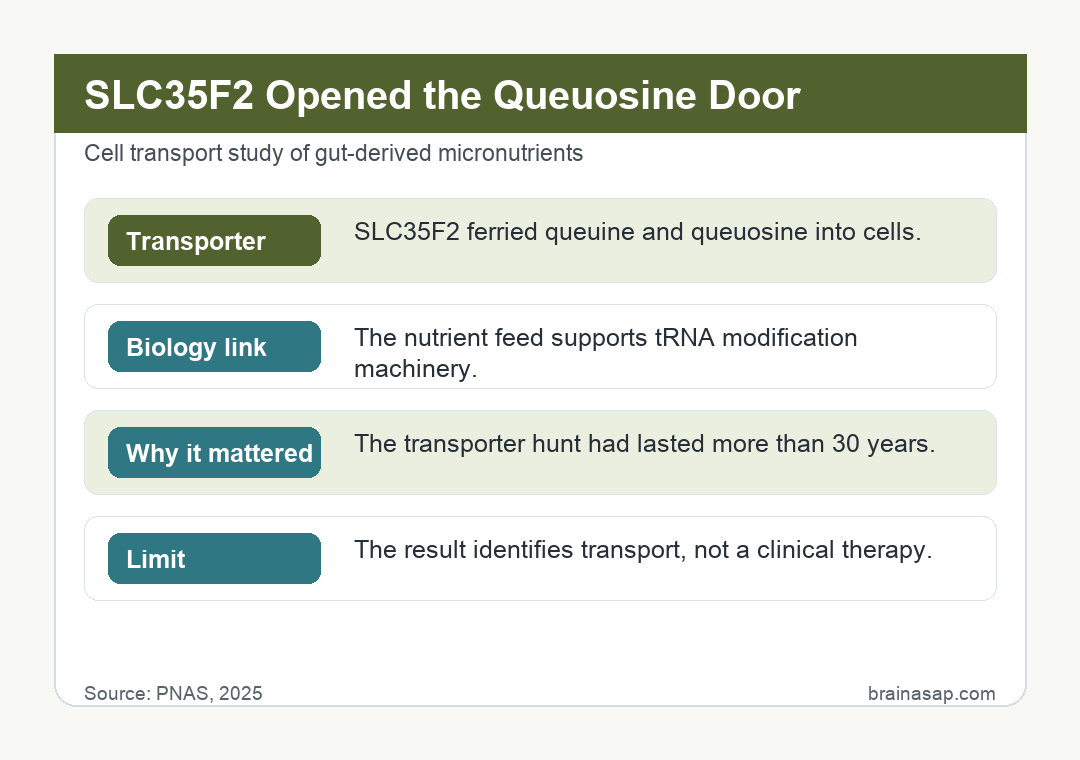
- SLC35F2 carried Q and q: The study identifies SLC35F2 as a unique transporter for both queuine and queuosine.
- tRNA wobble base modified: Queuosine is incorporated at position 34 of tRNAs decoding histidine, tyrosine, aspartate, and asparagine codons.
- Gut and diet supply it: Humans cannot make queuosine themselves; they acquire related micronutrients from food and gut bacteria.
- Cancer gene gained normal function: SLC35F2 was known in cancer and viral-entry contexts, but this study clarified its role in micronutrient biology.
Source: PNAS (2025) | Burtnyak et al.
Some nutrients are famous because supplement labels made them famous. Queuosine is the opposite: biologically important, gut-linked, and obscure enough that its human transporter stayed hidden for decades.
Queuosine Tuned the Wobble Base of tRNA
Queuine and queuosine are rarely discussed in standard nutrition writing. They matter because they modify transfer RNA, the adaptor molecules that help cells translate genetic code into protein.
Study details:
- 30-year transporter mystery: Scientists had suspected a selective queuine transporter for more than three decades
- SLC35F2 carried Q and q: The study identifies SLC35F2 as a unique transporter for both queuine and queuosine
- tRNA wobble base modified: Queuosine is incorporated at position 34 of tRNAs decoding histidine, tyrosine, aspartate, and asparagine codons
- Gut and diet supply it: Humans cannot make queuosine themselves; they acquire related micronutrients from food and gut bacteria
The modification lands at the wobble base, position 34, of tRNAs that decode histidine, tyrosine, aspartate, and asparagine codons. That position helps determine how flexibly and accurately a tRNA reads related codons.
a gut- and diet-derived molecule can reach the machinery that controls how cells read genes into proteins. The pathway is concrete: nutrient source, transporter, tRNA modification, and translation output.
- Source: humans rely on diet and gut bacteria for queuine-related micronutrients.
- Entry route: SLC35F2 provided the cellular transport step.
- Translation target: queuosine modifies tRNA at the wobble base.
- Biology opened: protein translation, stress responses, metabolism, and cancer behavior can now be tested through a named transporter.
SLC35F2 Became the Missing Uptake Route
For decades, researchers suspected that cells needed a selective route to take up queuine. Burtnyak and other researchers used cross-species bioinformatics and genetic validation to identify SLC35F2 as that route.
The result gives a name to the uptake route. SLC35F2 transports both queuine and queuosine, connecting diet, gut microbial supply, cellular uptake, and tRNA modification into one measurable pathway.
The transporter step is important because it makes the pathway experimentally tractable. Researchers can now ask what happens when SLC35F2 is knocked down, overexpressed, genetically varied, or challenged by different nutrient conditions.
Before this transporter was named, queuine biology had an awkward gap. Scientists could describe the micronutrient and the tRNA modification, but the cellular entry step was harder to pin down.
SLC35F2 closes that gap. It gives researchers a way to connect dietary supply and gut microbial production to an intracellular modification that can be measured directly.
The cross-species logic also matters.
If related organisms keep the same transporter relationship, that strengthens the case that SLC35F2 is not a random uptake artifact from one cell line.
It points to a conserved solution for moving a rare micronutrient into the cell.
That conservation makes the transporter a stronger candidate for follow-up work across model systems.
An Oncogene Turned Out to Move a Micronutrient
SLC35F2 had already appeared in studies of cancer biology, viruses, and drug entry into cells. The gene was medically familiar, but its normal physiological job was less clear.
This study reframes that history. A transporter noticed in disease and drug-response contexts can also handle ordinary micronutrient uptake, which means disease associations may partly reflect the same transport biology.
Queuosine does not explain cancer, viral entry, or brain function by itself. SLC35F2 sits at an unusually informative intersection: nutrient transport, translation control, and disease-relevant cellular behavior.
The cancer context also changes the way the transporter should be studied.
If SLC35F2 helps move both micronutrients and disease-relevant compounds, then expression differences could affect normal translation biology and drug sensitivity at the same time.
That is a helpful collision of fields.
Cancer researchers may care about SLC35F2 because it changes how cells handle compounds.
Nutrition and microbiome researchers may care because the same transporter helps explain how a bacterial or dietary molecule reaches the protein-synthesis machinery.
The gene is therefore not just a disease marker with a new footnote. It is a transport protein whose ordinary job can shape how disease experiments are interpreted.
Translation Biology Makes the Gut Link Testable
Learning, memory, cancer defense, metabolic regulation, and stress responses are plausible downstream tests because translation touches nearly every cell process.
The transporter result itself is more specific: it names the entry route that lets queuine biology be tested inside cells.
The careful claim is that SLC35F2 helps explain how a gut- and diet-derived micronutrient can reach cellular machinery that influences protein production.
It is not evidence that queuosine supplementation improves memory in people.
The stronger research path is mechanistic.
If SLC35F2-mediated uptake changes tRNA modification, then experiments can test which tissues depend on that uptake, which proteins shift, and whether stress or disease states change the requirement.
The brain-related claim needs that extra step.
Learning and memory depend on protein synthesis, but this study does not show that changing SLC35F2 changes cognition.
It supplies the transporter that future neuron, organoid, animal, or human-cell studies can test.
A strong follow-up would measure queuosine-modified tRNAs, protein-translation changes, stress-response proteins, and cell behavior after SLC35F2 manipulation.
That would show whether the transporter is merely necessary for uptake or whether it becomes a control point under stress.
Neurons make that test especially relevant because synaptic plasticity depends on tightly timed protein synthesis.
The study does not test learning directly, but it supplies a molecular handle for asking whether gut-derived queuine availability can alter translation programs in cells where protein production is central to adaptation.
SLC35F2 Still Needs Tissue-Specific Physiology
Identifying SLC35F2 settles the entry-route test, but it does not yet show which tissues depend most on that uptake.
The next layer is physiological scale: when transporter activity changes, how much do queuosine-modified tRNAs and downstream protein programs change in neurons, immune cells, gut-linked tissues, or tumors?
Even with that limitation, the discovery is clean enough to matter.
A named transporter turns a broad microbiome-nutrition idea into a pathway with a molecule, a carrier, a tRNA modification, and testable downstream consequences.
The next step is functional consequence.
Identifying the transporter sets up tests of which tissues rely most on SLC35F2-mediated uptake and when queuosine biology changes stress responses, metabolism, tumor behavior, or neural function.
The boundary is scientific rather than editorial: transporter discovery first, tissue-specific physiology next, clinical claims only after the pathway is tested in the relevant human systems.
Diet and microbiome research often struggles because broad exposure claims are hard to connect to cell-level machinery.
SLC35F2 gives this micronutrient story a rare clean handle: change the transporter, then watch whether the tRNA modification and downstream translation program change with it.
The most helpful future experiments will probably compare low-queuine and high-queuine conditions while altering SLC35F2 expression.
If tRNA modification changes only when the transporter is present, the pathway becomes much more credible as a loose diet-microbiome association.
That would also separate supply from uptake.
A person or model organism could have queuine available in the gut or diet, but the cellular consequence still depends on whether the right tissues express enough transporter to move it where tRNA modification happens.
Citation: DOI: 10.1073/pnas.2425364122. Burtnyak Burtnyak et al. The oncogene SLC35F2 is a high-specificity transporter for the micronutrients queuine and queuosine. Proceedings of the National Academy of Sciences . 2025. PNAS. 2025.
Study Design: Cross-species bioinformatic search and genetic validation study identifying a cellular transporter for queuine and queuosine.
Sample/Model: Cross-species bioinformatics and genetic validation experiments.
Key Statistic: SLC35F2 was identified as a high-specificity transporter for both queuine and queuosine, solving a transporter search that had lasted more than 30 years.
Caveat: Single-study evidence; interpret with the source design and sample.