TL;DR: A 2026 preprint cohort analysis in medRxiv found that about 24.1% of the sample met the PCL-5 threshold for probable post-traumatic stress disorder, or PTSD, while frequent uncensored video exposure was associated with higher PTSD symptom severity after accounting for other risk factors.
Key Findings
- Indirect trauma design: Researchers studied people who were not directly exposed to the attacks but encountered trauma through media or personal networks.
- Probable PTSD group: The dataset included 152 participants who met the probable PTSD cutoff.
- Main result: About 24.1% of the sample met the PCL-5 threshold for probable post-traumatic stress disorder, or PTSD.
- Second result: Frequent uncensored video exposure was associated with higher PTSD symptom severity after accounting for other risk factors.
- Caution: The findings are associative, preprint-level, and based on self-report rather than clinician diagnosis.
Source: medRxiv (2026) | Allouche-Kam et al.
Large traumatic events now unfold through phones as well as physical proximity. People may never be at the scene and still repeatedly encounter uncensored video, images, and firsthand accounts through social networks.
The study separated geographic proximity, interpersonal exposure, traditional media, and uncensored digital content. That distinction is important because raw graphic video may have a different psychological profile than edited news coverage.
The central number is understandable: about 24.1% of the sample met the PCL-5 threshold for probable PTSD. The exposure of interest was not general news use, but frequent uncensored graphic video after a collective traumatic event.
Uncensored Video Was Treated as a Trauma Exposure
Design: a self-report study of indirect trauma exposure after a collective traumatic event. Sample: people without direct exposure to the attacks, including 152 participants who met the probable PTSD cutoff.
The study separated geographic proximity, interpersonal exposure, traditional media, and uncensored digital content. The distinction is simple: edited news and raw graphic video are different exposures.
- Direct exposure: People who directly survived the attack were excluded.
- Interpersonal exposure: Loss or harm to family and friends was measured separately.
- Digital exposure: Uncensored video viewing was measured as its own exposure dimension.
- Symptoms: PTSD symptoms were measured with the PCL-5 self-report scale.
About 24% Met the Probable PTSD Cutoff
The main result starts with symptom burden: about 24.1% met the probable PTSD cutoff. That gives the exposure analysis a clear mental-health endpoint.
Frequent uncensored video exposure was associated with higher PTSD symptom severity after accounting for other risk factors. That should not be read as the videos caused PTSD by themselves.
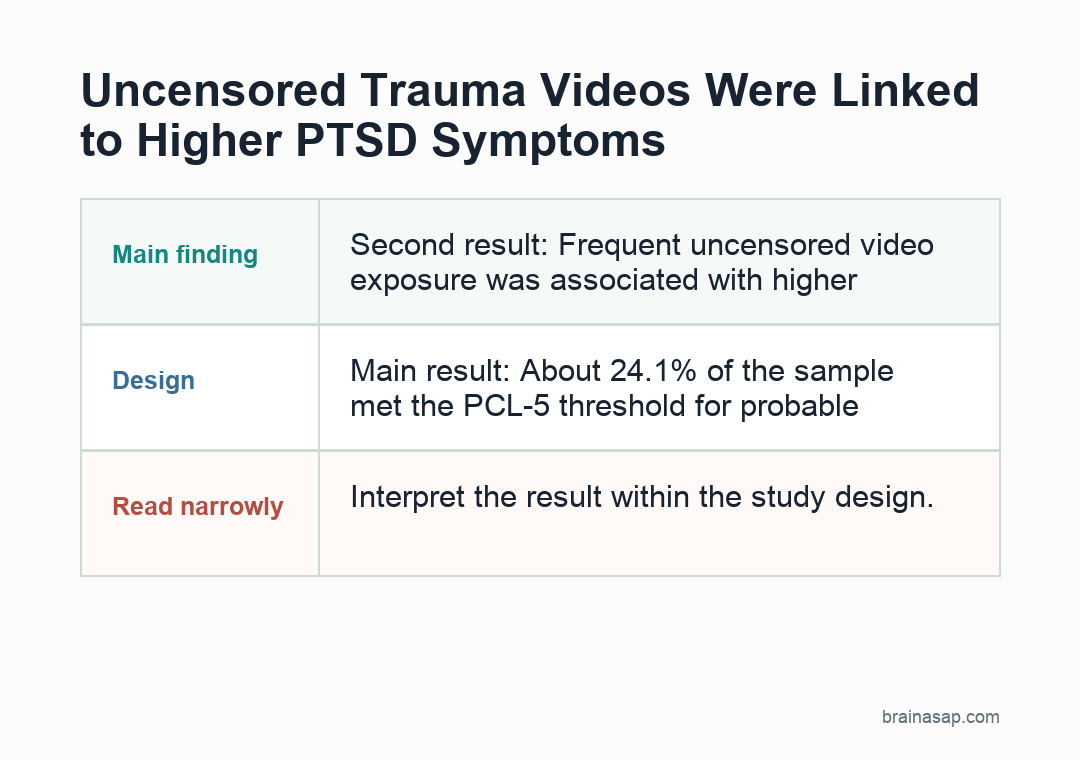
Measurement detail: PCL-5 is a self-report PTSD symptom scale. It is useful for screening and symptom severity, but it is not the same as a clinician diagnosis.
The media exposure claim is narrow. Researchers separated uncensored graphic video from edited news exposure, interpersonal exposure, and geographic proximity.
- Symptom anchor: About 24.1% of the sample met the PCL-5 threshold for probable PTSD.
- Exposure anchor: Frequent uncensored video exposure tracked higher PTSD symptom severity.
- Design boundary: The analysis was associative and relied on self-report.
- Clinical boundary: The study does not turn media viewing into a PTSD diagnosis.
Practical interpretation: mental-health screening after collective trauma should ask what people watched, not only where they were.
The next test is prospective: measure video exposure close to the event, then compare later symptoms against clinician-confirmed outcomes.
Exposure timing is the unresolved piece. A person with rising symptoms can seek out more graphic material, and graphic material can also intensify distress.
The study cannot fully separate those directions. It does show that uncensored video deserves its own screening item, rather than being collapsed into general media use.
- Ask specifically: Did the person repeatedly view raw or uncensored images?
- Separate exposure types: Direct danger, loss of loved ones, news reports, and social media clips are different experiences.
- Avoid overclaiming: The data support specific screening prompts, not a simple causal rule.
Clinical triage: repeated exposure to raw violent clips should raise the priority for sleep, avoidance, intrusive-memory, and hyperarousal screening after mass trauma.
Graphic Video Exposure Added to PTSD Symptom Prediction
PCL-5 is a self-report PTSD symptom scale. It is useful for screening and symptom severity, but it is not the same as a clinician diagnosis.
The restrained interpretation is that uncensored digital trauma exposure can track PTSD symptom burden. The finding is associative and preprint-level.
The digital-media distinction is the practical contribution. Mental-health screening after collective trauma may need to ask what people watched, not only where they were.
Self-Reported PTSD Symptoms Limit the Claim
Main limitation: the findings are associative, preprint-level, and based on self-report rather than clinician diagnosis.
- Preprint status: The work had not completed peer review in the PDF reviewed here.
- Self-report: Media exposure and symptoms came from participant report.
- Causality: Distress may change both viewing behavior and symptom reporting.
- Context: The sample and event were specific, so population claims should stay narrow.
Self-report, preprint status, and observational design all limit the claim. Those caveats are especially important when discussing traumatic events.
Digital Trauma Monitoring Should Ask About Uncensored Media
Practical takeaway: digital trauma exposure should be measured specifically after collective violence.
- Best use: Use the PCL-5 threshold and uncensored-video exposure as the main anchors.
- Do not overread: Do not claim raw videos alone caused PTSD or that the finding is clinically diagnostic.
- Next test: Test the association prospectively with clinician-confirmed outcomes and better exposure timing.
Clinical implication: trauma screening should include digital exposure. Causal claims still need stronger longitudinal evidence with event timing and clinician-rated symptoms.
Citation: DOI: 10.64898/2026.03.16.26348519; Allouche-Kam et al.; Witnessing Trauma in the Modern Era: The Role of Uncensored Media in Mental Health; medRxiv; 2026.
Study Design: A self-report study of indirect trauma exposure after a collective traumatic event.
Sample Size: People without direct exposure to the attacks, including 152 participants who met the probable PTSD cutoff.
Key Statistic: About 24.1% of the sample met the PCL-5 threshold for probable post-traumatic stress disorder, or PTSD.
Caveat: PTSD symptoms and media exposure were self-reported, and the preprint evidence was associative.