TL;DR: A 2026 study in Research on Child and Adolescent Psychopathology followed 951 New Zealand adolescents and found that 5 emotion-regulation profiles tracked different patterns of anxiety, depression, optimism, resilience, and wellbeing over 5 months.
Key Findings
- 951 adolescents were studied: The sample completed the Process of Emotion Regulation Measure (PERM), a tool that separates motives, strategies, and perceived strategy efficacy.
- Five profiles fit best: Latent profile analysis identified hypo-regulating, hyper-regulating, adaptive, maladaptive, and normative emotion-regulation styles.
- Valence mattered most: Adaptive and maladaptive profiles showed the strongest links with adolescent mental-health outcomes.
- Negative outcomes shifted differently: Hypo-regulating and hyper-regulating styles were more related to anxiety and depression deviations than to optimism or resilience.
- Unhelpful styles were less stable: Random intercept-latent transition analysis showed a general movement toward more adaptive regulation across the 5-month follow-up.
Source: Research on Child and Adolescent Psychopathology (2026) | Vukets et al.
PERM Split Emotion Regulation Into Motives, Strategies, and Efficacy
Emotion regulation is often discussed as if the main question is whether a teenager uses a helpful or unhelpful strategy. This study used the Process of Emotion Regulation Measure (PERM) to separate that question into measurable steps.
PERM separates 3 parts of regulation: why an adolescent wants to change an emotion, which strategy they select, and how effective they think that strategy is.
Two teens can use the same strategy for different reasons, or use a generally helpful strategy in a way that does not feel effective.
The cohort included 951 adolescents from New Zealand. Researchers used person-centered models rather than treating every regulation score as an isolated variable.
The analysis looked for common regulation styles across 3 PERM stages:
- Motives: whether teens were trying to increase, maintain, or decrease positive or negative emotions.
- Strategy selection: whether they tended toward adaptive or maladaptive ways of handling emotion.
- Perceived efficacy: whether adolescents thought those strategies actually worked for them.
That structure gave the study a practical clinical angle. It did not simply label a strategy as good or bad; it asked whether patterns of motivation, strategy, and perceived success clustered into recognizable adolescent profiles.
Five Emotion-Regulation Profiles Described the Adolescent Sample
The best-fitting model was a 5-profile solution. The researchers stopped before a 6-profile solution because the extra model produced weaker fit signals, including a small profile below 5% of the sample and a non-significant Lo-Mendell-Rubin test.
The 5 profiles were not diagnostic categories. They were statistical patterns that described how adolescents tended to regulate emotions in this sample.
- Adaptive: teens who more often showed helpful motives, strategy choices, and perceived efficacy.
- Maladaptive: teens who showed more contra-hedonic motives, maladaptive strategy use, and lower helpful regulation patterns.
- Normative: teens whose regulation pattern sat closer to the sample average.
- Hypo-regulating: teens who appeared to regulate less actively or less strongly than the norm.
- Hyper-regulating: teens who appeared to regulate more intensely or more frequently than the norm.
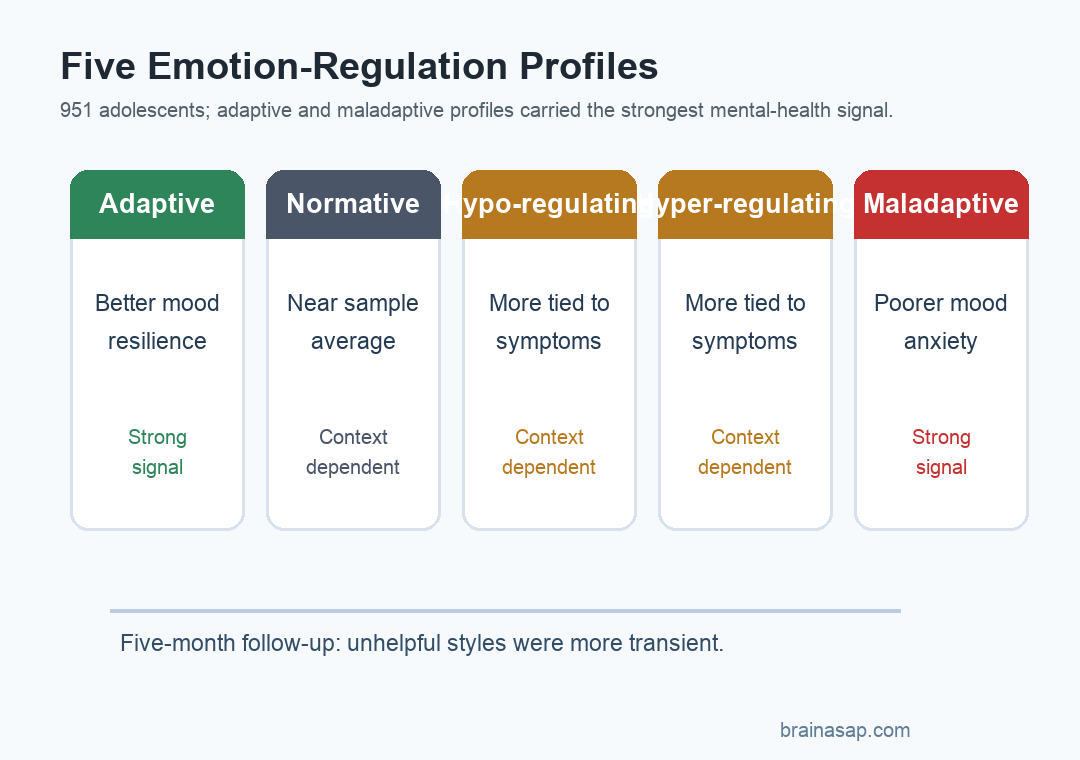
The important result was the contrast between valenced profiles. Adolescents in the adaptive profile tended to show better mental-health outcomes, while the maladaptive profile tracked poorer wellbeing.
Adaptive and Maladaptive Profiles Carried the Strongest Mental-Health Signal
The strongest pattern involved profiles that clearly leaned adaptive or maladaptive. Adaptive regulation was linked with better outcomes such as wellbeing, optimism, and resilience.
Maladaptive regulation was linked with worse outcomes, including anxiety and depression.
Hypo-regulating and hyper-regulating profiles were more complicated. They appeared to matter more for negative outcomes than for positive strengths.
Lower depression is not the same as higher resilience. The study suggests adolescent regulation profiles may relate differently to symptom reduction and positive mental-health development.
Three interpretation points stand out:
- Strategy labels were not enough: the profile approach combined motives, chosen strategies, and perceived efficacy.
- Positive and negative outcomes separated: anxiety and depression did not mirror optimism and resilience perfectly.
- Profile context mattered: hyper-regulation and hypo-regulation were not simply worse versions of the adaptive-maladaptive contrast.
For schools and clinicians, the result supports asking more specific questions. A teen may know a coping skill but use it to suppress, intensify, avoid, or manage emotion in different ways.
Five-Month Follow-Up Showed Movement Toward Adaptiveness
The longitudinal analysis used random intercept-latent transition analysis, a model that estimates how profile membership changes over time while accounting for stable person-level differences.
Across the 5-month follow-up, the overall pattern moved toward adaptiveness. Unhelpful profiles were described as more transient than helpful profiles, meaning teens were more likely to move out of some less helpful regulation patterns than out of adaptive ones.
Not every adolescent improved. Profile membership was not fixed, and the statistical direction favored more adaptive regulation over the follow-up window.
The result fits a practical view of adolescence. Regulation habits are developing, not sealed. Intervention may work best when it identifies the specific process that is off track.
- Motives can be targeted: teens may need help noticing whether they are trying to avoid, intensify, or tolerate emotions.
- Strategy selection can be taught: skills such as reappraisal, problem solving, and support seeking can be practiced directly.
- Efficacy beliefs can change: adolescents may abandon useful strategies if they do not recognize when those strategies are working.
Profile Models Can Guide Support Without Becoming Labels
The study should not be read as a new screening test that sorts every teenager into a permanent group. It was a longitudinal community-sample analysis, not a diagnostic tool.
Its value is more practical: emotion regulation may be clearer when researchers and clinicians look at patterns rather than single strategy scores. A teen who uses many strategies is not necessarily doing well if the motives are avoidant or the strategies do not feel effective.
Several limits keep the conclusion specific. The cohort came from New Zealand, the follow-up period was 5 months, and all main regulation measures depended on adolescent self-report.
Even with those limits, the findings suggest a more specific assessment approach. It may be useful to ask not only which coping tools adolescents know, but why they use them, whether the tools fit the emotional goal, and whether adolescents experience them as effective.
Citation: DOI: 10.1007/s10802-026-01461-y. Vukets et al. A Person-Centred Approach to Adolescent Emotion Regulation Motives, Strategies, and Perceived Efficacies. Research on Child and Adolescent Psychopathology. 2026;54:66.
Study Design: Longitudinal community-sample profile analysis using latent profile analysis and random intercept-latent transition analysis.
Sample Size: 951 adolescents in New Zealand.
Key Statistic: A 5-profile model best described emotion regulation patterns: hypo-regulating, hyper-regulating, adaptive, maladaptive, and normative.
Caveat: The profiles are statistical patterns from a self-report community sample, not diagnostic categories.