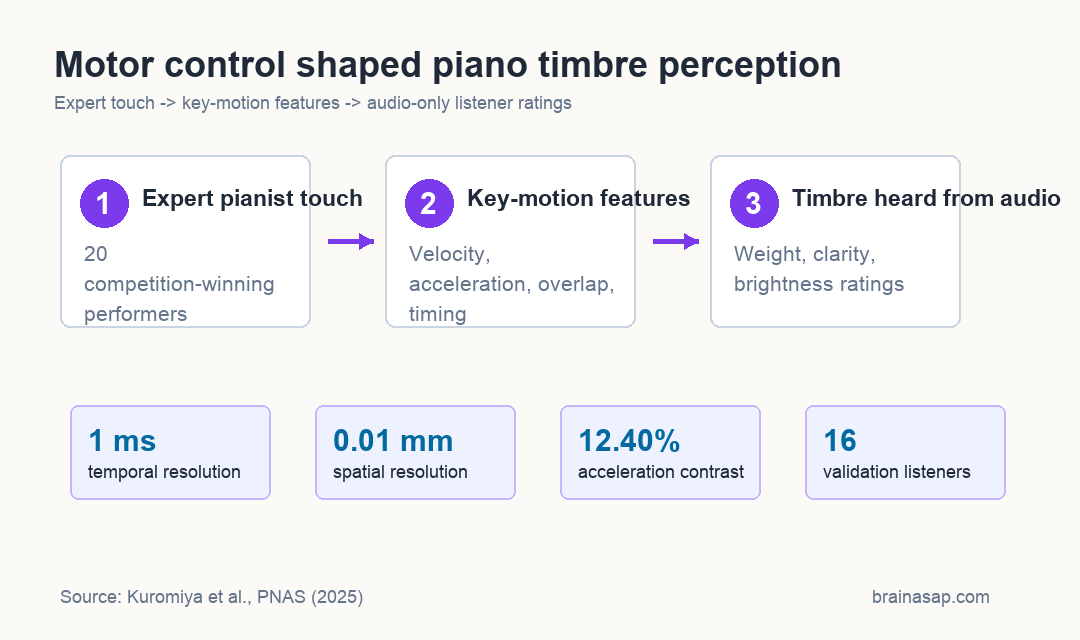
TL;DR: A 2025 study in PNAS found that expert pianists changed perceived piano timbre by altering specific key-movement features, and listeners could hear intended differences in weight, clarity, and brightness without seeing the performer.
Key Findings
- 20 expert pianists: The performance experiment recruited competition-winning pianists with an average of 25.5 years of professional piano training.
- 1 ms key tracking: A noncontact Hackkey system recorded all 88 piano keys with 1 ms temporal resolution and 0.01 mm spatial resolution.
- 40 listeners: A listening experiment included 20 pianists and 20 nonmusicians, who rated weight, clarity, and brightness from audio alone.
- Three timbre categories: Both listener groups perceived intended light/heavy, clear/blurred, and bright/dark contrasts, with pianists showing stronger discrimination.
- 12.40% validation contrast: A follow-up single-tone test isolated lower escapement acceleration and found expert listeners judged that tone as heavier and clearer than chance.
Source: PNAS (2025) | Kuromiya et al.
Piano timbre means the perceived tone quality of a note, separate from pitch and loudness.
Pianists often describe touch as light, heavy, clear, blurred, bright, or dark, but that claim is difficult to test because the key moves quickly and the listener may also be influenced by what they see.
Researchers combined expert performance, audio-only listening, and high-resolution key-motion sensing. The central question was whether subtle motor control could change what listeners heard from the same instrument.
Expert Pianists Played the Same Phrase With Seven Timbre Intentions
The first performance experiment used 20 expert pianists, all active performers who had won major professional piano competitions. Fifteen had also won prizes in international competitions.
Participants played a short Hanon exercise on a Shigeru Kawai grand piano. The task was chosen because it used simple rhythm, harmony, and phrasing, reducing the chance that expressive interpretation or hand size would dominate the result.
- Baseline condition: Pianists first played a mechanical expression after hearing a MIDI version without variation in loudness or rhythm.
- Weight contrast: They then played with light and heavy tone intentions while keeping loudness and tempo controlled.
- Clarity contrast: They played clear and blurred versions of the same material.
- Brightness contrast: They also played bright and dark versions without using the pedal.
The setup intentionally constrained obvious acoustic cues. If listeners could still identify the intended timbre, the difference had to come from more specific sound features shaped by touch.
Hackkey Measured Subtle Piano Key Motion at High Resolution
The study used Hackkey, a noncontact optical sensor system that recorded vertical key position across all 88 keys. It sampled at 1 kHz, giving 1 ms temporal resolution, and measured position with 0.01 mm spatial resolution.
From those motion traces, researchers extracted key-movement features around escapement, mute timing, onset noise, bottom noise, offset noise, overlap, and inter-keystroke timing. Escapement is the moment when the hammer briefly detaches from the key mechanism just before striking the string.
- Escapement velocity: The speed of the key near the sound-producing point became one major predictor of perceived timbre.
- Escapement acceleration: The acceleration of key descent also predicted timbre judgments, especially in the validation experiment.
- Overlap and timing: The temporal relationship between successive keypresses helped explain perceived weight, clarity, and brightness.
- Two-hand synchrony: Differences between right- and left-hand key movements contributed to some listener ratings.
These measures go beyond standard MIDI-like velocity and timing. They capture how the key travels during the brief mechanical window that shapes the hammer and string interaction.
Listeners Heard Intended Timbre Differences From Audio Alone
The listening experiment included 20 pianist listeners and 20 nonmusician listeners. They heard recorded performances from 18 of the original performers after two recordings were excluded for loudness-control problems.
Both groups rated tone weight, clarity, and brightness on seven-point scales. In all three timbre categories, listener ratings separated the intended expression pairs.
- Weight interaction: The group-by-expression effect was significant for weight, χ²(2) = 26.58, p = 1.70 × 10^-6.
- Clarity interaction: The same analysis was significant for clarity, χ²(2) = 15.51, p = 4.29 × 10^-4.
- Brightness interaction: Brightness also showed a significant interaction, χ²(2) = 12.97, p = 0.002.
- Expert sensitivity: Pianist listeners tended to rate light, heavy, blurred, and dark contrasts more strongly than nonmusicians.
The listener pattern was not simply a musician-only effect. Nonmusicians also perceived intended timbre differences, which means the acoustic consequences of touch were audible without visual performance cues.
Five Movement Features Predicted Weight, Clarity, and Brightness Ratings
Regression models linked listener ratings to a subset of key-motion features. For pianist listeners, perceived weight was predicted by escapement velocity, escapement acceleration, overlap, inter-keystroke interval, and intermanual difference in escapement velocity.
For clarity, pianist listeners perceived sounds as blurred when key movements showed smaller escapement velocity and larger acceleration, overlap, and inter-keystroke interval. For brightness, smaller escapement velocity, larger inter-keystroke interval, and smaller intermanual velocity difference were linked to darker ratings.
- Weight: Escapement velocity, acceleration, overlap, timing, and two-hand velocity difference contributed to heaviness ratings.
- Clarity: Smaller velocity and larger acceleration/timing measures contributed to blurred ratings in pianist listeners.
- Brightness: Smaller velocity and timing differences contributed to darker ratings.
The study therefore supports a motor-perception link: skilled finger movement changed piano-key motion, key motion changed sound, and listeners detected the intended timbral qualities.
Lower Escapement Acceleration Made Single Tones Sound Heavier and Clearer
A second validation experiment tested whether one movement feature could shift perception when other features were held nearly constant. A professional pianist produced two types of single-tone keystrokes that differed mainly in escapement acceleration.
The lower-acceleration keystroke had a 12.40% reduction in acceleration at escapement, while all other measured features differed by less than 3.50%. Sixteen professional pianist listeners judged randomized tone pairs.
- Heaviness judgment: The fixed intercept was below zero for weight, with 95% CI -0.968 to -0.014 and p = 0.044.
- Clarity judgment: The fixed intercept was above zero for clarity, with 95% CI 0.245 to 0.697 and p < 0.001.
- Selective manipulation: Escapement velocity differed by less than 1%, even though acceleration shifted the listening judgment.
The validation result narrowed the claim. It did not prove every aspect of piano timbre comes from one motor variable, but it showed that a specific key-acceleration feature could systematically alter perceived tone quality.
Piano Touch Offers a Measurable Sensorimotor Skill Model
The study is useful beyond music pedagogy because it turns a tacit motor skill into measurable behavior. Expert pianists had a shared movement vocabulary for changing timbre, and listeners could hear the result.
Several limits remain. Researchers did not directly measure internal hammer and string mechanics, the validation test used expert listeners, and visual cues were intentionally removed.
Real performance includes auditory, visual, and somatosensory information together.
Even with those limits, the core measurement is concrete: subtle finger and key-motion patterns can shape auditory perception. Piano performance becomes a clean model for studying how trained motor control produces nuanced perceptual experiences.
Citation: DOI: 10.1073/pnas.2425073122. Kuromiya et al. Motor origins of timbre in piano performance. PNAS. 2025;122:e2425073122.
Study Design: Expert pianist performance experiment, audio-only listener rating experiment, high-resolution key-motion analysis, and single-tone validation experiment.
Sample Size: Study 1 used 20 expert performers, 20 pianist listeners, and 20 nonmusician listeners; Study 2 used one professional pianist and 16 pianist listeners.
Key Statistic: A 12.40% reduction in escapement acceleration, with other measured features differing by less than 3.50%, made expert listeners judge tones as heavier and clearer than chance.
Caveat: The experiments isolated controlled piano tones and did not directly measure internal hammer-string mechanics or multimodal perception during live performance.