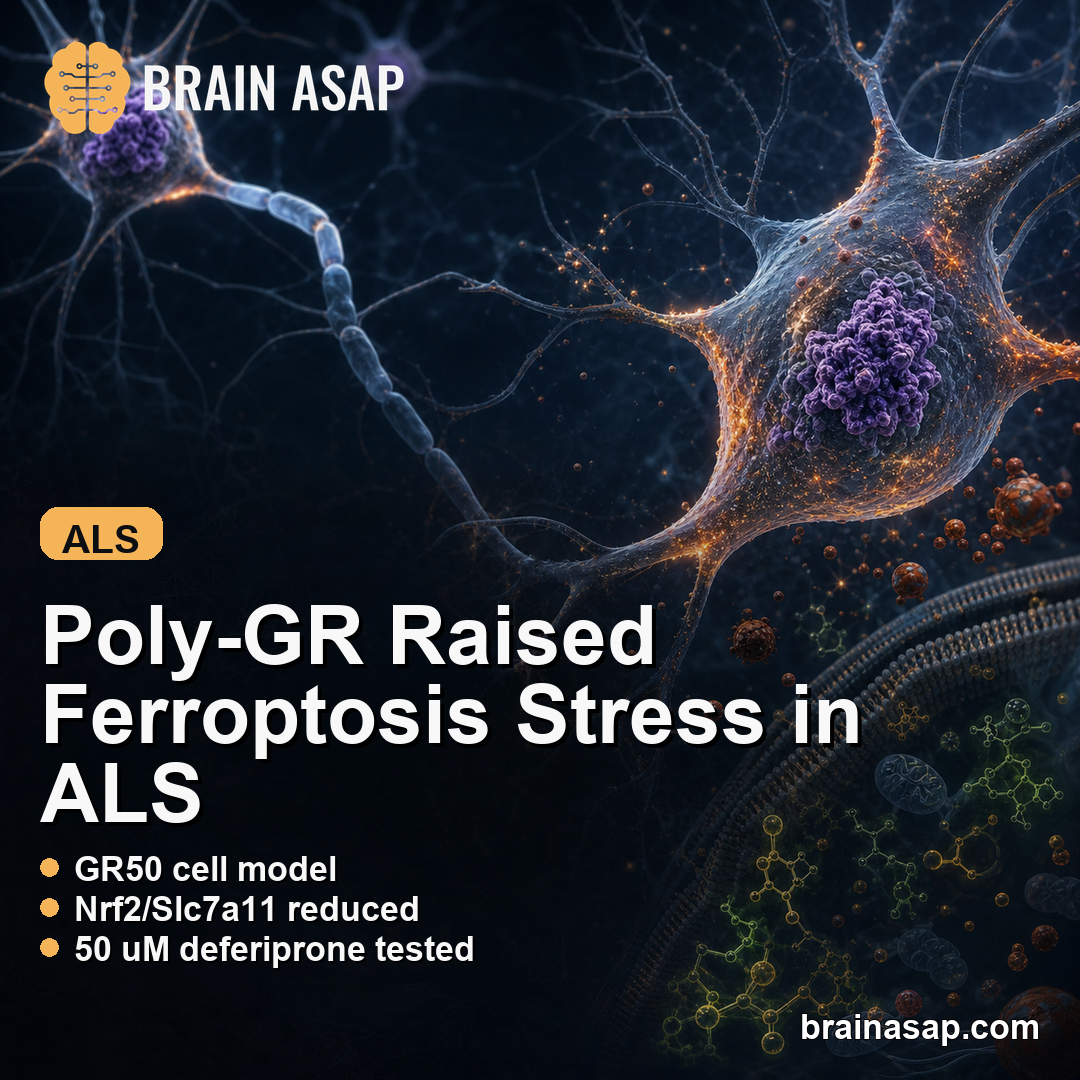
TL;DR: A 2026 study in Cell & Bioscience found that poly-GR, a toxic repeat protein linked to C9orf72-ALS, pushed motor neuron-like cells toward ferroptosis by raising lipid peroxidation and ferrous iron while weakening the Nrf2/Slc7a11 antioxidant pathway.
Key Findings
- GR50 model: Researchers expressed EGFP-GR50, a 50-repeat glycine-arginine poly-GR construct, in NSC-34 motor neuron-like cells.
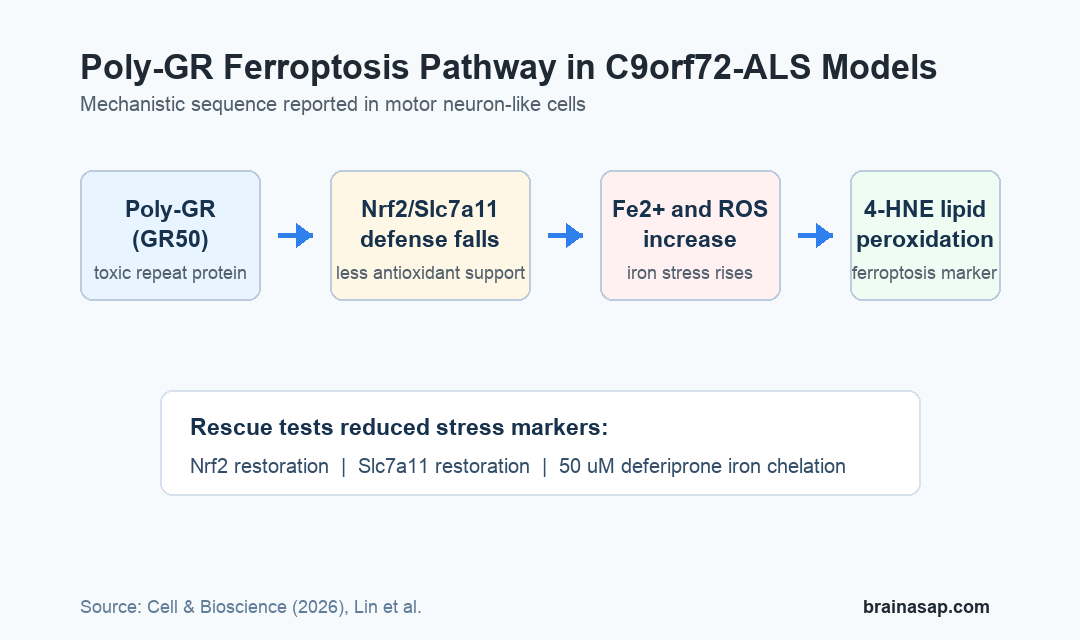
- Ferroptosis markers: Poly-GR increased 4-HNE lipid peroxidation, intracellular Fe2+, reactive oxygen species, and COX2 staining.
- Nrf2/Slc7a11 suppression: Poly-GR reduced Nrf2 nuclear localization, lowered Nrf2 binding at the Slc7a11 promoter, and decreased Slc7a11 transcription.
- Rescue tests: Nrf2 or Slc7a11 restoration reduced oxidative stress, and 50 uM deferiprone reduced Fe2+ accumulation in poly-GR-expressing cells.
- Translation limit: The paper did not validate the mechanism in C9orf72-ALS patient-derived iPSC motor neurons.
Source: Cell & Bioscience (2026) | Lin et al.
C9orf72-associated ALS is caused by a repeat expansion that can produce toxic dipeptide repeat proteins. One of the most harmful is poly-GR, a glycine-arginine repeat protein linked to motor neuron stress and degeneration.
This study asked whether poly-GR makes motor neurons vulnerable to ferroptosis, an iron-dependent form of cell death driven by lipid peroxidation. The work focused on mechanism, not on a new treatment in patients.
The question fits a broader ALS problem. Current disease-modifying drugs such as riluzole and edaravone have limited effects, so researchers keep looking for pathways that explain why motor neurons become selectively vulnerable.
For C9orf72-ALS, toxic repeat proteins offer one route into that question. If poly-GR changes iron handling or antioxidant defenses, it could connect repeat-protein toxicity with a cell-death program that can be tested directly in models.
Poly-GR Increased Ferroptosis Markers in Motor Neuron-Like Cells
The first experiments used NSC-34 motor neuron-like cells expressing EGFP-GR50. The construct allowed researchers to study how 50 glycine-arginine repeats changed oxidative and iron-related stress markers.
Poly-GR expression increased several features consistent with ferroptotic vulnerability. These included 4-HNE, a lipid peroxidation marker; intracellular Fe2+, the ferrous iron pool; reactive oxygen species; and COX2, a commonly used ferroptosis-associated marker.
Primary mouse neurons were used as a second cellular check for lipid peroxidation. That made the result less dependent on a single immortalized motor neuron-like line, even though it still remained a model-system finding.
- Lipid damage: 4-HNE staining increased in EGFP-GR50-expressing NSC-34 cells and primary neurons.
- Iron accumulation: FerroOrange imaging showed higher intracellular Fe2+ in poly-GR-expressing cells.
- Cell-stress context: Poly-GR made cells more vulnerable to erastin, a ferroptosis-inducing compound.
The paper also compared poly-GR with another arginine-rich repeat protein, poly-PR. Both could raise 4-HNE, but poly-GR produced stronger 4-HNE accumulation in the reported comparison.
Nrf2 and Slc7a11 Defense Signaling Was Weakened
The mechanistic center of the study was the Nrf2/Slc7a11/Gpx4 pathway. Nrf2 is a transcription factor that helps cells activate antioxidant defenses, while Slc7a11 supports cystine import for glutathione production.
Poly-GR reduced Slc7a11 and Gpx4 protein levels. Slc7a11 mRNA also decreased, while Gpx4 mRNA did not, suggesting that Slc7a11 was suppressed at transcription and Gpx4 was affected through another layer of regulation.
- Nrf2 localization: Poly-GR impaired movement of Nrf2 into the nucleus.
- Promoter binding: Chromatin immunoprecipitation showed lower Nrf2 occupancy at the Slc7a11 promoter.
- Promoter activity: Nrf2 overexpression increased Slc7a11 promoter activity, while poly-GR reduced it.
- Defense loss: Lower Slc7a11 weakens glutathione-linked control of lipid peroxides.
Nrf2, Slc7a11, and Deferiprone Reduced Cell Stress
The strongest part of the paper was the rescue logic. If poly-GR harms cells by weakening Nrf2/Slc7a11 signaling and increasing iron stress, then restoring that defense or reducing iron should reduce injury markers.
That is what the cell experiments supported. Nrf2 overexpression restored Slc7a11 expression in poly-GR-expressing cells, while Slc7a11 overexpression directly strengthened the downstream defense pathway.
- Nrf2 rescue: Nrf2 restoration reduced lipid peroxidation and reactive oxygen species.
- Slc7a11 rescue: Slc7a11 restoration reduced oxidative stress and helped cell viability under ferroptotic stress.
- Iron chelation: 50 uM deferiprone reduced Fe2+ accumulation and ferroptosis-associated injury.
- Erastin challenge: Poly-GR sensitized cells to 25 uM erastin, and rescue approaches reduced that vulnerability.
These experiments do not mean deferiprone is proven as an ALS therapy. They show that iron and antioxidant-defense pathways were functionally involved in this poly-GR cell model.
Mouse Brain Expression Added In Vivo Stress Evidence
The paper also used an AAV9-hSyn-EGFP-GR50 mouse expression model. Neonatal C57BL/6J mice received intracerebroventricular injection at postnatal day 0 and were monitored across early postnatal stages.
Brain tissue from EGFP-GR50-expressing mice showed neurodegeneration-associated changes and higher 4-HNE staining, consistent with increased lipid peroxidation in vivo. The animal work strengthened the link between poly-GR expression and oxidative damage outside a dish.
The in vivo evidence was still acute and mechanistic. It did not test long-term ALS progression, behavior, or therapeutic rescue in an ALS disease model.
Patient-Derived Motor Neurons Remain the Missing Test
The paper’s limitation section is important for interpretation. Most experiments were performed in NSC-34 cells and primary motor neurons, and the study did not include C9orf72-ALS patient-derived induced pluripotent stem cell (iPSC) motor neurons.
The upstream source of iron dysregulation also remains uncertain. The authors noted that ferritinophagy, iron import/export pathways, ribosomal stalling, selenium metabolism, and other mechanisms were not fully tested.
- Model limitation: Motor neuron-like cells are useful for mechanism, but they do not reproduce the full patient disease state.
- Mechanism gap: The pathway explains Slc7a11 suppression better than the upstream cause of iron buildup.
- Treatment gap: Ferroptosis-targeting interventions were protective in vitro, but therapeutic efficacy in vivo remains unproven.
The finding is still useful because it narrows a testable mechanism in C9orf72-ALS. Poly-GR may damage motor neurons partly by combining weaker antioxidant defense with higher ferrous iron and lipid peroxidation.
Citation: DOI: 10.1186/s13578-026-01574-3. Lin et al. Poly-GR promotes ferroptosis-associated vulnerability in C9orf72-ALS. Cell & Bioscience. 2026.
Study Design: Mechanistic cell and mouse expression study testing poly-GR effects on ferroptosis-associated stress pathways in C9orf72-ALS models.
Sample/Model: EGFP-GR50 NSC-34 motor neuron-like cells, primary mouse neurons, and neonatal AAV9-EGFP-GR50 mouse brain expression.
Key Statistic: Cell experiments used 50 uM deferiprone and 25 uM erastin to test iron chelation and ferroptotic stress in poly-GR-expressing cells.
Caveat: The mechanism was not validated in C9orf72-ALS patient-derived iPSC motor neurons or tested as a long-term in vivo treatment.