TL;DR: A reviewed preprint in eLife found that adult vestibular hair-cell kinocilia carry both primary-cilia and motile-cilia features, including motile-cilia gene signatures and spontaneous motion in bullfrog and mouse balance organs.
Key Findings
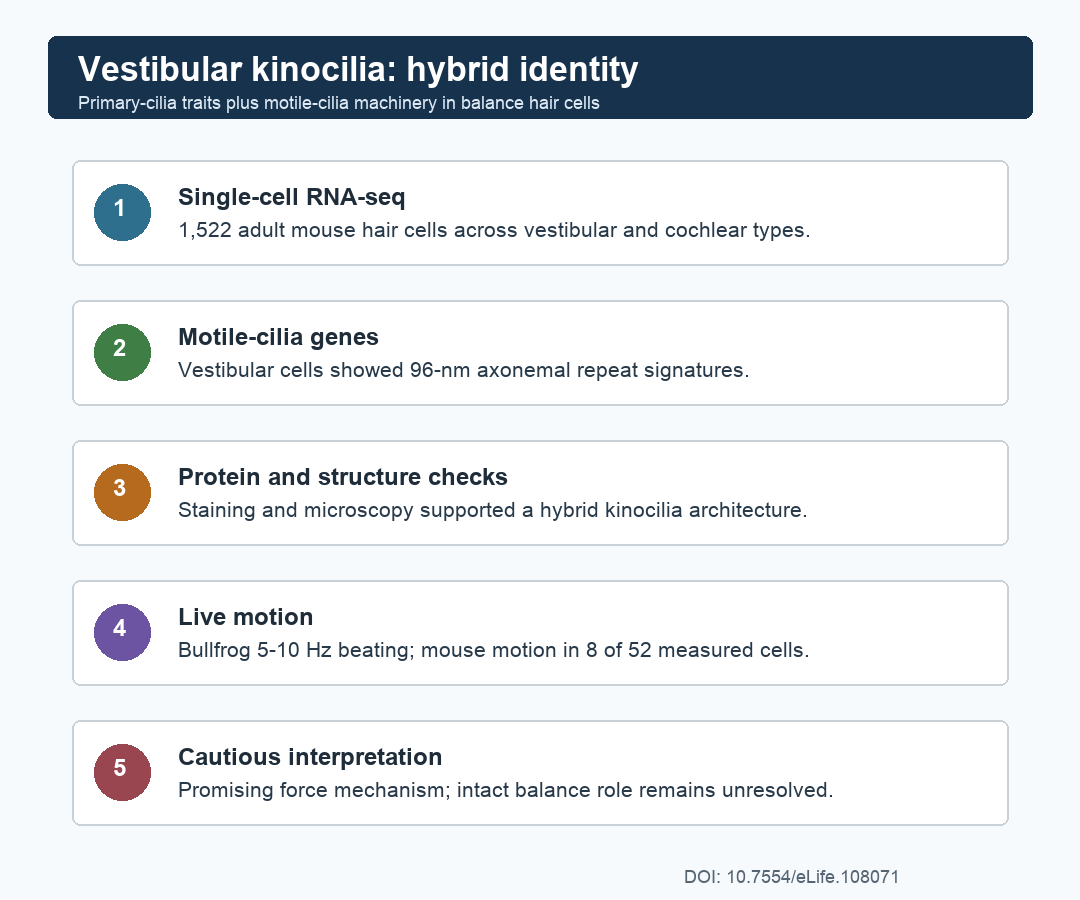
- 1,522 mouse hair cells: The single-cell RNA-seq dataset included cochlear inner and outer hair cells plus vestibular type I and type II hair cells.
- 887 vestibular-enriched genes: Vestibular hair cells showed a broad gene-expression profile distinct from cochlear hair cells.
- Motile-cilia genes stood out: Vestibular hair cells, but not cochlear hair cells, were enriched for genes tied to the 96-nm axonemal repeat and ciliary motility.
- Protein staining backed the transcript data: Immunostaining detected key cilia-associated proteins in vestibular kinocilia.
- Motion was observed: Bullfrog kinocilia beat at about 5-10 Hz, while mouse crista hair bundles showed subtler motion in 8 of 52 measured cells.
Source: eLife (version of record published 2026) | Xu, Tavakoli et al.
Vestibular Hair Cells Use Kinocilia to Sense Head Motion
Vestibular hair cells help the nervous system detect gravity, head rotation, and balance-relevant motion. Their sensory hair bundle includes actin-rich stereocilia and a taller structure called the kinocilium.
The kinocilium has usually been discussed as a primary-cilium-like structure rather than a beating motile cilium. In this paper, the research team tested whether that classification is too simple.
The researchers compared adult mouse hair-cell types using single-cell RNA sequencing, then checked whether the molecular signal matched protein staining, cross-species datasets, electron microscopy, and live movement measurements.
- Mouse cochlea: 131 inner hair cells and 668 outer hair cells.
- Mouse vestibular organs: 588 type I vestibular hair cells and 135 type II vestibular hair cells.
- Main test: whether vestibular kinocilia are passive primary-cilium-like structures or have motile-cilia machinery.
The issue is important because balance input begins as a mechanical event. If the kinocilium can generate or tune force inside the hair bundle, it may be more than a static landmark for sensory polarity.
Single-Cell RNA Sequencing Found a Vestibular Cilia Signature
The first layer of evidence came from single-cell RNA sequencing of adult mouse hair cells. About 71% of detected genes were shared across the four hair-cell types, but the vestibular and cochlear cells still separated into distinct molecular groups.
The team reported 674 cochlear-enriched genes and 887 vestibular-enriched genes. Vestibular-enriched genes included candidates linked to extracellular matrix biology, adhesion, mineralized matrix, acid-base balance, and cilia.
Several genes emerged as possible vestibular markers, including Cfap43, Cfap126, Cib3, Cxcl14, Pcdh20, Pifo, Slc9a3r2, and Tmc2. The paper did not present these as clinical biomarkers; they were molecular clues about hair-cell identity.
- Primary-cilia genes: 410 of roughly 420 primary-cilia-associated genes or proteins were detected in at least one hair-cell type.
- Vestibular enrichment: gene ontology terms related to cilium organization appeared in vestibular hair cells.
- Motility terms: the analysis also returned terms related to microtubule-based cilia motility.
The motility result was the surprising part. It suggested the vestibular kinocilium might carry molecular equipment usually associated with active cilia, even though it is physically embedded in a sensory hair bundle.
Motile-Cilia Machinery Appeared in Vestibular, Not Cochlear, Hair Cells
The paper then focused on the 96-nm axonemal repeat, a repeating structural module that helps organize dynein motors and regulatory complexes in motile cilia and flagella.
Vestibular hair cells showed expression of many genes tied to this motility-related architecture. These included genes associated with axonemal dynein arms, radial spokes, the nexin-dynein regulatory complex, and other ciliary structures.
Examples included Dnah5, Dnah6, Wdr66, Cfap206, Ccdc39, Ccdc40, Foxj1, and Lrrc6. In the analysis, cochlear hair cells showed little or no comparable enrichment for these motile-cilia signatures.
- Cross-species support: orthologous motility-related genes were also found in zebrafish and human vestibular hair-cell datasets.
- Protein support: confocal imaging detected key motile-cilia-related proteins in vestibular kinocilia.
- Structural support: bullfrog kinocilia showed a hybrid architecture, shifting between 9+2 and 9+0 microtubule arrangements along different zones.
The important claim is not that vestibular kinocilia are identical to airway cilia or sperm flagella. The claim is more specific: vestibular kinocilia appear molecularly hybrid, with primary-cilia traits and a subset of motile-cilia machinery.
Bullfrog and Mouse Preparations Showed Spontaneous Kinocilia Motion
The live-imaging results gave the molecular finding a functional direction. In acute bullfrog semicircular-canal preparations, the researchers observed spontaneous kinociliary motility in some crista hair cells.
The movement had a flagella-like beating pattern and occurred at approximately 5-10 Hz at room temperature. The authors wrote that the displacements were large enough to deflect the whole hair bundle.
The bullfrog result did not occur in every measured cell. The paper estimated that visible motility appeared in only about 1-5% of crista hair cells in the excised preparation, possibly because dissection and in vitro conditions can damage or unload the kinocilium.
- Bullfrog crista: robust spontaneous kinocilia movement in a small subset of hair cells.
- Mouse crista: subtler bundle motion measured with a photodiode method.
- Tip-link test: mouse bundle motion persisted after treatment intended to break mechanotransduction tip links.
In mice, the team measured spontaneous bundle motion from 52 crista hair cells across 6 mice. Motion was detected in 8 cells.
The movement measured in mice was much smaller than airway-cilia motion and smaller than the bullfrog kinocilia movement.
Hybrid Kinocilia May Tune Balance Signals, but Function Remains Open
The paper proposes that the kinocilium could act as an active force-generating component of the vestibular hair bundle. Because the kinocilium connects to the tallest stereocilia through kinocilial links, movement or stiffness changes could influence bundle mechanics.
That idea fits the biology of balance sensing, where tiny mechanical changes can alter how hair cells convert motion into neural firing patterns.
It also offers a reason why vestibular hair cells might maintain motile-cilia machinery that cochlear hair cells lack.
But the study is careful about what remains unknown. The researchers did not prove that spontaneous kinocilia movement changes behavior, balance perception, vestibular reflexes, or disease risk.
- Preparation limits: live motility was observed in excised tissue, where ATP levels, extracellular attachments, and tissue integrity may differ from living organs.
- Subset detection: only a minority of measured cells showed clear motion under the tested conditions.
- Mechanistic gap: the direct role of kinocilia motility in vestibular encoding still needs targeted experiments.
- Species gap: the strongest visible motion came from bullfrog tissue, while mouse motion was subtler.
Under those limits, the paper reframes the kinocilium as a specialized sensory organelle rather than a simple non-motile appendage.
The next question is whether this hybrid machinery actively tunes balance input in intact vestibular organs.
Citation: DOI: 10.7554/eLife.108071. Xu, Tavakoli et al. The dual molecular identity of vestibular kinocilia bridges structural and functional traits of primary and motile cilia. eLife. 2025;14:RP108071. Version of record published 2026.
Study Design: Single-cell transcriptomic, immunostaining, structural, cross-species, and live-imaging study of vestibular and cochlear hair cells.
Sample Size: 1,522 adult mouse hair cells in the main single-cell RNA-seq dataset; mouse motion measurements from 52 crista hair cells across 6 mice.
Key Statistic: Mouse spontaneous bundle motion was detected in 8 of 52 measured crista hair cells; bullfrog kinocilia beating occurred at about 5-10 Hz in some cells.
Caveat: The study supports a hybrid kinocilia identity, but the functional importance of kinocilia motility for balance signaling remains unresolved.