TL;DR: A 2026 Journal of Global Health analysis of Global Burden of Disease 2021 data estimated that 162.86 million people had substance use disorders in 2021, with age-standardized rates down since 1990 but major inequality across sex, age, region, and development level.
Key Findings
- 162.86 million cases: Global Burden of Disease 2021 estimates put worldwide substance use disorders at 162.86 million people in 2021.
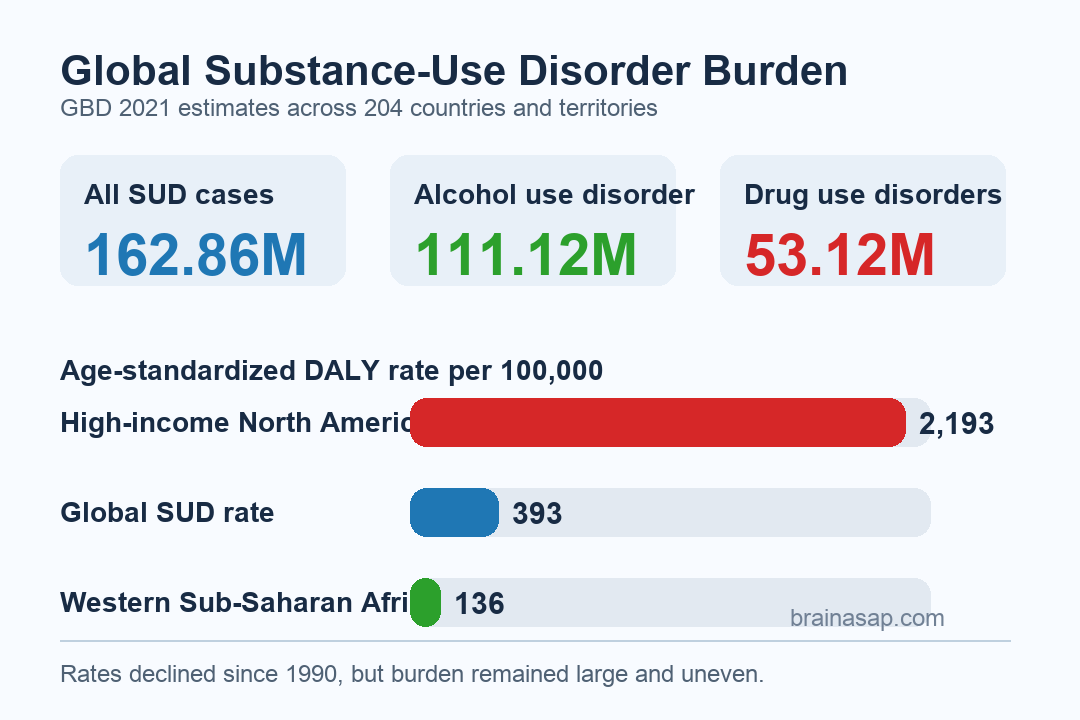
- Alcohol dominated case counts: Alcohol use disorder accounted for about 111.12 million cases, while drug use disorders accounted for about 53.12 million.
- Rates declined since 1990: The global age-standardized prevalence rate declined by 16.9%, incidence by 17.3%, and DALY rate by 9.1%.
- High-income North America stood out: Its age-standardized DALY rate was 2,193.48 per 100,000, far above the global SUD rate of 393.36.
- Young adult men carried more burden: Burden peaked around ages 25-35 and was consistently higher among males.
Source: Journal of Global Health (2026) | Yu et al.
Substance use disorders include alcohol use disorder and drug use disorders severe enough to produce measurable health loss. This study used Global Burden of Disease 2021 estimates to compare long-term trends across 204 countries and territories.
The main result is not a simple rise-or-fall pattern. Global age-standardized rates declined over three decades, but the 2021 burden remained large, geographically uneven, and concentrated in specific age and sex groups.
Age-standardized improvement can also coexist with large absolute need because populations grow, age structures change, and drug markets shift. For service planning, the case count and the DALY rate both matter.
Global Substance Use Disorder Rates Fell, but Case Counts Stayed Large
In 2021, the analysis estimated 162.86 million people with substance use disorders worldwide. The global age-standardized prevalence rate was 1,982.13 per 100,000.
Compared with 1990, age-standardized prevalence declined by 16.9%, while incidence declined by 17.3%. The age-standardized disability-adjusted life-years rate, or DALY rate, declined by 9.1%.
A DALY combines years lost to premature death with years lived with disability. For substance use disorders, that measure helps capture both fatal overdose or alcohol-related harm and long-running disability from addiction.
- Prevalence: 1,982.13 per 100,000 globally in 2021.
- Incidence: 843.37 new or newly estimated cases per 100,000.
- DALY rate: 393.36 per 100,000, down from 1990 but still a major source of health loss.
Alcohol Use Disorder Accounted for Most Cases
Alcohol use disorder accounted for about 111.12 million cases in 2021. Drug use disorders accounted for about 53.12 million.
Those categories overlap conceptually in public-health planning but are tracked separately in GBD estimates. The distinction matters because prevention, treatment access, overdose response, liver-disease prevention, and mental-health services target different risks.
The authors also reported that drug-use-disorder burden increased in several high-Socio-demographic Index settings during 2020-2021. That recent signal is important because a long-term global decline can hide short-term worsening in specific countries.
- Alcohol use disorder: Larger case count and broad global burden.
- Drug use disorders: Smaller global case count but sharp high-burden signals in some developed settings.
- Combined SUD measure: Useful for system planning, but it should not erase substance-specific prevention needs.
High-Income North America Had the Highest DALY Rate
The regional contrast was large. High-income North America had an age-standardized DALY rate of 2,193.48 per 100,000, while Western Sub-Saharan Africa had the lowest rate, 136.22 per 100,000.
That difference should not be read as a simple behavioral failure in one region and success in another. GBD estimates reflect substance markets, treatment access, mortality patterns, diagnostic data, and model assumptions.
Still, the direction is policy-relevant. Regions with high measured DALY rates need prevention, treatment, harm reduction, and mortality surveillance that match their local substance landscape.
The SDI benchmarking also helps separate expected burden from excess burden. A country can have high development indicators and still show drug-related health loss above the level predicted from development alone.
- Surveillance: Track substance-specific trends rather than waiting for all-SUD averages to move.
- Treatment access: Align addiction care with the substances and age groups driving local burden.
- Harm reduction: Use overdose prevention, safer-use education, and linkage to care where drug-related DALYs are rising.
Burden Peaked in Young Adults and Was Higher in Males
Age patterns were not flat. The study reported that burden peaked around ages 25 to 35 years, a period when substance use disorders can collide with work, parenting, housing, injury risk, and psychiatric comorbidity.
Burden was also consistently higher among males. Risk among women remains clinically important, while male-focused prevention and treatment engagement stay central in many settings.
The age-sex pattern is one reason substance-use planning belongs inside mental-health systems, not only law enforcement or emergency medicine. The burden often lands during years when early intervention can change decades of health and social outcomes.
The GBD Model Is a Map, Not a Local Chart Review
The main limitation is that Global Burden of Disease estimates depend on available data and statistical modeling. Countries with weaker surveillance may have more uncertainty than countries with dense mortality, survey, and treatment datasets.
Even with that caveat, the analysis gives a useful global map. Substance use disorder rates have improved on an age-standardized basis since 1990, but 162.86 million cases and widening development-level divergence make the burden far from solved.
Citation: DOI: 10.7189/jogh.16.04131. Yu et al. Global substance use disorders burden from 1990 to 2021: post-COVID shifts and widening inequalities. Journal of Global Health. 2026;16:04131.
Study Design: Global Burden of Disease 2021 modeling analysis across countries, regions, ages, sexes, and development levels.
Sample Size: Modeled estimates for 204 countries and territories from 1990 to 2021.
Key Statistic: In 2021, 162.86 million people had substance use disorders; high-income North America had the highest age-standardized DALY rate at 2,193.48 per 100,000.
Caveat: GBD estimates depend on source-data quality and statistical modeling, so country-level numbers should be interpreted with uncertainty intervals.