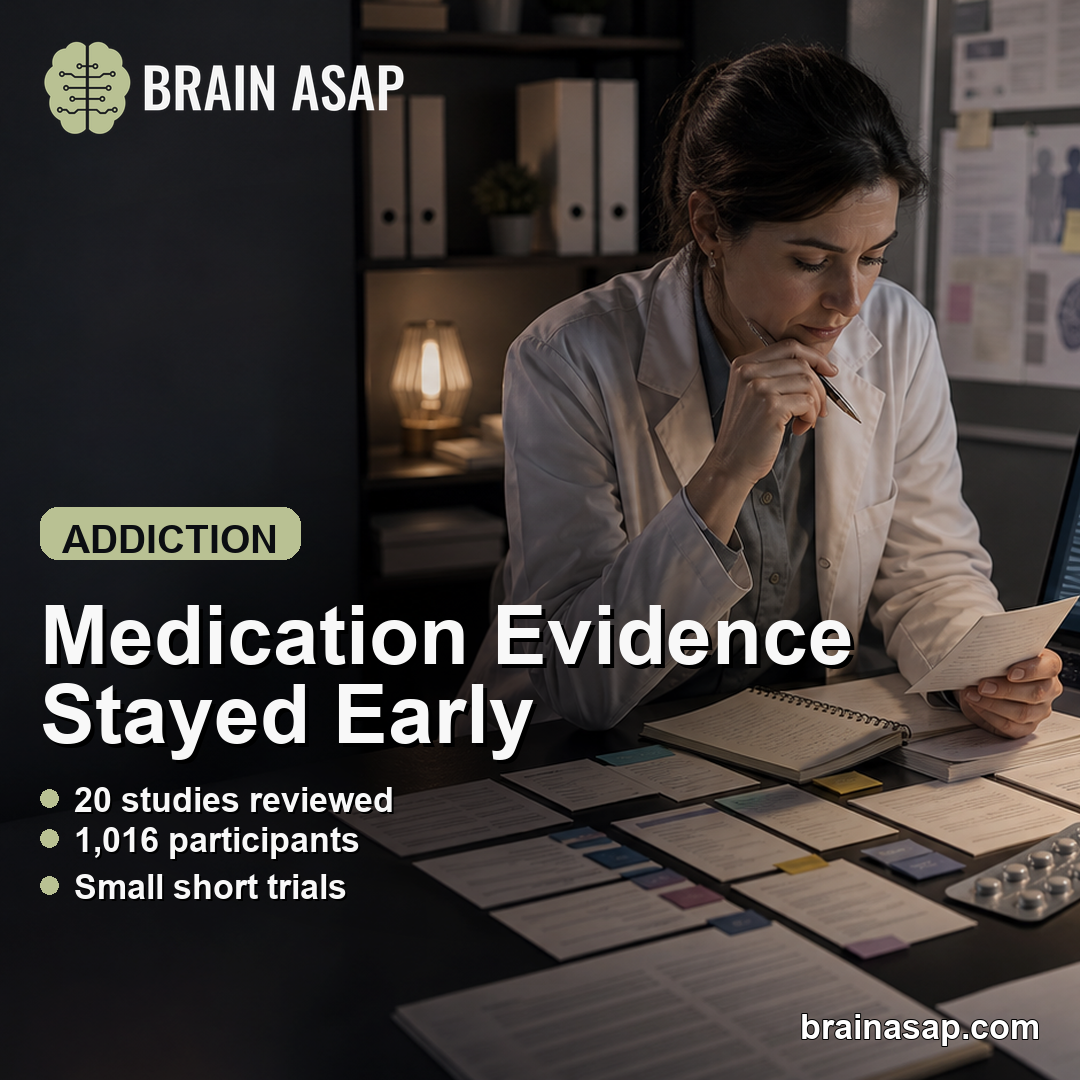
TL;DR: A 2026 systematic review in Future Science OA found early medication evidence for online behavioral addictions, but the 20 included studies were mostly small, male-heavy, and short-term.
Key Findings
- Medication evidence stayed early: The review found small, mixed pharmacotherapy signals across 20 online behavioral addiction studies.
- Clinical groups stayed small: The 1,016 total participants were spread across studies with sample sizes from 12 to 126.
- 95.5% male participants: Across the included studies, 970 participants were male, and 13 studies enrolled only male participants.
- Seven randomized trials: The evidence base included seven RCTs, nine pre-post studies, and four other nonstandard or mixed designs.
- Medication classes repeated: Bupropion, selective serotonin reuptake inhibitors, and opioid receptor antagonists were the most frequently studied drugs.
Source: Future Science OA (2026) | Park et al.
Online behavioral addictions include clinically impairing online gaming, online gambling, problematic internet use, and compulsive online sexual behavior. The review asked whether medications have been tested for these conditions, not whether any drug is already established as standard care.
The authors searched PubMed, MEDLINE, and Embase, with an initial search in August 2025 and an update in January 2026. Eligible studies had to test pharmacotherapy for an addictive online behavior and report a post-intervention outcome on severity, duration, or frequency.
Bupropion and SSRIs Dominated Medication Studies for Online Gaming
Problematic online gaming accounted for the largest share of the evidence. Of the 20 included studies, 10 studies investigated medication treatment for problematic online gaming.
Bupropion appeared most often in this group. Several studies used 150 mg/day during the first week and increased to 300 mg/day, then measured changes in gaming duration, craving, or internet-addiction severity scales.
- Bupropion studies: Some trials or pre-post studies reported reduced gaming duration or severity after treatment.
- SSRI studies: Escitalopram and other selective serotonin reuptake inhibitors appeared in gaming or broader internet-use studies, often with co-occurring depression or anxiety in view.
- ADHD medication studies: Atomoxetine or methylphenidate appeared when attention-deficit/hyperactivity disorder was part of the clinical picture.
A randomized study comparing bupropion plus education with placebo plus education reported greater improvement after 8 weeks, but not at a 12-week follow-up. Another trial found better 8-week outcomes when bupropion was combined with cognitive behavioral therapy than when bupropion was paired with brief monitoring interviews.
Those details matter because they suggest medication may not work as a standalone answer. Several studies were testing drugs inside a broader treatment setting, with psychotherapy, education, or co-occurring psychiatric symptoms shaping the result.
Online Gambling and Compulsive Sexual Behavior Had Thinner Drug Evidence
The review found fewer studies for online gambling and compulsive online sexual behavior. These areas included opioid receptor antagonists, such as naloxone or naltrexone, and other agents used in gambling or compulsive-behavior research.
For online gambling, one randomized trial tested intranasal naloxone plus psychosocial support against placebo plus support. The review reported no significant post-treatment difference between groups on gambling severity measures.
An open-label Romanian study tested naltrexone 50 mg daily plus weekly cognitive behavioral therapy for online gambling disorder. It reported reduced severity over 6 months, but the design did not isolate medication effects from therapy, time, expectancy, or clinical contact.
- Online gaming: The most studied online behavior, with bupropion appearing repeatedly.
- Online gambling: Included opioid-antagonist studies, but findings were mixed and designs varied.
- Compulsive online sexual behavior: Included limited naltrexone and citalopram evidence, with online-specific outcomes not always reported clearly.
For compulsive online sexual behavior, one naltrexone pre-post study found reductions in compulsive sexual behavior severity, but only six of 20 participants specifically reported cybersex. A citalopram trial reported a greater decrease in weekly pornography-use duration, while severity differences were not significant.
Most Pharmacotherapy Evidence Was Small, Male-Heavy, and Moderate Quality
The full evidence base had 1,016 participants. Sample sizes ranged from 12 to 126, which limits confidence in subgroup findings and makes adverse-event patterns harder to interpret.
Participant mix was also narrow. Across the included studies, 970 participants were male, and 13 studies included only male participants.
The male-heavy sample may partly reflect the review’s focus on gaming disorder, but it narrows generalizability.
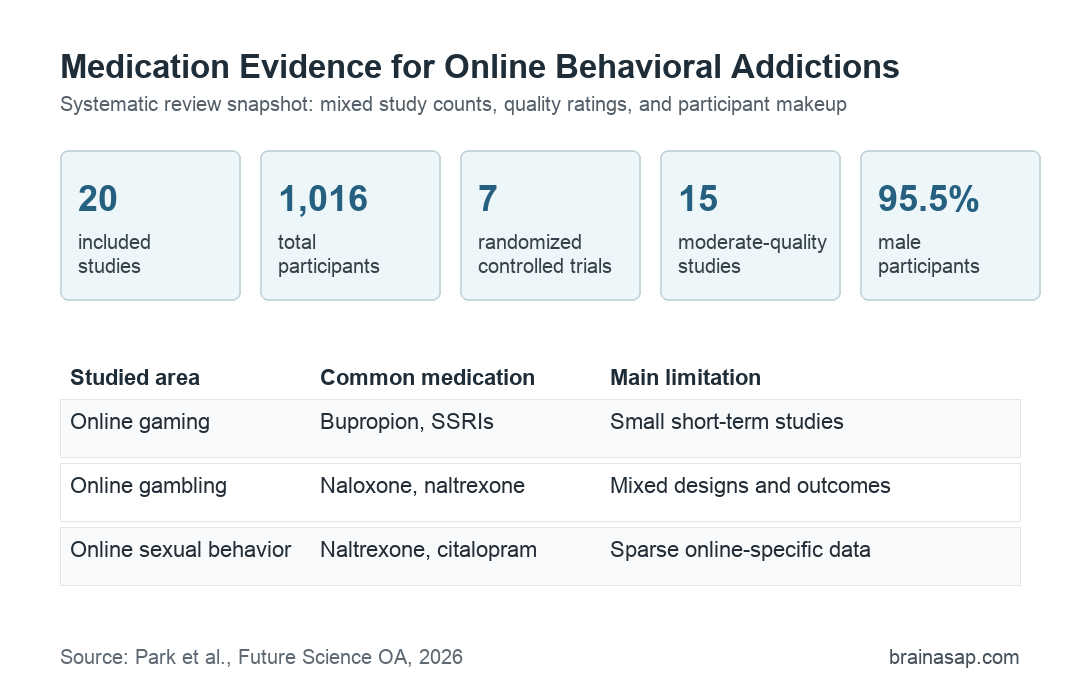
- Design mix: Seven studies were randomized controlled trials, while nine were pre-post studies.
- Quality ratings: Fifteen studies scored moderate, three scored weak, and two scored strong on the EPHPP tool.
- Geography: Twelve studies were conducted in Asia, four in the United States, and four in Europe.
- Follow-up: Many studies used short post-treatment windows, often weeks rather than durable long-term follow-up.
Nearly half of the pharmacotherapy studies also addressed co-occurring concerns such as depression, anxiety, ADHD, or obsessive-compulsive symptoms. That is clinically realistic, but it also complicates interpretation when an online behavior improves during treatment.
No Medication Is Ready as a Standard Treatment for Online Behavioral Addictions
The review did not identify a medication with enough evidence for clinical guidelines or regulatory approval for online behavioral addictions. The stronger reading is that medication research exists, but it remains early and uneven across online behavior types.
Future trials need larger samples, clearer diagnostic definitions, longer follow-up, and better separation between medication effects and combined psychotherapy effects. For gaming disorder, combined treatment deserves careful testing because the review found signs that psychotherapy plus medication may outperform medication paired only with brief monitoring.
- Clinical use: Medication approaches would generally be off-label and tied to patient-specific symptoms or co-occurring disorders.
- Research need: Trials should report online-specific outcomes, not only broad psychiatric symptom changes.
- Emerging behaviors: The authors named AI-based sexual engagement and problematic cryptocurrency trading as future areas needing study.
For clinicians and readers, the review supports caution. Bupropion, SSRIs, and opioid receptor antagonists have been tested, but the existing studies do not yet show a settled medication pathway for online behavioral addictions.
Citation: DOI: 10.1080/20565623.2026.2681577. Park et al. Pharmacotherapy for online behavioral addictions: a systematic review. Future Science OA. 2026;12:2681577.
Study Design: Systematic review of randomized controlled trials and quasi-experimental medication studies.
Sample Size: 20 studies with 1,016 total participants.
Key Statistic: Bupropion, SSRIs, and opioid receptor antagonists were most frequently studied and showed early symptom-reduction signals, but the evidence base was small and methodologically limited.
Caveat: No medication had enough evidence for a standard treatment recommendation for online behavioral addictions.