
TL;DR: A 2026 secondary analysis in Addiction found that adults switched to very-low-nicotine cigarettes often used alternative nicotine products and maintained much higher nicotine intake than cigarette-only users.
Key Findings
- 438 smokers: The parent randomized clinical trial enrolled adults who smoked 5 to 40 cigarettes per day.
- 0.4 mg/g cigarettes: The very-low-nicotine-content group received Spectrum research cigarettes containing 0.4 mg nicotine per gram of tobacco.
- 32.7% ANDS-only use: At week 12, 32.7% of VLNC participants used alternative nicotine delivery systems only, compared with 7.5% of normal-nicotine participants.
- 0.05 cigarette-only titration: VLNC cigarette-only users had median week-12 nicotine titration of 0.05, showing very low nicotine replacement from cigarettes alone.
- 0.89 ANDS-only titration: VLNC participants who used only alternative nicotine systems had median week-12 titration of 0.89.
Source: Addiction (2026) | Benowitz et al.
Very-low-nicotine-content (VLNC) cigarettes are designed to reduce cigarette addictiveness by lowering nicotine in the tobacco filler itself. This secondary analysis asked what happens to nicotine intake when adults who smoke VLNC cigarettes can also access non-combusted nicotine products.
The available products were grouped as alternative nicotine delivery systems (ANDS), including electronic cigarettes, nicotine replacement medications, oral nicotine products, and nicotine pouches. The central measurement was urine total nicotine equivalents, or TNE, compared with each participant’s baseline nicotine intake.
VLNC Cigarettes Alone Produced Very Low Nicotine Titration
The parent trial randomized participants for 12 weeks to either VLNC Spectrum cigarettes or normal-nicotine-content cigarettes. Normal-nicotine cigarettes contained 15.8 mg nicotine/g tobacco, while VLNC cigarettes contained 0.4 mg nicotine/g tobacco.
Researchers defined nicotine titration as the ratio of urine TNE during the study to urine TNE at baseline. A value near 1.0 meant a participant maintained roughly baseline nicotine intake.
The trial also used several checks to avoid mixing product groups incorrectly. Recent combustible use was assessed with expired carbon monoxide, and VLNC adherence was checked with urine anatabine when the biomarker was available.
Those checks mattered because the analysis depended on separating cigarette-only, ANDS-only, and dual-use patterns.
- Cigarette-only users: Participants reported using study cigarettes but no alternative nicotine products.
- ANDS-only users: Participants reported non-combusted alternative nicotine products without cigarette use.
- Dual users: Participants used both cigarettes and alternative nicotine products.
At week 12, cigarette-only users in the normal-nicotine group had median titration of 0.84. Cigarette-only users in the VLNC group had median titration of only 0.05.
That contrast shows the intended pharmacologic effect of the VLNC cigarettes. When nicotine in the tobacco filler was reduced by more than 90%, participants could not maintain baseline nicotine intake by smoking VLNC cigarettes alone.
Alternative Nicotine Products Restored Much of Baseline Nicotine Intake
The pattern changed when participants used ANDS. In the VLNC group, ANDS-only users had median week-12 titration of 0.89, and dual users had median titration of 0.91.
Those values were much closer to baseline nicotine exposure than the VLNC cigarette-only value. They also resembled the normal-nicotine comparison groups, where week-12 titration was 0.81 for ANDS-only users and 1.00 for dual users.
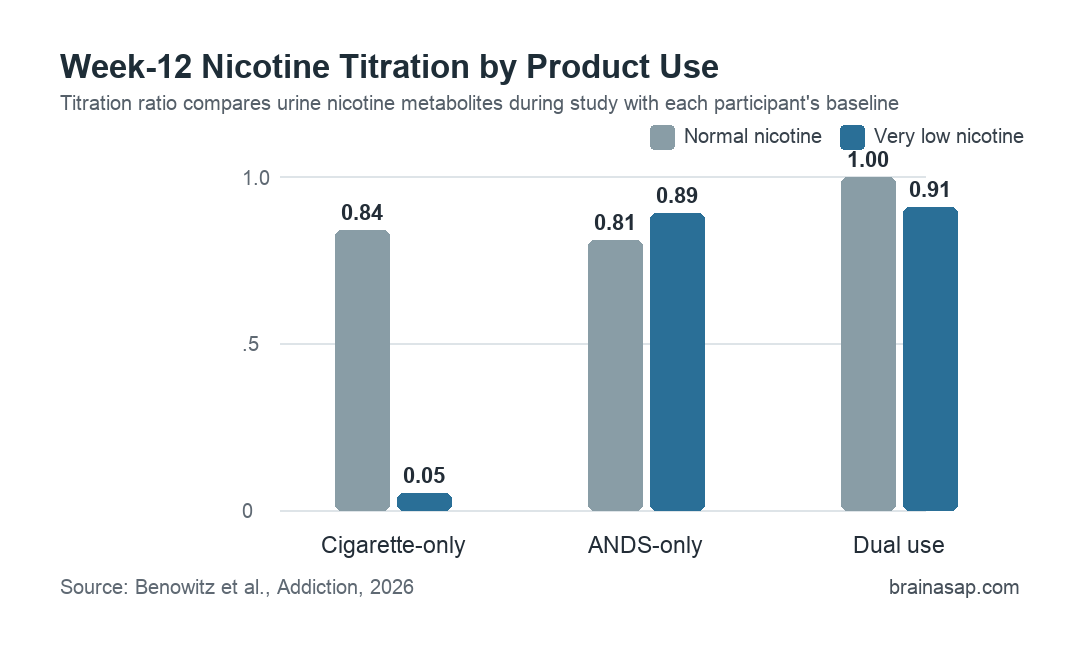
- VLNC cigarette-only: Median titration was 0.05 at week 12.
- VLNC ANDS-only: Median titration was 0.89 at week 12.
- VLNC dual use: Median titration was 0.91 at week 12.
- Normal-nicotine dual use: Median titration was 1.00 at week 12.
E-cigarettes were the most common alternative product among ANDS-only users, followed by nicotine replacement medication. Smokeless tobacco use was very low in the reported product categories.
Most VLNC Participants Used ANDS by Week 12
Product-use patterns also shifted. At week 12, only 25.0% of the VLNC group reported cigarette-only use, compared with 60.3% of the normal-nicotine group.
In the VLNC group, 32.7% reported ANDS-only use and 42.3% reported dual use at week 12. Combining ANDS-only and dual-use groups, any ANDS use was significantly more common in VLNC participants at weeks 4, 8, and 12.
- Week 4: Any ANDS use was higher in VLNC than normal-nicotine participants.
- Week 8: The same product-use difference remained statistically significant.
- Week 12: ANDS use was still higher in the VLNC group, with chi-square test p < 0.001.
This supports a policy-relevant point: if cigarettes contain far less nicotine, many adults who smoke may shift nicotine intake toward non-combusted products when those products are available.
Free Product Access and Self-Report Limit the Nicotine Policy Translation
The study does not show what would happen in a normal retail market. Cigarettes and ANDS were available through an experimental marketplace with no personal financial cost, so price and access barriers were not the same as everyday purchasing.
Several product-use measures were self-reported. The analysis used biochemical checks, including carbon monoxide and urine anatabine, but anatabine analyses were not available at weeks 4 and 8.
- Generalizability: Real-world titration could be lower if alternative nicotine products cost more than participants can afford.
- Secondary analysis: The paper analyzed product-use groups within a previously published randomized trial.
- Missing data: Some participants were excluded from product-use analyses because of missing data, no product use, non-study cigarette use, or failed biochemical verification.
The finding is still useful for nicotine-reduction policy. VLNC cigarettes alone produced very low nicotine replacement, while access to non-combusted nicotine products was associated with much higher nicotine titration and more movement away from cigarette-only use.
Citation: DOI: 10.1111/add.70385. Benowitz et al. Titration of nicotine intake in smokers switching to reduced nicotine content cigarettes with access to alternative nicotine systems: Secondary analysis of a randomized clinical trial. Addiction. 2026;121:1899-1906.
Study Design: Secondary analysis of a multicenter randomized clinical trial, NCT03272685.
Sample Size: 438 adults who smoked 5 to 40 cigarettes per day.
Key Statistic: At week 12, median titration was 0.05 for VLNC cigarette-only users, 0.89 for VLNC ANDS-only users, and 0.91 for VLNC dual users.
Caveat: Product use was partly self-reported and products were available without personal financial cost in an experimental marketplace.