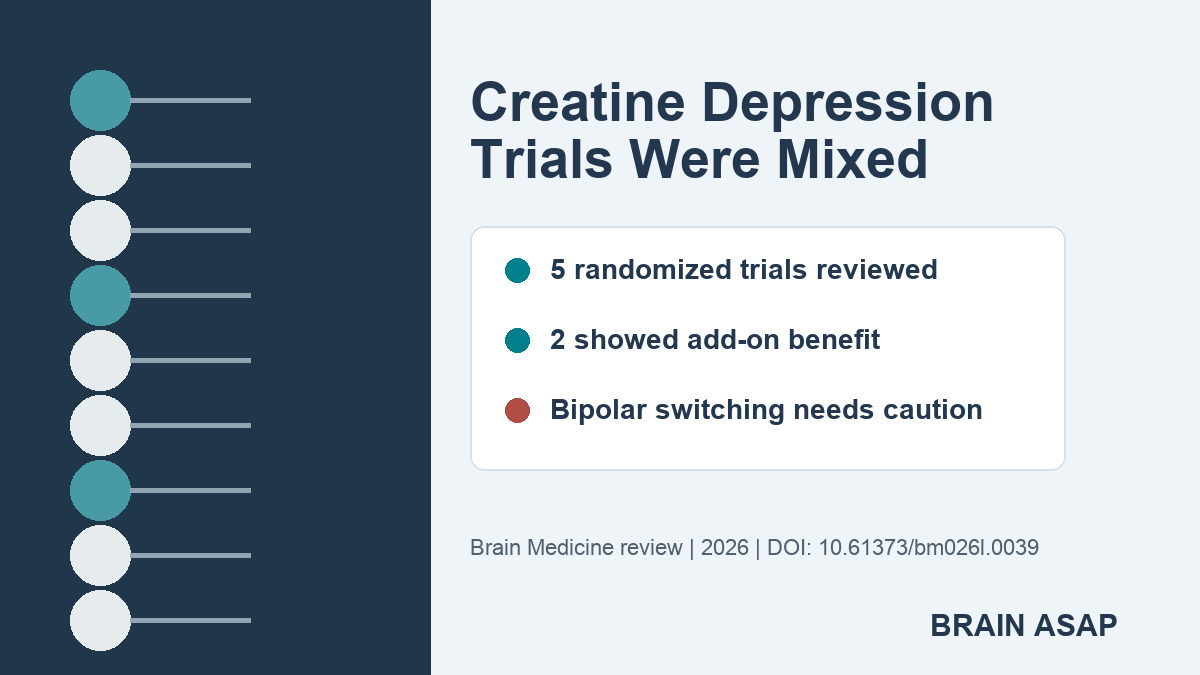
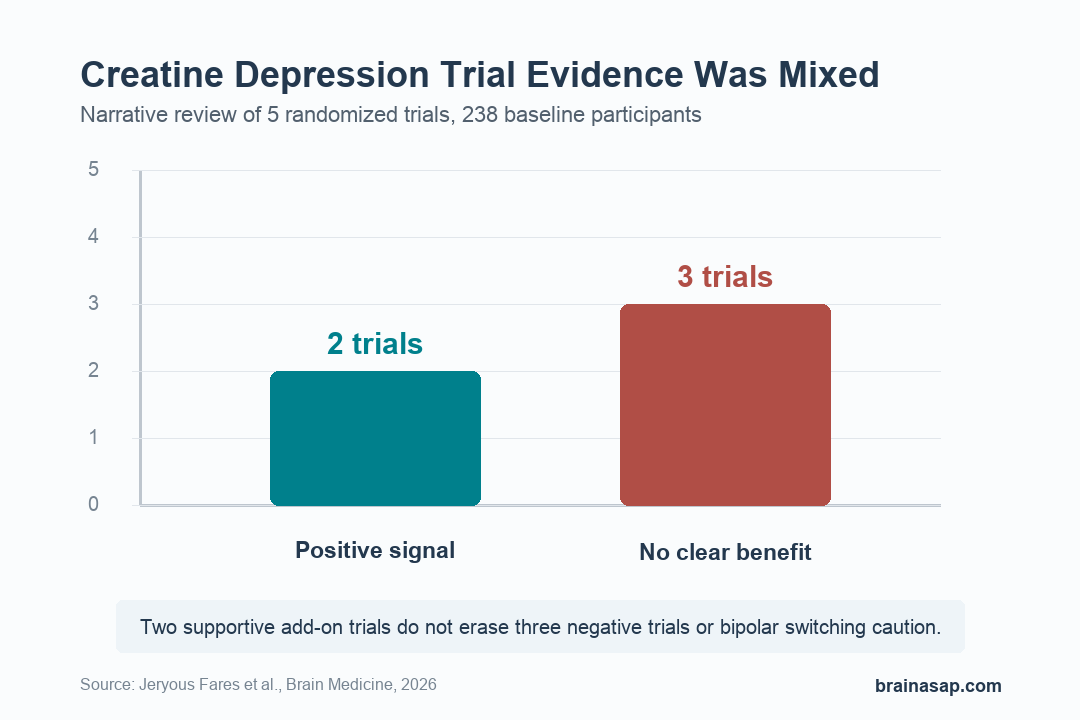
TL;DR: A 2026 review in Brain Medicine found mixed randomized-trial evidence for creatine monohydrate as an add-on depression treatment: 2 of 5 trials showed symptom benefits, while 3 did not find a clear advantage.
Key Findings
- Five randomized trials were reviewed: The review summarized 238 baseline participants across trials of creatine monohydrate for mood disorders.
- Two trials showed benefit: Creatine added to escitalopram or cognitive behavioral therapy was linked to larger depression-symptom reductions in 2 studies.
- Three trials were negative: Other studies found no significant treatment or dose effect, including an adolescent MDD trial and a bipolar depression trial.
- Evidence was too mixed for meta-analysis: Researchers summarized the trials narratively because the studies differed in design, diagnosis, dose, and comparison.
- Bipolar safety needs caution: In the bipolar depression trial, 2 participants receiving creatine developed hypomania or mania.
Creatine monohydrate is being studied for depression because brain energy metabolism may be altered in some mood disorders. The supplement helps buffer cellular energy demand by supporting rapid replenishment of adenosine triphosphate, or ATP, the molecule cells use for energy transfer.
The 2026 review does not show that creatine is a proven depression treatment. It gives a narrower answer: randomized trials have produced a few encouraging signals, but the evidence is small, inconsistent, and concentrated in mood disorders rather than psychiatric conditions more broadly.
Five Randomized Trials Tested Creatine in Mood Disorders
Researchers reviewed 6 study reports from 5 randomized controlled trials. Together, the trials included 238 baseline participants: 126 assigned to creatine monohydrate and 112 assigned to placebo or comparison treatment.
The average participant age was 36 years, and only 26% of participants were male. Two trials enrolled women only, which matters because sex representation was one of the review’s main generalizability limits.
The diagnoses were also narrow:
- Major depressive disorder: Four trials tested creatine in people with MDD.
- Bipolar depression: One trial tested creatine in people with bipolar I or II disorder during a depressive episode.
- Other mental disorders: The review found no randomized trials for creatine in psychiatric diagnoses outside mood disorders.
Because the trials differed in diagnosis, dosing, treatment context, and outcome measures, researchers did not pool the results into a meta-analysis. They summarized the findings trial by trial.
Two Depression Trials Reported Larger Symptom Drops
The strongest positive signal came from an 8-week trial in women with major depressive disorder. Participants received 5 g/day of creatine monohydrate or placebo as an add-on to escitalopram.
Depression severity improved more in the creatine group. On the Hamilton Depression Rating Scale, the review reports week-8 scores of 5.4 in the creatine group versus 9.8 in the placebo group, with a Cohen’s d of 1.13.
A separate trial also supported an add-on effect. Participants receiving creatine plus cognitive behavioral therapy had lower Patient Health Questionnaire-9 scores than those receiving placebo plus cognitive behavioral therapy: 5.8 versus 11.9.
Those results matter clinically because they point to creatine as a possible augmentation strategy rather than a standalone antidepressant. In both positive studies, creatine was paired with another depression treatment.
Three Trials Did Not Show a Clear Benefit
The remaining trials made the overall evidence mixed. One study found no significant treatment or dose effect after 4 weeks in participants who had not responded adequately to pharmacotherapy.
Another trial tested 2 g/day, 4 g/day, and 10 g/day creatine doses in adolescent females with major depressive disorder. After 8 weeks, depression scores did not differ significantly across creatine dose groups or placebo.
The bipolar depression trial was also negative. Participants received 6 g/day creatine as an add-on to pharmacotherapy, but the study found no significant treatment effect across depression scales after 6 weeks.
The bipolar trial also raised a safety point. Two participants taking creatine developed hypomania or mania, so future bipolar-disorder studies need to monitor affective switching directly.
Creatine Was Usually Tolerated, but Evidence Stayed Small
Across the reviewed trials, creatine monohydrate was generally tolerated. Reported side effects were mostly mild gastrointestinal symptoms, rather than a broad safety signal.
The evidence limits are still substantial:
- Small total sample: The full randomized-trial evidence base contained 238 baseline participants.
- Short treatment windows: Trials generally lasted 4 to 8 weeks.
- Uneven bias ratings: Two trials were rated low risk of bias, while 3 raised some concerns.
- Limited male representation: Two studies enrolled only women, and men made up about one quarter of the pooled baseline sample.
Those limits explain why the review’s conclusion stays cautious. Creatine may be worth testing as an add-on strategy for major depressive disorder, but larger double-blind trials are needed before clinicians can know which patients, doses, and treatment combinations matter.
The Brain-Energy Rationale Remains Plausible
The biological rationale is not random. Creatine helps cells maintain energy availability, and depression research has repeatedly examined mitochondrial function, brain metabolism, dopamine chemistry, and serotonin pathways.
Measurement detail: The review also separates symptom improvement from proof of mechanism. A supplement can fit a plausible energy-metabolism model and still fail to improve clinical outcomes in enough randomized trials.
That mechanism does not prove treatment benefit. The review notes that altered brain creatine metabolism in mood disorders is still correlational and inconsistent across studies.
A practical interpretation is narrower: creatine is inexpensive, familiar, and usually tolerated, but the depression evidence is not yet strong enough to treat it as a reliable adjunct. The next useful tests would be larger randomized trials, longer follow-up, better sex balance, and clear monitoring for bipolar switching.
Citation: DOI: 10.61373/bm026l.0039. Jeryous Fares et al. Creatine as a treatment for depression. Brain Medicine. 2026;AOP:1-2.
Study Design: Narrative review of randomized controlled trials of creatine monohydrate for mental disorders.
Sample Size: Five randomized trials with 238 baseline participants.
Key Statistic: Two trials supported creatine augmentation for depression, while 3 trials did not show a clear treatment or dose effect.
Caveat: The evidence was small, heterogeneous, short-term, and mostly limited to mood disorders.