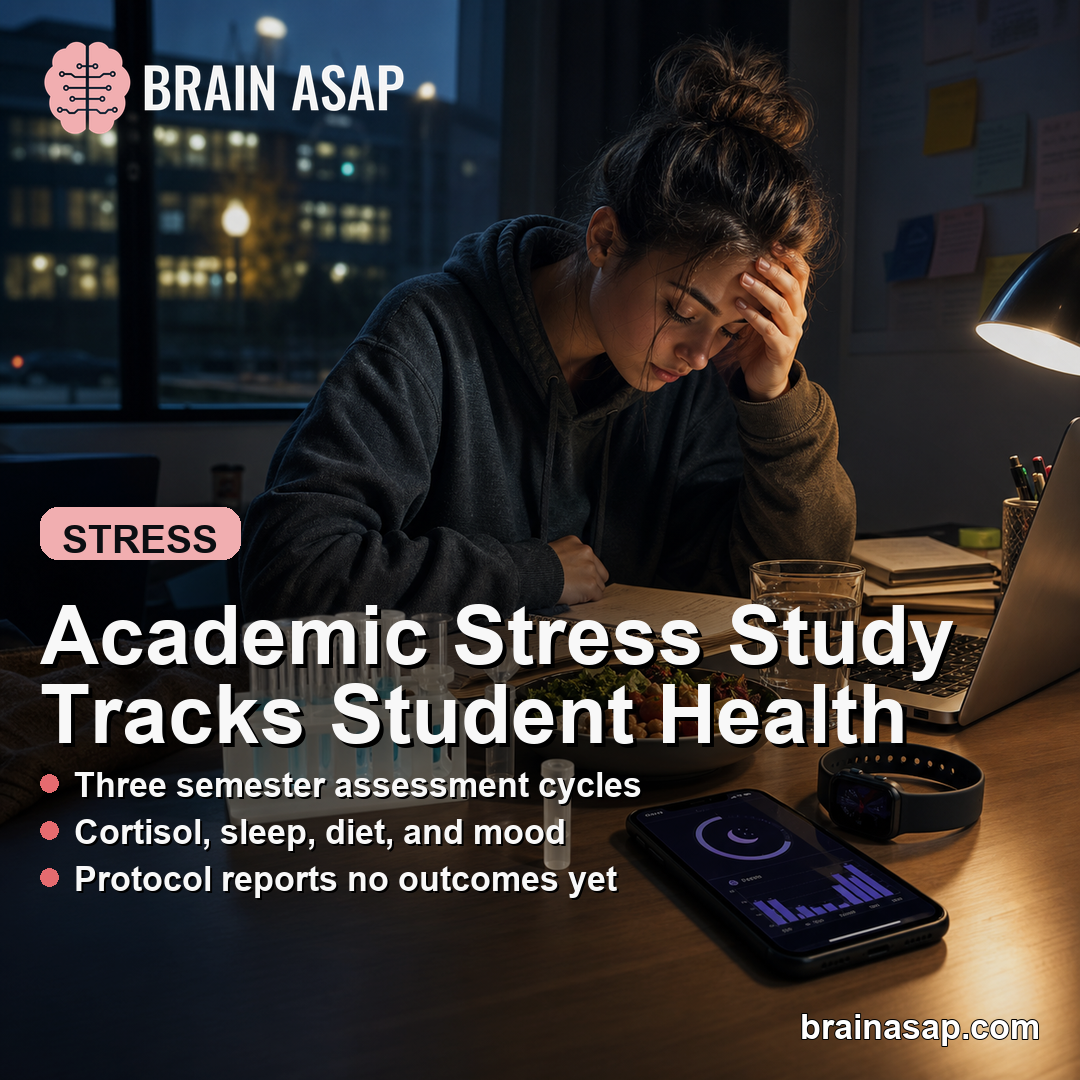
TL;DR: A 2026 study protocol in PLOS One describes a planned longitudinal study that will track academic stress, depressive symptoms, diet, sleep-related wearable measures, salivary cortisol, and other health indicators across a university semester, but it does not yet report outcome results.
Key Findings
- Study protocol only: The source describes the planned design and hypotheses; no participant outcome data were generated or analyzed yet.
- Three semester assessments: Researchers plan three repeated measurement cycles across an academic semester.
- University student sample: The planned convenience sample will recruit undergraduate students in years 2 to 4 from the Faculty of Medicine at the University of Concepción in Chile.
- Stress biology included: Saliva collection will measure cortisol dynamics and salivary alpha-amylase, markers tied to hypothalamic-pituitary-adrenal and sympathetic stress pathways.
- Mental health outcome included: The protocol will examine academic stress alongside depressive symptoms, eating-related patterns, nutrition, sleep-related metrics, and somatic indicators.
Academic stress is more than exam pressure. In health research, it can be treated as a chronic, multidimensional stress exposure that may interact with sleep, eating patterns, depressive symptoms, and physiological stress systems.
The protocol lays out a longitudinal study rather than a completed result. Its value is in the measurement plan: repeated assessments during a real academic semester, using questionnaires, diet interviews, wearable data, saliva, and blood markers.
Academic Stress Will Be Measured Across Three Semester Cycles
The planned study is observational and nonexperimental. Researchers will follow undergraduate medical-faculty students during three assessment cycles in one academic semester.
The target group is students in 2nd to 4th year at the Faculty of Medicine, University of Concepción in Chile. Students already receiving psychological or pharmacological treatment can participate, which may make the sample closer to real university health settings.
The protocol’s main hypotheses are directional:
- Behavioral pathway: Higher academic stress will be associated with less favorable eating-related patterns, nutritional indicators, somatic indicators, and depressive symptoms.
- Cortisol pathway: Higher academic stress will be associated with altered post-awakening cortisol dynamics, including a lower cortisol awakening response and altered area-under-the-curve measures.
- Sympathetic pathway: Higher academic stress will be associated with higher salivary alpha-amylase, a noninvasive marker often used for sympathetic arousal.
Those are hypotheses, not findings. The source states that no datasets were generated or analyzed for the protocol publication.
Questionnaires, Diet Recalls, Wearables, Saliva, and Blood Are Planned
The measurement design is broad because the research question is broad. Academic stress may show up in mood, eating behavior, sleep, heart-rate patterns, and stress biology rather than in one isolated endpoint.
Planned data collection includes:
- Electronic surveys: REDCap questionnaires will assess academic stress, perceived stress, eating-related patterns, and depressive symptoms.
- Nutritional interviews: Repeated 24-hour dietary recalls will be treated as time-specific observations and modeled longitudinally.
- Diet quality indices: The protocol includes diet-quality and dietary inflammatory-potential measures.
- Wearable measures: Devices will record heart rate, oxygen saturation, and sleep-related metrics during monitoring periods.
- Biological samples: Saliva will be collected twice per week during each assessment cycle, and blood samples will be collected at baseline and semester end.
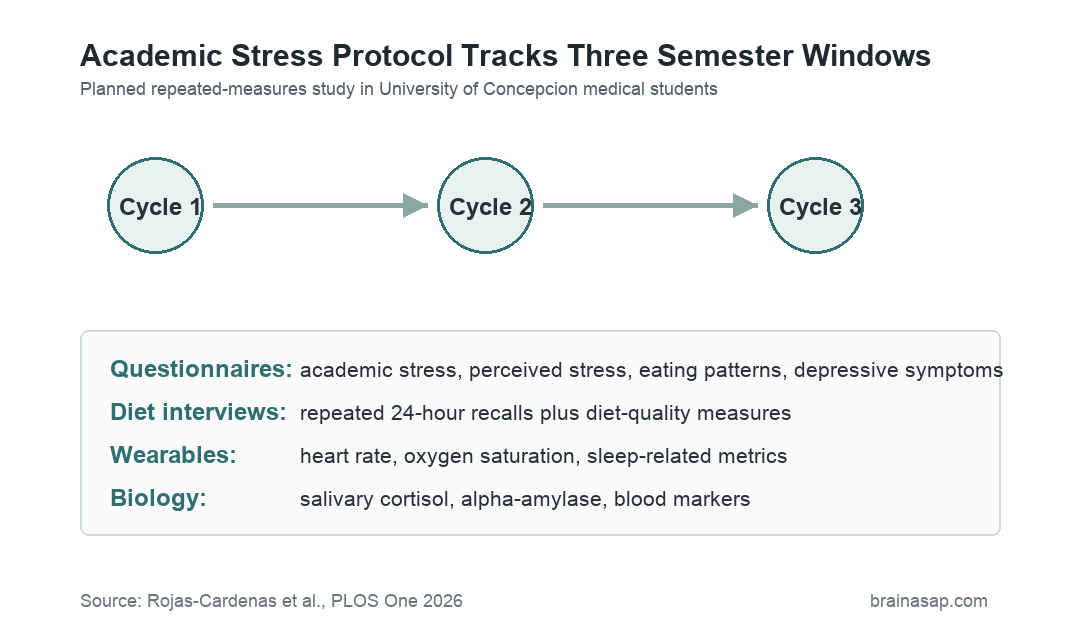
The blood panel will include lipid profile, fasting glucose, albumin, globulin, and total proteins. Those markers do not diagnose academic stress, but they help place psychological and behavioral data in a broader physical-health context.
Cortisol and Alpha-Amylase Anchor the Stress-Biology Piece
The protocol gives special attention to two biological stress systems. The hypothalamic-pituitary-adrenal (HPA) axis helps coordinate cortisol release after stress, while the autonomic nervous system contributes to sympathetic arousal.
Salivary cortisol is planned as a noninvasive readout of HPA-related activity. The study will look at post-awakening cortisol dynamics, including the cortisol awakening response and area-under-the-curve metrics.
Salivary alpha-amylase is included as a marker related to sympathetic activation. Combining cortisol and alpha-amylase may help separate different stress-response patterns rather than treating academic stress as a single questionnaire score.
The planned physiology is best read as a mapping strategy:
- Morning cortisol pattern: May capture how the HPA axis responds after waking.
- Alpha-amylase activity: May reflect sympathetic arousal during stressful periods.
- Wearable sleep metrics: May show whether stress-related physiology aligns with sleep disruption.
- Depressive symptoms: May reveal whether mood changes track with stress, diet, and biological markers over time.
Depressive Symptoms and Eating Patterns Are Central Outcomes
The protocol links academic stress to mental health and nutrition because university stress can change both mood and behavior. The planned outcomes include depressive symptoms, perceived stress, eating-related patterns, nutritional status, and sleep-related metrics.
Student health may not move through one pathway. A student under sustained pressure may sleep worse, eat differently, show altered stress-hormone timing, and report more depressive symptoms during the same semester.
The planned analysis reflects that complexity. Mixed-effects models will test longitudinal associations, while random-intercept cross-lagged panel models will explore temporal relationships across the three measurement cycles.
The design remains associational. It can test whether within-semester changes align, but it cannot prove that academic stress causes a specific biological or depressive-symptom change.
The Protocol Is a Map, Not a Result
The main boundary is straightforward: this source does not tell us whether academic stress actually changed cortisol, diet, sleep, or depressive symptoms in the student sample. It describes how researchers plan to measure those links.
That still has value. Strong protocols can prevent vague student-stress research by specifying the timing, measures, hypotheses, and analysis plan before results are known.
Several limits should carry forward when the study reports outcomes. The sample is feasibility-based rather than population-representative, all inference will be observational, and the planned participants come from one university faculty.
The useful question for the eventual study is whether repeated stress, sleep, nutrition, mood, and saliva measures reveal a coherent pattern. Until those results are published, the protocol should be treated as a planned framework for student mental-health research, not as evidence that any intervention works.
Citation: DOI: 10.1371/journal.pone.0352779. Rojas-Cárdenas et al. Longitudinal associations of academic stress with eating related patterns, nutrition, somatic indicators, and depressive symptoms in university students: A study protocol. PLOS One. 2026;21:e0352779.
Study Design: Study protocol for a longitudinal, observational, repeated-measures study across one academic semester.
Sample/Model: Planned convenience sample of 2nd- to 4th-year undergraduate students from the Faculty of Medicine, University of Concepción, Chile.
Key Statistic: Three assessment cycles are planned, with saliva collected twice per week during each cycle and blood collected at baseline and semester end.
Caveat: No outcome data were generated or analyzed for this protocol publication, so it cannot support claims about actual stress, depression, diet, sleep, or biomarker effects.