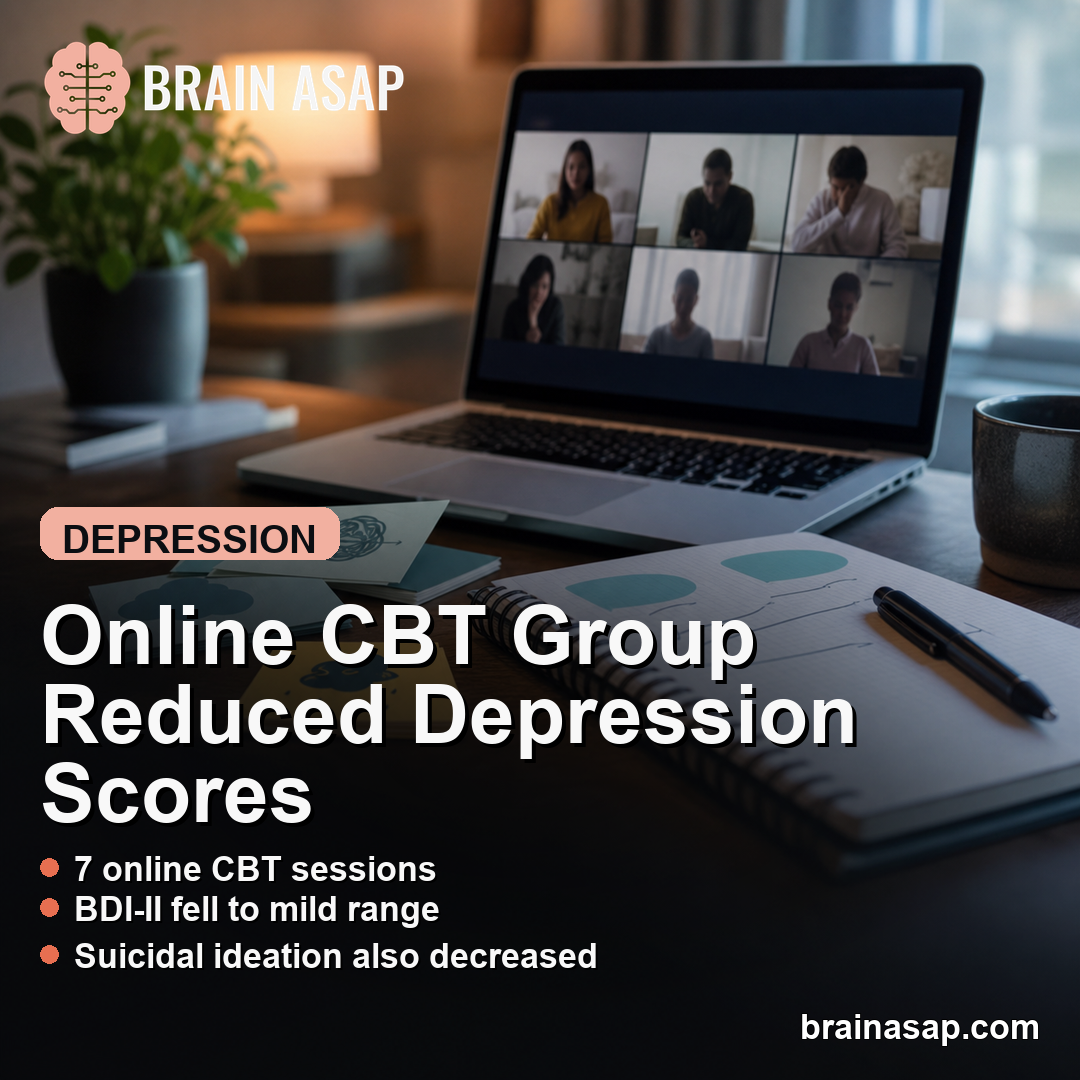
TL;DR: A 2026 randomized trial in JMIR mHealth and uHealth found that a 7-session CBT-based online self-help group reduced depression symptoms, with the average Beck Depression Inventory-II score moving from the moderate range to the mild range after the program.
Key Findings
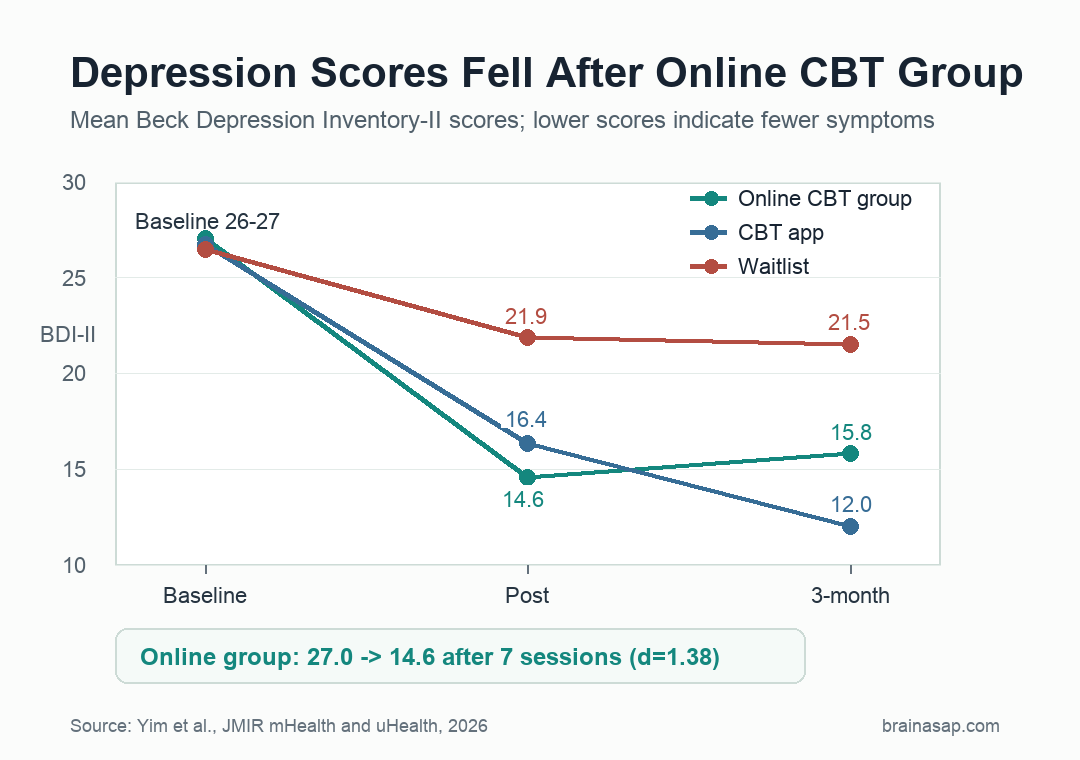
- Depression scores decreased: The CBT-based online self-help group fell from a mean BDI-II score of 27.03 at baseline to 14.57 after the intervention.
- The effect was large inside the group: The within-group depression effect size was Cohen d=1.38 after the program.
- Three-month scores stayed improved: Depression scores in the online group did not significantly worsen between postintervention and 3-month follow-up.
- Suicidal ideation also fell: Beck Scale for Suicide Ideation scores decreased in the online group from baseline to postintervention.
- The comparison was not simple: A CBT mobile app produced similar depression improvement, while the waitlist group was recruited separately rather than fully randomized with the 2 active arms.
Researchers compared a seven-session CBT-based online self-help group (COS), which included live peer discussion, with a self-guided CBT mobile app in a Korean sample of people with depressive symptoms.
COS combined CBT exercises with videoconference group sessions built around shared discussion.
A 7-Session Online CBT Group Was Compared With a CBT App
The randomized part of the study assigned participants to either the COS online group or a CBT-based mobile app. The online group included 79 participants at baseline, while the app group included 39 participants.
A third waitlist control group included 48 participants, but it was recruited separately during a later phase. It provides context for natural symptom change, not the same strength of evidence as the randomized COS-versus-app comparison.
The COS program was brief and structured:
- 7 sessions: Participants met twice weekly by videoconference.
- Small groups: Each group typically had 4 to 6 participants plus a facilitator.
- CBT content: Sessions covered cognitive distortions such as catastrophizing, mind reading, overgeneralization, should statements, tunnel vision, and black-and-white thinking.
- Peer discussion: Participants read scenarios, suggested alternative thoughts, and shared related experiences when appropriate.
The mobile app used similar CBT content, including short stories and exercises about cognitive distortions. App participants were asked to use it for about 270 to 360 minutes, which was meant to approximate the time spent in the group sessions.
BDI-II Depression Scores Moved From Moderate to Mild
The primary outcome was the Beck Depression Inventory-II (BDI-II), a self-report depression scale. At baseline, the COS group averaged 27.03, which the source described as the moderate range.
After the intervention, the COS mean fell to 14.57, in the mild range. The model-estimated baseline-to-postintervention difference was 11.84 points, and the corrected P value was below .001.
The app group also improved. Its mean BDI-II score fell from 26.72 at baseline to 16.35 after the program, with a within-group effect size of d=0.93.
The active comparison narrows the interpretation. The online group was effective inside the trial, but it did not clearly beat the CBT app on depression symptoms.
At postintervention, the COS-versus-app difference was not statistically significant.
Three-Month Depression Scores Stayed Improved
The COS group’s depression scores remained improved at the 3-month follow-up. The postintervention-to-follow-up change was not statistically significant, meaning the group did not show clear symptom rebound over that period.
The trial also used a reliable change index, which asks whether an individual participant’s change is large enough to exceed measurement noise. In the COS group, 75% of participants with the needed pre-post data showed reliable improvement.
For comparison, reliable improvement appeared in:
- 56 of 75 COS participants: 75% showed reliable pre-to-post improvement.
- 21 of 37 app participants: 57% showed reliable improvement.
- 16 of 46 waitlist participants: 35% showed reliable improvement.
Reliable improvement was numerically more common in COS than in the app group, but the between-group difference was marginal rather than clearly significant. On this outcome, superiority over the structured CBT app was not established.
Suicidal Ideation Decreased Only in the Online Group
The secondary outcome was the Beck Scale for Suicide Ideation (BSS), another self-report measure. In the COS group, scores fell from 9.78 at baseline to 6.01 after the program.
The model-estimated within-group decrease was 3.13 points, with a corrected P value below .001. The app and waitlist groups did not show a significant baseline-to-postintervention decrease on this measure.
The suicidal-ideation result is distinctive, but it should be read carefully. The overall time-by-group interaction was a trend rather than a conventionally significant result.
The strongest statement is narrower: within the COS group, suicidal-ideation scores decreased after the intervention.
The researchers suggested that group contact may have mattered because the online sessions included validation, normalization, and shared experience. That is plausible, but the trial did not isolate those ingredients from the rest of the program.
The Trial Supports Access, Not Replacement of Care
This study fits a practical treatment-access problem. Depression care is limited by cost, geography, clinician availability, stigma, and scheduling.
A brief, manualized online group could be easier to distribute than standard individual therapy.
Still, the design does not support treating online self-help as a replacement for clinical care. The sessions were facilitated by people with psychological training.
Facilitators were instructed to monitor safety and escalate active suicidal thoughts. No active suicidal ideation events were reported during the study.
The main limitations are straightforward:
- Self-report outcomes: Depression and suicidal ideation were measured by participant questionnaires.
- Separate waitlist recruitment: The waitlist comparison was not randomized in the same way as the 2 active groups.
- Limited generalizability: The sample was mostly female and averaged in the late twenties.
- Short follow-up: The study followed outcomes for 3 months, not a year or longer.
- Facilitator support: The program was designed for peer-led delivery, but trained facilitators were present in this trial.
The practical takeaway is that structured online group self-help can reduce depression symptoms in a controlled study, with a possible signal for suicidal ideation.
The next question is whether that signal holds in larger, more diverse samples and in fully peer-led or stepped-care implementations.
Citation: DOI: 10.2196/76028. Yim et al. Efficacy of a Cognitive Behavioral Therapy-Based Online Self-Help Group for Depression and Suicide Ideation: Randomized Controlled Trial. JMIR mHealth and uHealth. 2026;14:e76028.
Study Design: Randomized controlled trial comparing a CBT-based online self-help group with a CBT mobile app, with a separately recruited waitlist control group.
Sample Size: 79 participants in the online self-help group, 39 in the app group, and 48 in the waitlist comparison group.
Key Statistic: The online group’s mean BDI-II depression score fell from 27.03 at baseline to 14.57 after the intervention, with a within-group effect size of d=1.38.
Caveat: Outcomes were self-reported, the waitlist group was recruited separately, and the follow-up lasted 3 months.