TL;DR: A 2026 randomized trial in Journal of the International Society of Sports Nutrition found that 12 weeks of combined interval resistance and aerobic training increased Maresin-1, an inflammation-resolving lipid mediator, in men with obesity, with the largest insulin-resistance improvement when training was paired with 200 mg/day fisetin.
Key Findings
- 44 men completed the trial: Researchers randomized obese, inactive adult men into control-placebo, fisetin-only, training-placebo, or training-fisetin groups, with 11 participants analyzed in each arm.
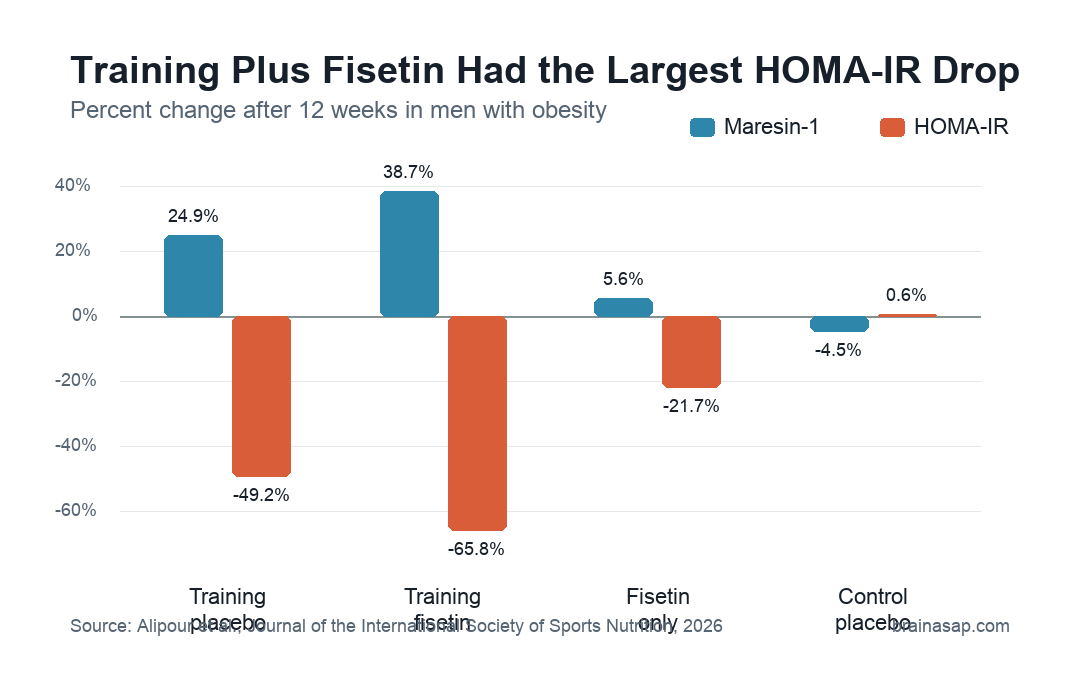
- Maresin-1 rose with training: Plasma Maresin-1 increased by 24.93% with training-placebo and 38.67% with training-fisetin, but not with fisetin alone.
- Inflammation markers fell: Interleukin-6 decreased by 68.21% in the training-fisetin group and tumor necrosis factor-alpha decreased in all active intervention groups.
- HOMA-IR improved most with the combination: The insulin-resistance index fell by 65.78% with training-fisetin, compared with 49.18% with training-placebo and 21.70% with fisetin alone.
- Generalizability is narrow: The sample was small, male-only, sedentary, and drawn from a single region, with no long-term follow-up after the 12-week intervention.
Fisetin plus combined training was tested to determine whether a flavonoid supplement added to the anti-inflammatory effects of structured exercise in men with obesity.
The central marker was Maresin-1, also called MaR1. It is part of a family of lipid mediators involved in resolving inflammation rather than simply suppressing it.
Source: Journal of the International Society of Sports Nutrition (2026) | Alipour et al.
Four Trial Arms Separated Fisetin From Training Effects
The randomized trial began with 60 enrolled men and analyzed 44 completers. Each group ended with 11 participants, which makes the comparison balanced but still small.
Researchers used 4 arms so they could separate supplement effects from exercise effects:
- Control-placebo: No fisetin and no training intervention.
- Fisetin-only: 200 mg/day fisetin without the structured exercise program.
- Training-placebo: Combined interval resistance and aerobic training with placebo capsules.
- Training-fisetin: The same training plan plus 200 mg/day fisetin.
The exercise program lasted 12 weeks and used 3 sessions per week. Each session combined resistance work with treadmill aerobic exercise, so the intervention targeted muscle loading, cardiorespiratory work, and metabolic stress in the same visit.
The resistance phase used 8 exercises, including back squat, bench press, leg curl, biceps curl, leg press, shoulder press, leg extension, and lat pulldown. Work sets used 60% of 1-repetition maximum, followed by lighter active-recovery repetitions at 20%.
The aerobic phase progressed from 15 minutes at 50% of estimated maximum heart rate to 25 minutes at 70% by the final 4 weeks. Coaches supervised the training, and the supplement side was blinded.
Maresin-1 Increased Only in the Training Groups
The headline Maresin-1 result was not a simple fisetin-only effect. Training-placebo increased Maresin-1 from 709.02 to 944.54 pg/mL, a 24.93% rise.
The training-fisetin group increased from 756.67 to 1233.87 pg/mL, a 38.67% rise. Fisetin alone moved from 837.62 to 887.12 pg/mL, which was not statistically significant.
Maresin-1 was supposed to reflect inflammation resolution. In this trial, the mechanical and metabolic stimulus of training appeared necessary for a clear Maresin-1 shift.
Post-intervention Maresin-1 was significantly higher in the training-fisetin group than in the control-placebo group. The group-by-time interaction for Maresin-1 was also significant, supporting a real difference in change over the 12 weeks.
Training-Fisetin Produced the Largest HOMA-IR Reduction
The metabolic outcomes moved in the same direction. HOMA-IR, an index of insulin resistance calculated from fasting glucose and insulin, decreased most in the training-fisetin group.
HOMA-IR changed as follows:
- Training-fisetin: 5.67 to 3.42, a 65.78% decrease.
- Training-placebo: 5.46 to 3.66, a 49.18% decrease.
- Fisetin-only: 5.44 to 4.47, a 21.70% decrease.
- Control-placebo: 5.30 to 5.33, essentially unchanged.
Fasting blood glucose also fell most in the combination group, from 112.53 to 82.51 mg/dL. Fasting insulin decreased from 20.43 to 16.81 mU/L in the same arm.
The training-only arm also improved substantially, so the result should not be read as fisetin replacing exercise. The cleaner interpretation is that exercise carried the core effect, while fisetin may have amplified some metabolic and inflammatory changes.
IL-6 and TNF-Alpha Moved Toward a Lower-Inflammation Profile
The trial also measured interleukin-6 (IL-6) and tumor necrosis factor-alpha (TNF-alpha), 2 inflammatory cytokines often discussed in obesity-related metabolic dysfunction.
IL-6 showed the clearest spread across groups:
- Training-fisetin: IL-6 decreased by 68.21%.
- Training-placebo: IL-6 decreased by 37.32%.
- Fisetin-only: IL-6 decreased by 29.55%.
- Control-placebo: IL-6 increased by 8.79%, which was not significant.
TNF-alpha decreased in all 3 active intervention arms. The largest reported percentage decrease was in the training-placebo group, followed by training-fisetin and fisetin-only.
Maresin-1 was negatively correlated with several metabolic and inflammatory measures. The strongest Maresin-1 correlations were with HOMA-IR (r = -0.599), insulin (r = -0.597), and fasting blood glucose (r = -0.548).
The Small Male Sample Limits the Clinical Claim
The study is useful because it connects a structured exercise program, a defined supplement dose, and measured blood markers in a randomized design. It is not enough to show that fisetin should be used broadly for obesity or insulin resistance.
The main limits are concrete:
- Small per-group sample: Each analyzed arm had only 11 participants.
- Male-only cohort: The findings may not apply to women or mixed-sex obesity populations.
- Single-region recruitment: Participants came from a narrow geographic and clinical context.
- No durability test: Markers were measured after 12 weeks, without longer follow-up.
- Mechanism inferred from blood markers: The trial did not directly measure tissue-level macrophage polarization, NF-kB signaling, or lipid-mediator enzyme activity.
For now, the strongest practical reading is modest. In sedentary men with obesity, a supervised program combining resistance intervals and aerobic work improved inflammation and insulin-resistance markers over 12 weeks.
Adding fisetin was associated with the largest Maresin-1 and HOMA-IR shifts, but larger trials are needed before that combination can be treated as a general recommendation.
Citation: DOI: 10.1080/15502783.2026.2679718. Alipour et al. 12-weeks fisetin supplementation and interval resistance with aerobic training: changes in Maresin-1 and inflammatory markers in men with obesity: a randomized controlled trial. Journal of the International Society of Sports Nutrition. 2026;23:2679718.
Study Design: 12-week parallel-group randomized controlled trial with 4 arms: control-placebo, fisetin-only, training-placebo, and training-fisetin.
Sample Size: 44 obese adult men completed the trial, with 11 participants analyzed in each group.
Key Statistic: HOMA-IR decreased by 65.78% in the training-fisetin group, while Maresin-1 increased by 38.67%.
Caveat: The sample was small, male-only, sedentary, and measured only through the immediate 12-week endpoint.