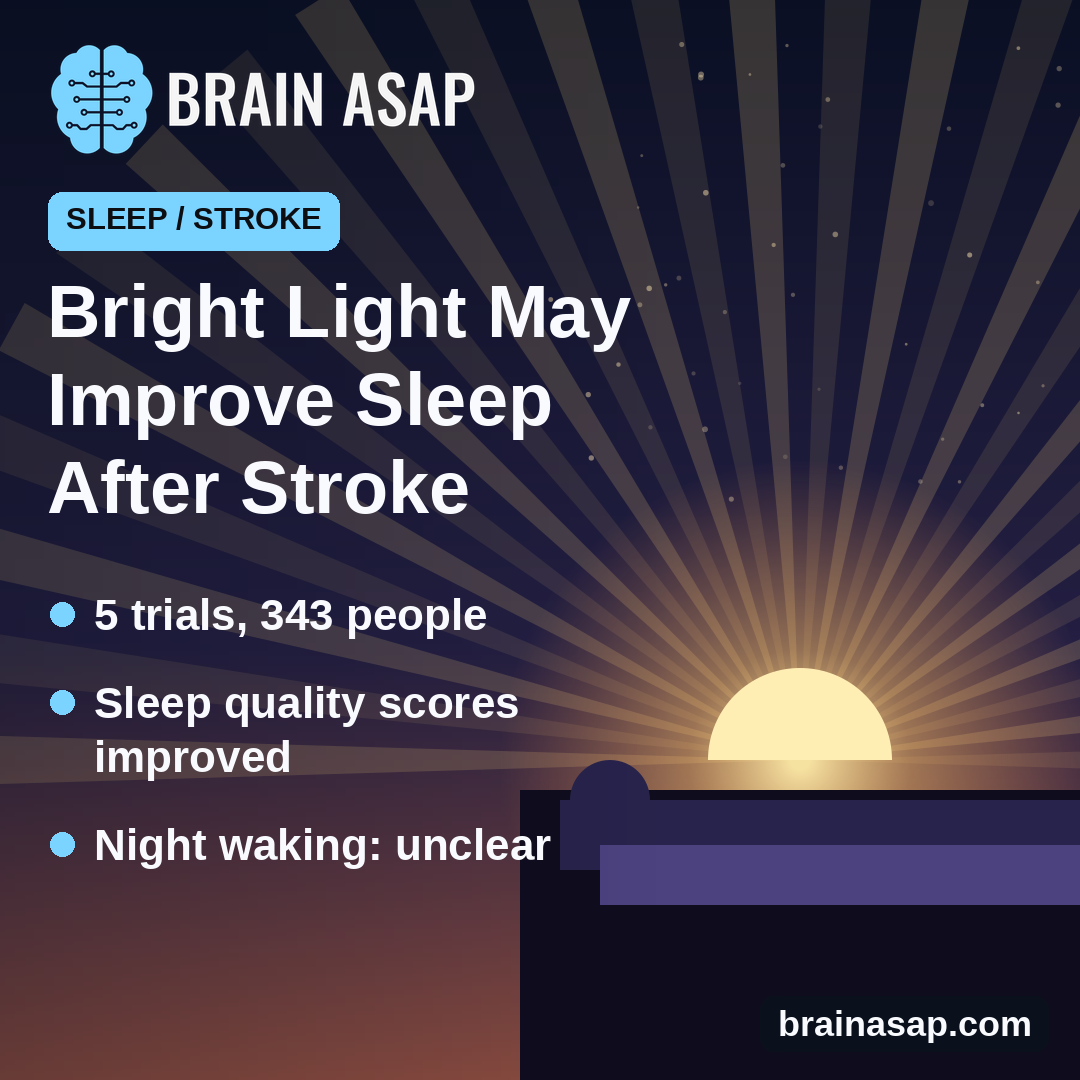
TL;DR: Across 5 small trials of 343 people after stroke, people who sat in bright morning light reported better sleep quality than comparison groups. But measured time awake at night showed no clear change, so the benefit may be more about how sleep feels.
Key Findings
- 5 trials, 343 people: All gave light in the morning; strength ranged from 400 to 10,000 lux.
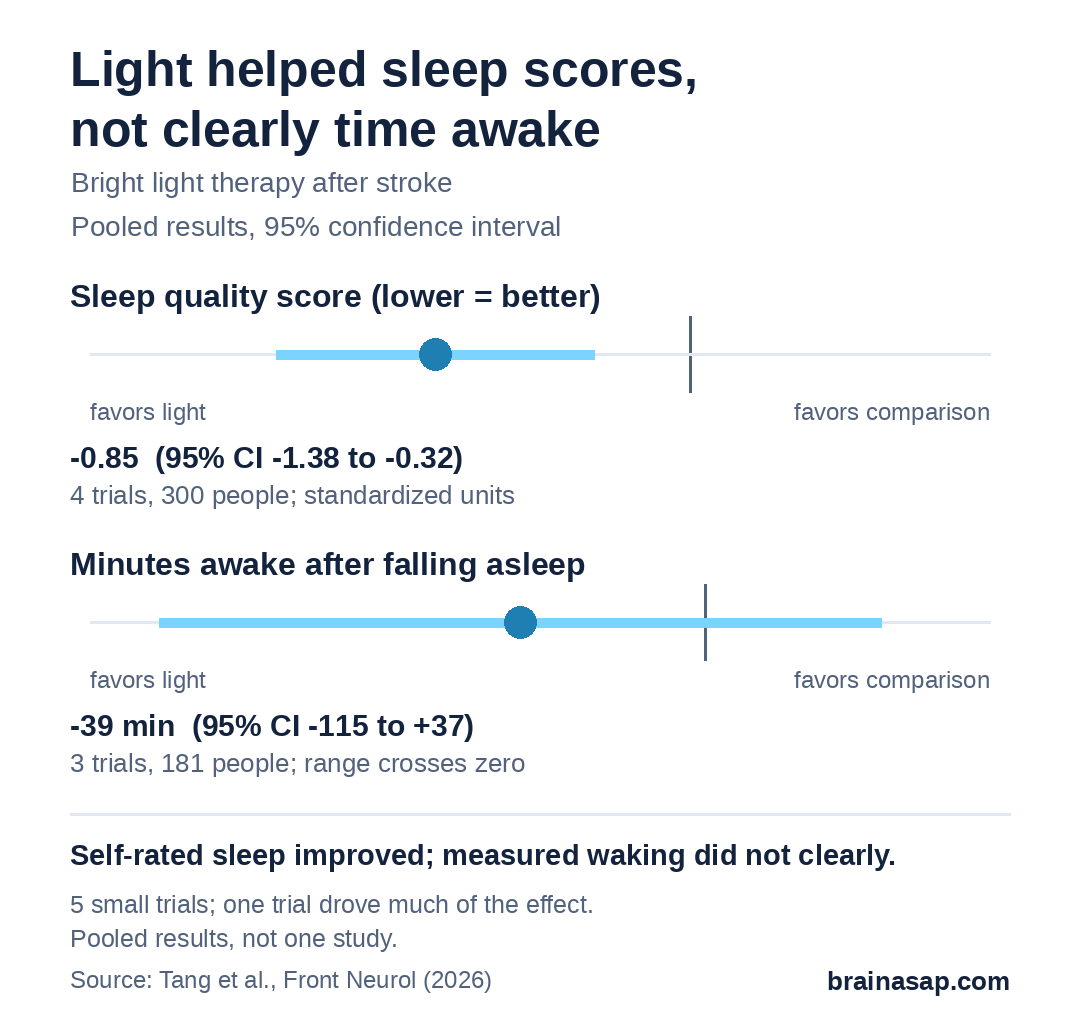
- Sleep quality scores favored light: Pooled effect of −0.85 (95% CI −1.38 to −0.32) across 4 trials of 300 people.
- Time awake at night unclear: About 39 minutes less, but the range (−115 to +37 minutes) includes no change.
- One trial drove much of it: Dropping it cut the sleep-quality effect to −0.55 and the night-waking estimate to about 4 minutes.
- Small evidence base: 2 of 5 trials had high risk of bias.
Source: Frontiers in Neurology (2026) | Tang et al.
Sleep often falls apart after a stroke. Nearly half of survivors report insomnia, and poor sleep has been linked to slower recovery. Sleeping pills are not an easy fix in people already managing a fragile brain.
Bright light is a drug-free idea: a dose of light early in the day can reset the body clock. Does it work for stroke survivors? A team in Hangzhou, China, pooled the randomized trials to find out.
Five Small Trials Gave People Morning Light
The researchers searched ten English and Chinese databases through April 2026 and found 5 randomized trials, published 2021 to 2025, with 343 adults after stroke. Average ages ran from about 63 to 74. Four trials ran in hospital or rehab settings, and one was home-based.
Every trial gave light in the morning or soon after waking, but the plans differed a lot:
- Strength: From 400 lux (a dim indoor level) up to 10,000 lux, the usual level for light boxes
- Session length: 25 to 60 minutes
- Length of treatment: 5 days to 6 weeks
- Comparison: Dim red or filtered placebo light, standard lighting, routine care, or a medicine (escitalopram) alone
One trial added light on top of escitalopram, and one was a master’s thesis rather than a journal article. Three trials had a low risk of bias and two a high risk.
Sleep Quality Scores Improved
Four trials (300 people) asked participants to rate their own sleep with questionnaires, where lower scores mean better sleep. Light came out ahead: a pooled standardized effect of −0.85 (95% CI −1.38 to −0.32). Three of those trials used the same well-known questionnaire, the Pittsburgh Sleep Quality Index, and found light lowered scores by about 1 point (95% CI −1.25 to −0.76).
The trials disagreed on how big the effect was (heterogeneity was high, at 78%). One trial, a master’s thesis, reported a much larger effect than the rest. Without it, the effect shrank to −0.55 (95% CI −0.83 to −0.28), but was still in favor of light and the trials agreed with each other.
Nighttime Waking Showed No Clear Change
The measured picture is weaker. Three trials (181 people) tracked wake time after falling asleep with wrist or bedside sleep monitors. Light users woke about 39 minutes less on average, but the 95% CI ran from 115 minutes less to 37 minutes more. The trials disagreed wildly (heterogeneity 96%).
The thesis trial again drove the result. Without it, the difference was about 4 minutes (95% CI −29 to +20). Total sleep time and sleep efficiency pointed in different directions across trials and could not be pooled.
Why Better Scores Don’t Prove Better Sleep
- Self-report can’t be blinded well: Bright lamps are easy to notice, and people who expect a benefit may rate their sleep higher.
- Very few trials: Only 3 fed the waking-time result and 4 the sleep-quality result.
- Mixed methods: Different light levels, lengths, monitors and comparison groups.
- Medicine in one trial: Removing it kept the sleep-quality benefit (−1.01), so it didn’t explain the result.
- Nothing on recovery: No result here shows light helps stroke recovery itself.
Bigger Trials Need to Check What Light Does to the Body Clock
The safest reading is that bright morning light may help stroke survivors feel they sleep better, without yet showing that they sleep longer or wake less. Anyone considering a light box should ask their stroke team first, especially with eye conditions or mood disorders.
The authors call for larger trials using the same light settings and sleep measures, plus direct checks of the body clock, to learn whether light truly shifts sleep or only its perceived quality.
Citation: DOI: 10.3389/fneur.2026.1875347. Tang et al. Bright light therapy for post-stroke sleep disturbances: a systematic review and meta-analysis. Front Neurol. 2026;17:1875347.
Study Design: Systematic review and meta-analysis of randomized trials (PROSPERO CRD420251111617); RoB 2 risk-of-bias ratings.
Sample Size: 5 trials, 343 adults after stroke (178 light, 165 comparison).
Key Statistic: Subjective sleep quality SMD −0.85 (95% CI −1.38 to −0.32; 4 trials, 300 people); wake after sleep onset MD −39.17 min (95% CI −115.34 to 36.99; 3 trials, 181 people).
Caveat: Few, small, varied trials with high heterogeneity; one thesis trial drove much of the effect; one trial combined light with escitalopram.