TL;DR: Across 24 studies of adults with depression, anxiety or stress, talk therapy built around getting back to work was linked to a modestly higher chance of fully returning. Its edge over other care for symptoms was small and faded by later follow-up.
Key Findings
- 24 studies, 3,279 treated: Adults with common mental disorders, mostly in the Netherlands, Denmark and Norway.
- Back at work: 56% of treated people fully back after therapy; 87% at later follow-up.
- Modest edge over other care: 23% higher chance of full return by end of treatment, 15% at follow-up.
- Symptoms improved a lot within groups: Advantage over comparison care was small, and clear only against waitlists.
- No clear difference in self-rated work ability.
- Messy work data: Studies measured return to work in ways hard to pool.
Source: BMC Psychology (2026) | Finnes et al.
Depression, anxiety and burnout are among the most common reasons people end up on long sick leave. Standard therapy often eases the symptoms, but feeling better does not always mean getting back to the job.
Work-focused cognitive behavioral therapy tries to close that gap. This Swedish-led review asked whether it actually does.
Therapy That Treats the Job as Part of Recovery
Cognitive behavioral therapy (CBT) is a structured talk therapy that works on unhelpful thoughts and habits. The work-focused version makes returning to work a goal from the first session. Typical pieces include:
- Work-related thoughts: Challenging beliefs like “I’ll fail as soon as I’m back.”
- Graded return: Planned, step-by-step exposure to work demands.
- Problem-solving: Specific plans for workplace barriers.
The review pooled 24 studies with 3,279 people receiving this therapy. Participants were working-age adults, about 70% women, averaging 43 years old, with mild to moderate depression, anxiety, adjustment disorder or stress-related exhaustion. Most were on sick leave. The median course was 8 sessions.
17 studies were randomized trials. The comparison groups got whatever each study chose: usual care, a waitlist, or another form of therapy. 7 studies did not randomly assign treatments.
More People Fully Back at Work
Across 11 studies, 56% of people who got work-focused CBT were fully back at work by the end of treatment. Across 7 studies, the later follow-up figure was 87%. Follow-up timing varied; the median across the review was about 8.5 months after treatment.
Those percentages describe the treated groups only. Many people on sick leave go back over time anyway. The fairer test is the comparison with other care, where the gap was smaller:
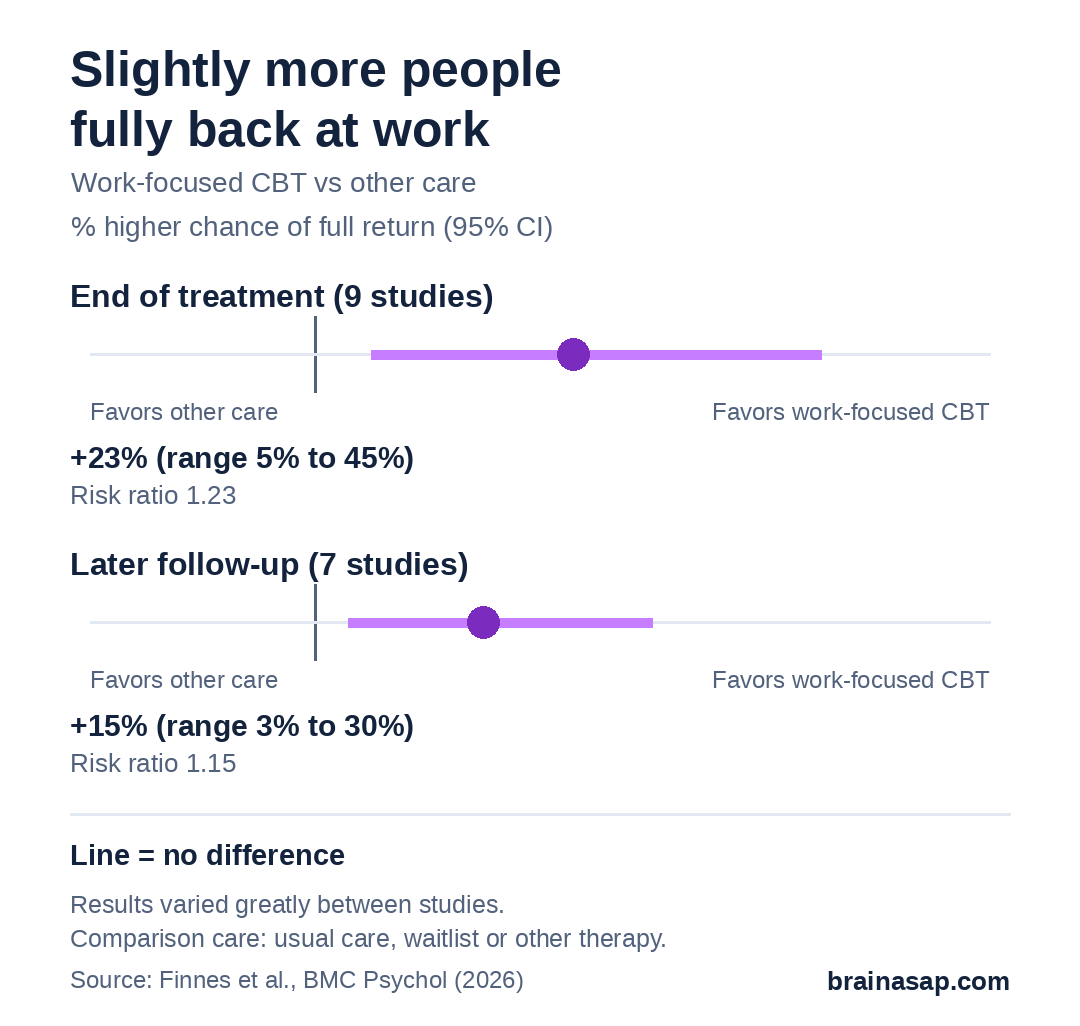
- End of treatment: 23% higher chance of full return to work (9 studies).
- Later follow-up: 15% higher chance (7 studies).
- Time to full return: No clear difference.
- Self-rated work ability: No clear difference.
Symptoms Improved, but So Did Comparison Groups
Within the therapy groups, symptoms of depression, anxiety and stress dropped substantially, and the improvement held at follow-up.
Against comparison groups, the advantage was small at the end of treatment and nearly gone at follow-up. It was clear only when the comparison group was on a waitlist. Against usual care or another CBT-based therapy, there was no significant difference. The authors read this as a sign that adding a work focus does not weaken CBT’s effect on symptoms, rather than proof that it adds much.
Return-to-Work Numbers Are Hard to Pool
A central point of the review is methodological. Return-to-work data are awkward: days off sick are skewed, capped, or full of zeros. Many studies still analyzed them as if they followed a normal bell curve.
- Huge variation: Between-study differences for return to work were extreme (I² above 97%).
- Mixed designs: 7 studies did not randomly assign treatments.
- Lower rigor: Median methods score of 16.5, below the roughly 22 typical of standard CBT trials.
- English only: Studies in other languages were excluded.
- Northern Europe: Sick-leave systems there may not match other countries.
Worth Asking About, With Realistic Expectations
For someone off work with depression, anxiety or burnout, a therapist who builds the return to work into treatment is a reasonable thing to look for. The likely benefit over other good care is modest, not dramatic.
The open question is how big that benefit really is. Answering it will take trials that measure return to work the same way and analyze it with methods that fit the data.
Citation: DOI: 10.1186/s40359-026-05648-2. Finnes A, Johansson M, Bernhardtz R, Öst L-G. Work-focused cognitive behavioural therapy for common mental disorders: a systematic review and meta-analysis. BMC Psychol. 2026;14:1374.
Study Design: Systematic review and multilevel meta-analysis of randomized and non-randomized studies (PROSPERO CRD42021265973).
Sample Size: 24 studies, 26 treatment conditions, 3,279 participants receiving work-focused CBT.
Key Statistic: Full return to work vs comparison care: risk ratio 1.23 (95% CI 1.05 to 1.45) at post-treatment.
Caveat: Very high heterogeneity in work outcomes; 7 non-randomized studies; symptom advantage significant only vs waitlist.