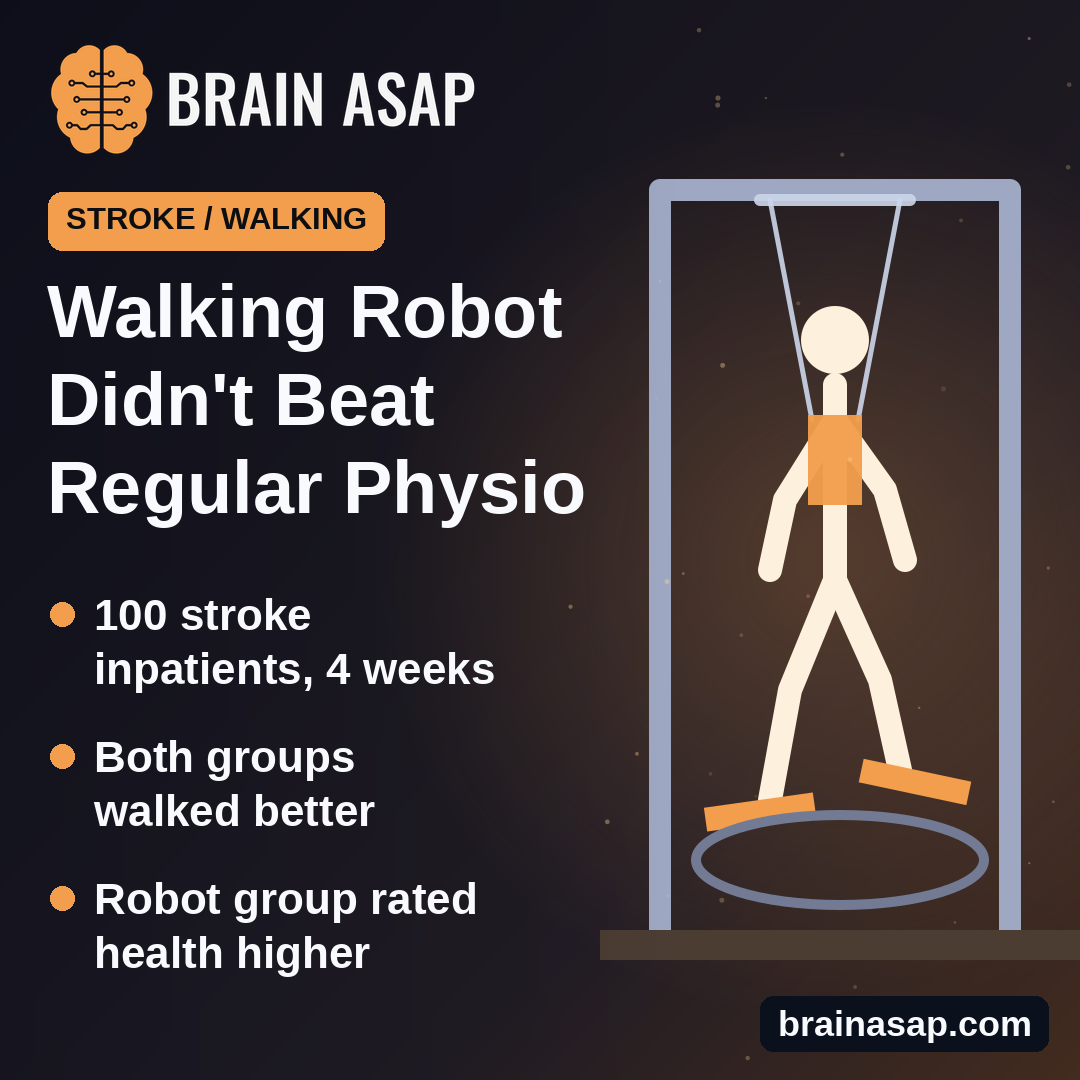
TL;DR: In a 4-week trial of 100 stroke rehab inpatients, walking practice on a robot showed no clear advantage over regular physiotherapy for walking independence or daily activities. Both groups improved, and the robot group rated their own health higher.
Key Findings
- 100 inpatients, 4 weeks: Half in the first 6 months after stroke, half later.
- Same therapy time: Robot walking sessions replaced regular physio sessions.
- No clear edge: Walking independence and daily activities improved similarly in both groups.
- Fewer people reported falls: The share dropped from 35% of people to 7%.
- Robot group felt healthier: Self-rated health rose more after robot training.
- More dropouts: 7 of 25 left the early-recovery robot group.
Source: Frontiers in Neurology (2026) | Stampfer-Kountchev et al.
Walking again is one of the biggest goals after a stroke. Robots that move the feet through a normal stepping pattern, with a harness taking some body weight, promise more steps per session with less strain on therapists.
Whether they beat hands-on physiotherapy is still debated. This Austrian trial tested that head to head, and asked whether timing after the stroke made a difference.
Robot Steps vs Hands-On Physio
The trial ran at a rehab clinic in Münster, Austria. It enrolled 100 inpatients: 50 in the early-recovery phase (1 week to 6 months after stroke) and 50 in the later phase (more than 6 months). Within each phase, people were randomly split into two groups:
- Robot group: 45 to 50 minutes on an end-effector robot four times a week, where the feet rest on moving footplates, plus 25 minutes of regular physio twice a week.
- Regular-physio group: The same time in hands-on physiotherapy focused on walking.
Both groups trained four times a week for four weeks, alongside the clinic’s usual program. Assessors did not know who was in which group.
Both Groups Walked Better, With No Clear Robot Advantage
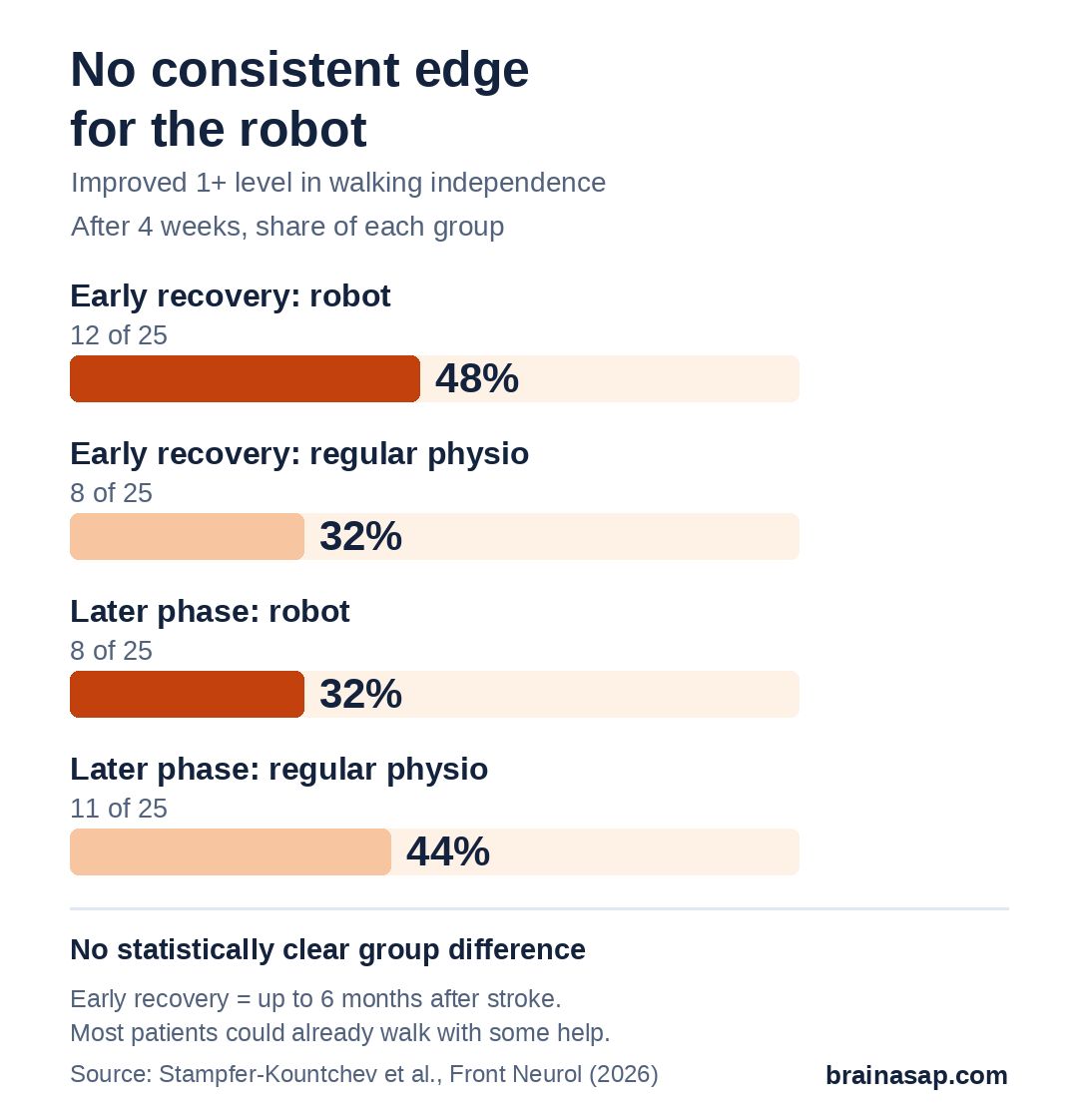
The two main measures were walking independence, on a 0 to 5 scale called Functional Ambulation Categories, and basic daily activities, on the Barthel Index. Both improved over the four weeks in both groups, with no statistically clear difference between treatments on these measures.
Other results pointed the same way:
- Walking speed, distance and getting up to walk: Improved over time, with no overall difference between groups.
- Falls: 35% of people had fallen before the program, 7% after.
- Timing: Early-recovery patients gained more walking endurance than later-phase patients.
Where the Robot Did Stand Out
On a 0 to 100 self-rating of overall health, the robot group improved significantly more than the regular-physio group. Satisfaction was high in both groups, with no difference in enjoyment.
In an exploratory look at early-recovery patients only, walking speed rose about 0.23 meters per second more with the robot. That was one of several comparisons, and it came with wide uncertainty.
What Could Hide a Real Difference
- Fairly mobile patients: Most could already walk with some help, leaving little room to rise on the main scale.
- Uneven dropouts: 7 of 25 left the early-recovery robot group, vs 1 in each other group.
- Short follow-up: Walking tests at 12 weeks were limited after discharge.
- Busy rehab setting: Everyone also got other therapies, making the robot’s share hard to isolate.
- One clinic.
A Useful Tool, Not a Replacement
For stroke survivors who can already walk with help, this trial found no clear advantage from replacing some hands-on physiotherapy with robot training. The robot may be a reasonable way to add variety or ease therapists’ workload, and some patients may feel better about it.
Whether robots help more for people who cannot walk at all, the group most underrepresented here, is still the key open question.
Citation: DOI: 10.3389/fneur.2026.1898475. Stampfer-Kountchev M, Mildner S, Hotz I, et al. Robot-assisted gait training in people with subacute and chronic stroke: a randomized controlled trial. Front Neurol. 2026;17:1898475.
Study Design: Single-center, assessor-blinded, time-matched randomized controlled trial stratified by stroke phase (DRKS00029910).
Sample Size: 100 randomized (25 per group); 10 withdrawals; intention-to-treat analysis.
Key Statistic: No significant time × treatment interaction for walking independence (FAC) or Barthel Index.
Caveat: Mostly ambulatory patients; uneven attrition; limited follow-up; single inpatient clinic.