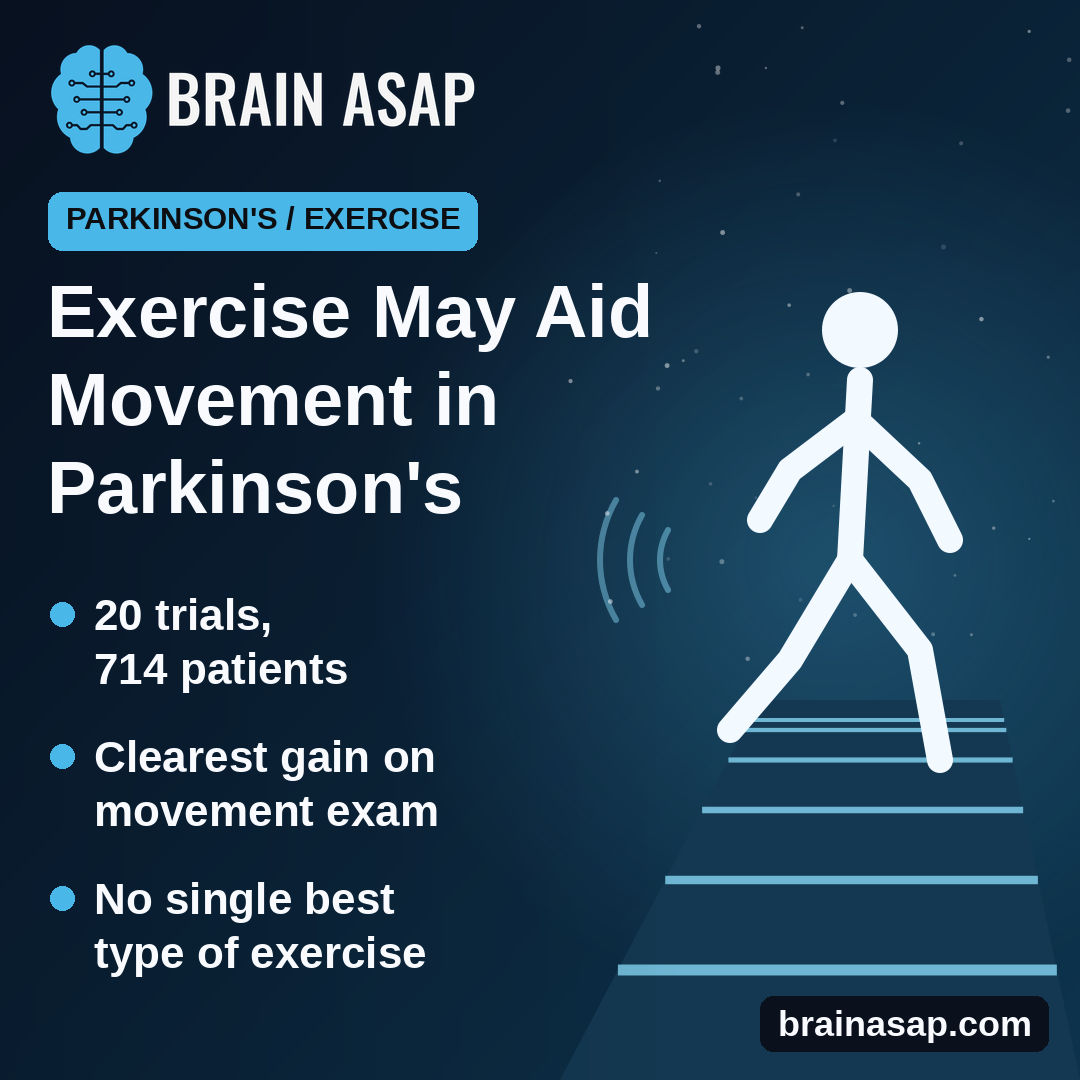
TL;DR: Pooling 20 small trials in Parkinson’s disease, structured exercise improved movement-exam scores, freezing while walking and one balance test compared with usual care. The strongest evidence was for the movement exam, and no one type of exercise stood out.
Key Findings
- 20 trials, 714 people: Tai chi, dance, treadmill, yoga, strength, water exercise and more.
- Movement exam improved: Large effect, moderate-certainty evidence.
- Less freezing while walking: Moderate effect, low certainty.
- Balance mixed: Better on the Berg test; no clear change on the Mini-BESTest.
- No winner: Type, dose and length of exercise did not clearly matter.
- No trial rated low risk of bias.
Source: PLOS One (2026) | Zhang et al.
Parkinson’s medicines help tremor and stiffness, but they often do less for walking problems and balance. Many people also experience “freezing,” when the feet suddenly feel glued to the floor.
Exercise is widely recommended to fill that gap. This review pulled together randomized trials to see how much it actually helps, and whether some kinds work better than others.
Twenty Trials of Structured Exercise
The researchers searched five databases through January 2026 and found 20 randomized trials published between 2009 and 2024, with 714 people with Parkinson’s in total.
- Exercise groups: Structured training only, with no added therapies. Types included dance, tai chi, qigong, yoga, treadmill, balance and gait training, resistance, water exercise and walking.
- Comparison groups: Usual care, usual rehab, or no structured exercise.
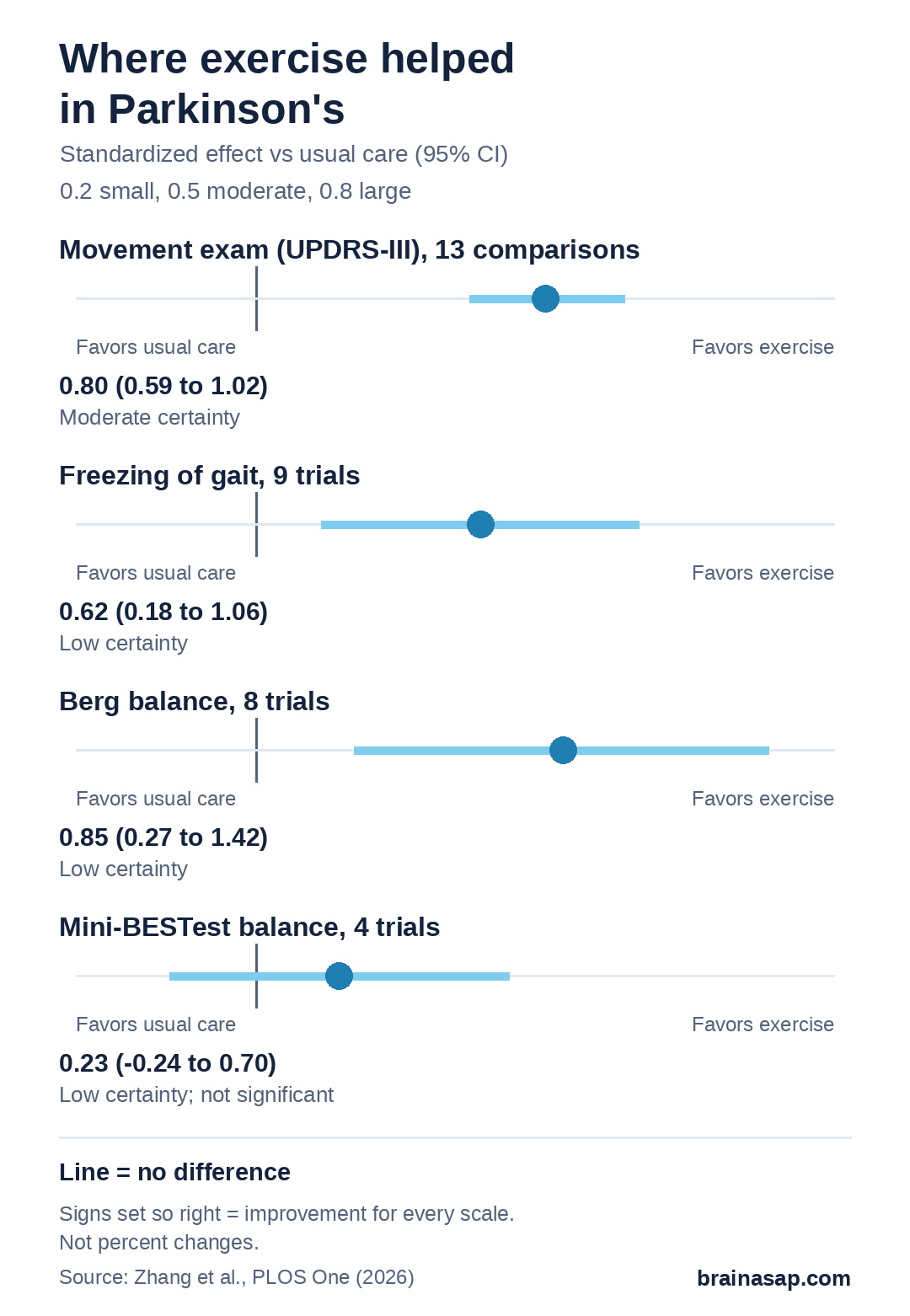
Results were pooled as standardized effect sizes, a way to combine different scales. Roughly 0.2 is small, 0.5 moderate and 0.8 large.
The Movement Exam Showed the Clearest Gain
The UPDRS-III is a doctor-rated exam of Parkinson’s movement signs such as slowness, stiffness, tremor and walking. Across 13 comparisons, exercise groups scored better than comparison groups by a large effect of 0.80. Results were consistent from trial to trial, and the certainty was rated moderate.
Freezing and Balance: Helpful but Less Certain
- Freezing of gait: A self-report questionnaire improved with a moderate effect of 0.62 across 9 trials. Results varied between trials; low certainty.
- Berg Balance Scale: Improved with a large effect of 0.85 across 8 trials, but with high variation; low certainty.
- Mini-BESTest: A tougher balance test that includes reactions to being pushed. Only 4 trials, and no clear gain.
The Berg test mostly covers steady, everyday balance tasks. The Mini-BESTest adds harder challenges, which may explain part of the difference, though with so few trials it is hard to tell.
No Single Best Type or Dose
The researchers looked at whether exercise type, session length, frequency, program length, age or years with Parkinson’s changed the results. The review did not establish a best exercise type or dose. These checks were exploratory, and the researchers did not formally test differences between subgroups.
- Small trials: 714 people across 20 studies.
- Bias: 16 trials had some concerns and 4 were at high risk; none were low risk.
- Unblinded participants: People know when they are exercising.
- Broad exam: The UPDRS-III covers more than legs and walking.
Keep Moving, in the Way You Will Stick With
For people with Parkinson’s, these results support regular structured exercise as a way to improve movement and possibly freezing and balance, on top of medicine. Since no type clearly outperformed the others, the best choice may be the one a person enjoys and keeps doing.
The open question is which exercise best targets freezing and harder balance challenges, which will take larger, better-blinded head-to-head trials.
Citation: DOI: 10.1371/journal.pone.0359274. Zhang C, Jia Z, Wang Y, Zang W. Effects of exercise interventions on gait, motor function, and balance in patients with Parkinson’s disease: A meta-analysis with clinical implications. PLoS One. 2026;21(9):e0359274.
Study Design: Systematic review and random-effects meta-analysis of RCTs with GRADE (PROSPERO CRD420261281718).
Sample Size: 20 RCTs; 714 patients (372 exercise, 342 control).
Key Statistic: UPDRS-III SMD -0.80 (95% CI -1.02 to -0.59), moderate certainty.
Caveat: No low-risk-of-bias trials; low certainty for FOGQ, BBS and Mini-BESTest; subgroups exploratory.