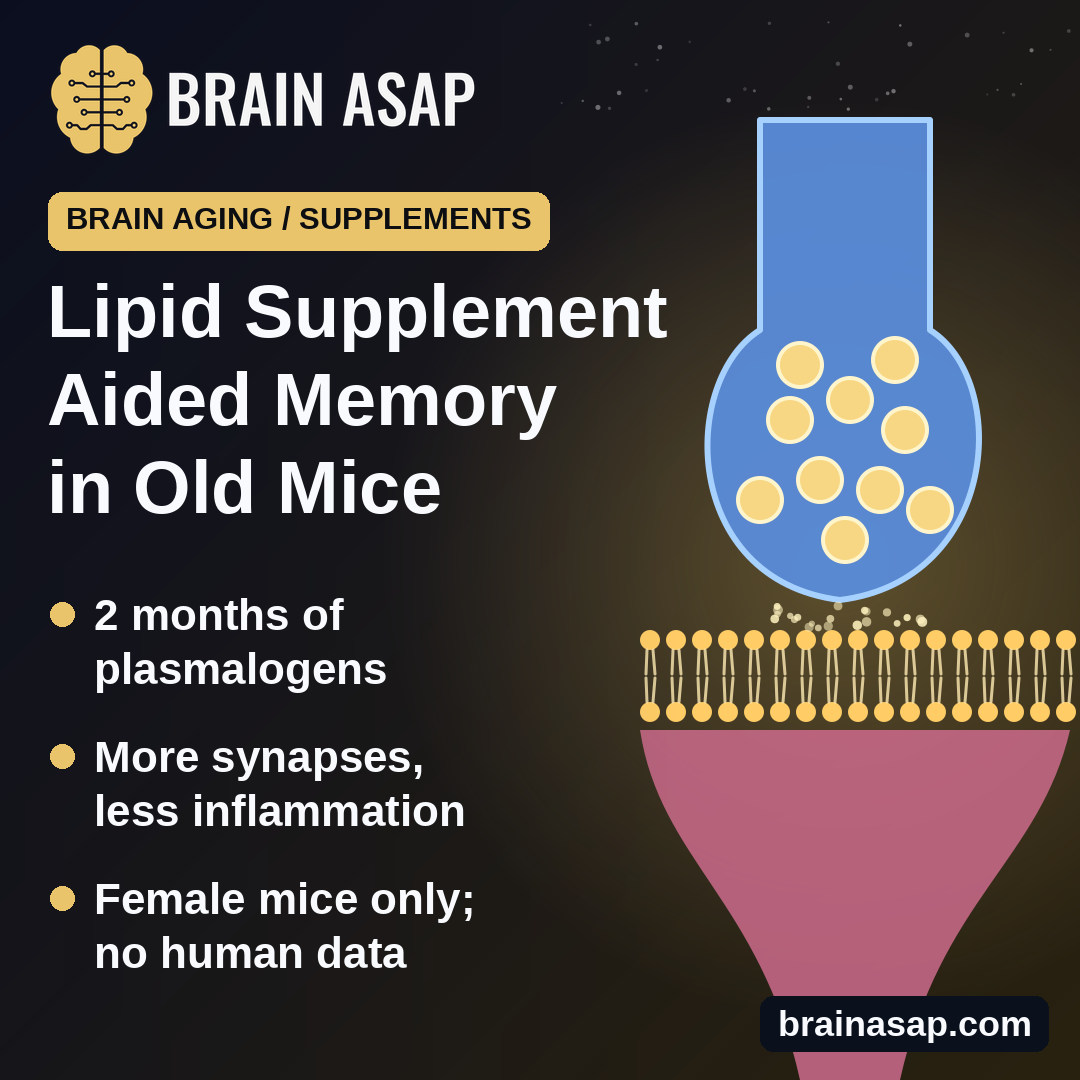
TL;DR: Old female mice given plasmalogens, a fat found in brain cell membranes, 5 days a week for 2 months did better on a memory maze than old mice given water. Their brains also showed more synapses and less inflammation, but this is a mouse study, not a human trial.
Key Findings
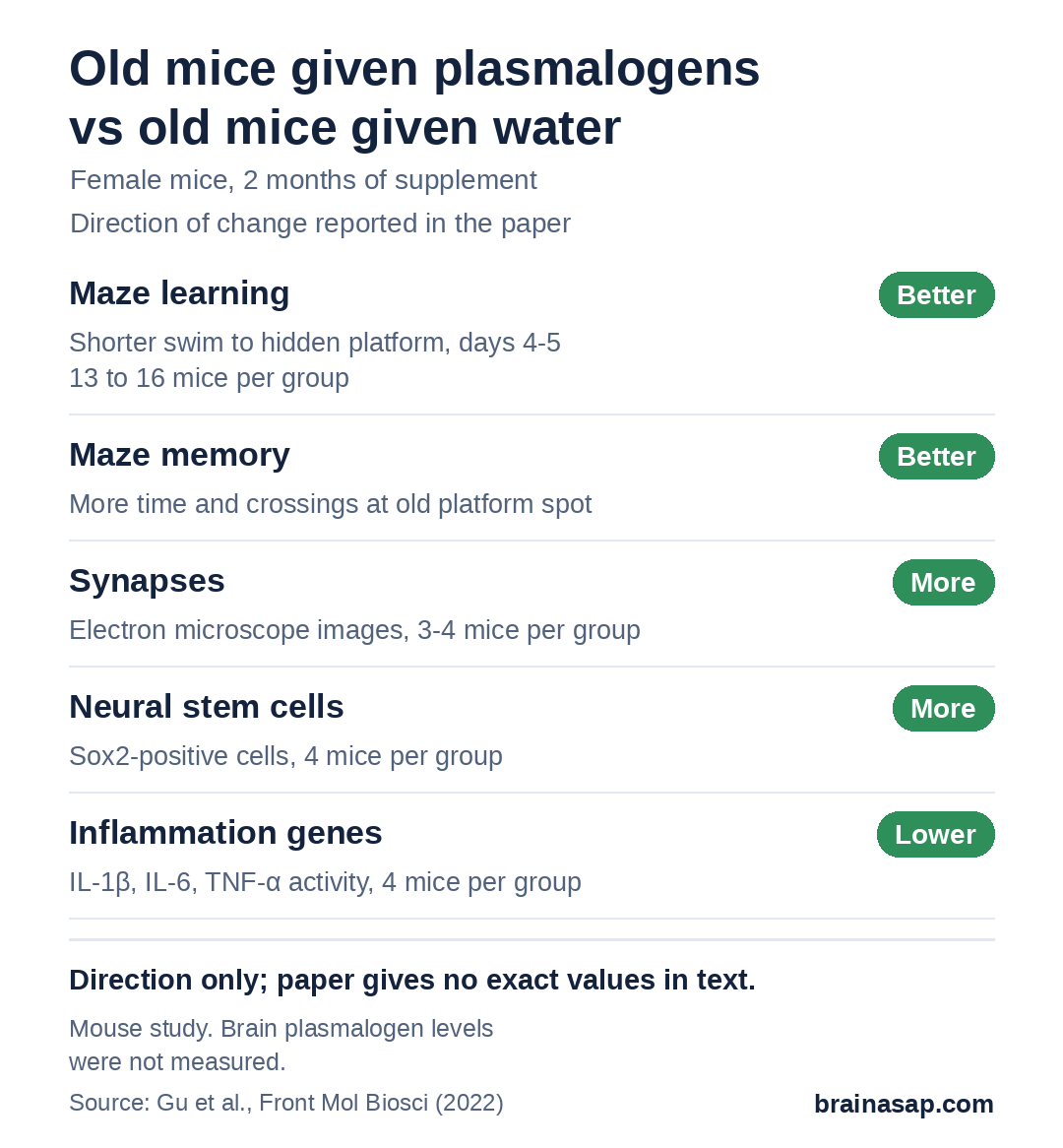
- Better maze memory: Treated old mice found a hidden platform faster on days 4 and 5 and remembered its spot better.
- More synapses: Electron microscope images showed more nerve connections in a memory region.
- More stem cells: Treated mice had more neural stem cells in the hippocampus.
- Less inflammation: Immune cells looked calmer, and three inflammation genes were less active.
- Small tissue samples: Most brain tests used 3 or 4 mice per group.
Source: Frontiers in Molecular Biosciences (2022) | Gu et al.
Plasmalogens make up about 20% of the phospholipids in human cell membranes. These fats are especially common in the brain. Levels drop with age, and they are lower still in people with Alzheimer’s and Parkinson’s.
That raises an obvious question: would topping them up help an aging brain? A team from Shanghai Jiao Tong University tested the idea in old mice. The study came out in 2022.
A 2-Month Supplement for Old Mice
The researchers extracted plasmalogens from sea squirts, a marine animal rich in them. The extract also carried omega-3 fats such as DHA and EPA.
All mice were female. The study compared three groups:
- Old mice given plasmalogens (16 mice): A dose delivered straight to the stomach 5 days a week, from 16 to 18 months of age
- Old mice given water (13 mice): Same handling, no supplement
- Young mice (14 mice): 3 months old, for reference
Eighteen months is roughly late middle age to early old age for a lab mouse.
Treated Mice Found the Hidden Platform Faster
Memory was tested in a water maze, where mice learn to find a platform hidden just under the surface of a pool.
- Learning: Old mice given plasmalogens swam shorter distances and reached the platform sooner than water-fed old mice on days 4 and 5
- Memory: With the platform removed, treated mice spent more time where it used to be and crossed its spot more often
- Weight: No difference between the two old groups
The researchers also noticed that untreated old mice had gray, thinning fur, while treated mice grew new black hair from about the third week. That was an observation from photos, not a measured outcome.
More Synapses and Neural Stem Cells
The team then looked inside the hippocampus, a region central to memory.
- Synapses: Electron microscope images showed many more synapses and tiny message-carrying sacs, called vesicles, in treated mice than in water-fed old mice
- Synaptophysin: This vesicle protein was higher in treated mice by two methods
- Neural stem cells: More cells carrying the stem-cell marker Sox2
- Gene activity: 802 genes differed between the two old groups, many linked to synapses and nerve growth
Calmer Brain Immune Cells
Microglia are the brain’s resident immune cells. In aging brains, they often shrink their branches and become primed to cause inflammation.
In water-fed old mice, microglia had short, stubby branches. In treated mice, they had longer, more branched shapes like those in young mice. Three inflammation signals, IL-1β, IL-6 and TNF-α, were also less active in treated brains.
Small Samples and No Brain Lipid Measurements
- Mice, not people: No human data
- Females only: Chosen on purpose, but males may respond differently
- Few animals per brain test: 3 to 4 mice per group for most tissue work
- Unclear delivery: The researchers did not check whether the supplement raised plasmalogen levels in the brain
- Mixed ingredients: The extract also carried omega-3 fats, which may matter on their own
- Missing mice: 40 old mice were bought, but 29 appear in the maze results; the paper does not explain the gap
- Bold language: The title says plasmalogens “eliminate” aging defects, which goes beyond what a small mouse study can show
Human Trials Would Need to Show the Same Benefit
Plasmalogen supplements are already sold. This mouse study offers a plausible reason they might help, but not proof that they do.
The open question is whether a supplement taken by mouth actually raises plasmalogens in the human brain, and whether that slows memory loss in a properly controlled trial.
Citation: DOI: 10.3389/fmolb.2022.815320. Gu J, Chen L, Sun R, et al. Plasmalogens Eliminate Aging-Associated Synaptic Defects and Microglia-Mediated Neuroinflammation in Mice. Front Mol Biosci. 2022;9:815320.
Study Design: Controlled experiment in naturally aged female C57BL/6J mice with a young reference group.
Sample Size: Maze: 14 young, 13 old water-fed, 16 old plasmalogen-fed mice; most tissue assays 3 to 4 mice per group.
Key Statistic: Shorter swim distance and time to platform on days 4 to 5 and better probe-trial memory versus water-fed old mice (p < 0.05).
Caveat: Mouse study; small tissue samples; brain plasmalogen levels not measured; extract also contained omega-3 fats.