TL;DR: In a small Polish trial of 22 children aged 6 to 9 with coordination problems, coordination exercises with and without moves that cross the body’s center line both improved movement planning and two-sided coordination. Final scores were about the same in both groups.
Key Findings
- 22 children finished: Out of 32 who started, split into two groups of 11.
- Both groups improved: On tests of sequencing movements and coordinating both sides of the body.
- No winner at any time point: Group scores never differed significantly.
- Timing differed: Midline group’s gains showed up right after the program; the other group’s only at follow-up.
- Perception barely changed in either group.
Source: Frontiers in Neurology (2026) | Bagrowski et al.
Some children struggle to tie shoelaces, catch a ball or copy a sequence of hand movements, even though nothing is wrong with their muscles or intelligence. When these problems are persistent, doctors call it developmental coordination disorder, or dyspraxia.
One popular idea in child therapy is that moves crossing the body’s center line, like touching a hand to the opposite knee, give the brain an extra workout. A team in Poznań, Poland, tested whether adding those moves makes coordination exercises work better.
Two Versions of the Same Exercise Program
The children were 6 to 9 years old and had signs of dyspraxia, with or without a formal diagnosis. All followed Bilateral Integration, a structured program of whole-body movement exercises created by British therapist Sheila Dobie. The groups differed in one ingredient:
- Midline group: Exercises included moves where arms or legs cross the body’s center line.
- Same-side group: The same type of exercises, without crossing the center line.
Children were tested before the program, right after it and again after a break of several weeks. The full cycle took 15 to 16 weeks. Tests covered body and touch perception, movement planning (called praxis), and coordination of both sides of the body.
Both Groups Reached Similar Final Scores
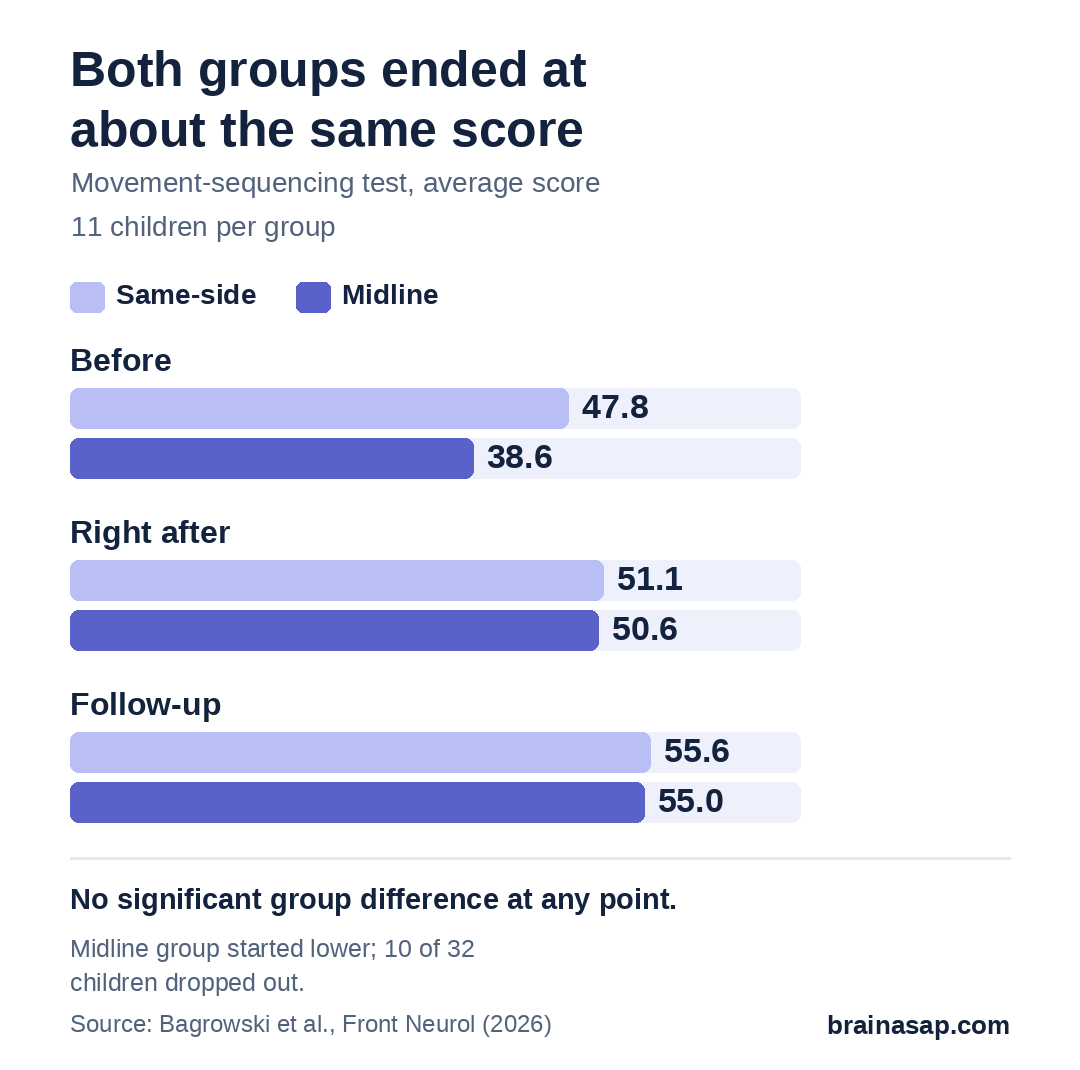
On the main movement-sequencing test, both groups ended at nearly the same score. Two-sided coordination also improved in both groups. At no point did the groups differ significantly from each other.
Earlier Gains With Midline Moves
The groups did follow different paths. In the midline group, sequencing and two-sided coordination scores jumped right after the program and held. In the same-side group, scores rose gradually and only reached significance at follow-up.
The midline group also improved on a few extra measures, including hand and finger sequencing, leg coordination and speed on a task following spoken instructions. But the midline group started lower on sequencing, so it had more room to improve. A gain within one group is not proof that it beat the other group.
Small, Uneven and Not an Independent Test
- High dropout: 10 of 32 children (31%) did not finish.
- Simple allocation: Odd and even enrollment numbers decided the group.
- No untreated group: Normal development over 4 months could explain part of both groups’ gains.
- Same children as an earlier report: The team’s preliminary paper analyzed the main results from this trial; this one adds subtests.
- Brain claims untested: Ideas about frontal and parietal brain areas were not measured with scans.
Is Crossing the Midline Worth Adding?
For parents and therapists, the reassuring part is that structured coordination exercises were linked to progress either way. Whether midline moves truly speed things up needs a larger trial with an untreated comparison group and a direct test of how the two groups change over time.
Citation: DOI: 10.3389/fneur.2026.1891034. Bagrowski B, Grobelny B, Dalziell A, Górny P, Mojs E. The effects of gross motor exercises on perception and praxis in children with motor coordination difficulties-randomized controlled study. Front Neurol. 2026;17:1891034.
Study Design: Two-arm randomized comparison of Bilateral Integration exercises with vs without midline crossing; three assessment points.
Sample Size: 32 enrolled, 22 completed (11 per group).
Key Statistic: Sequencing Praxis total at follow-up 55.0 (midline) vs 55.6 (same-side); between-group p = 0.946.
Caveat: 31% dropout, no untreated control, overlapping cohort with a preliminary report.