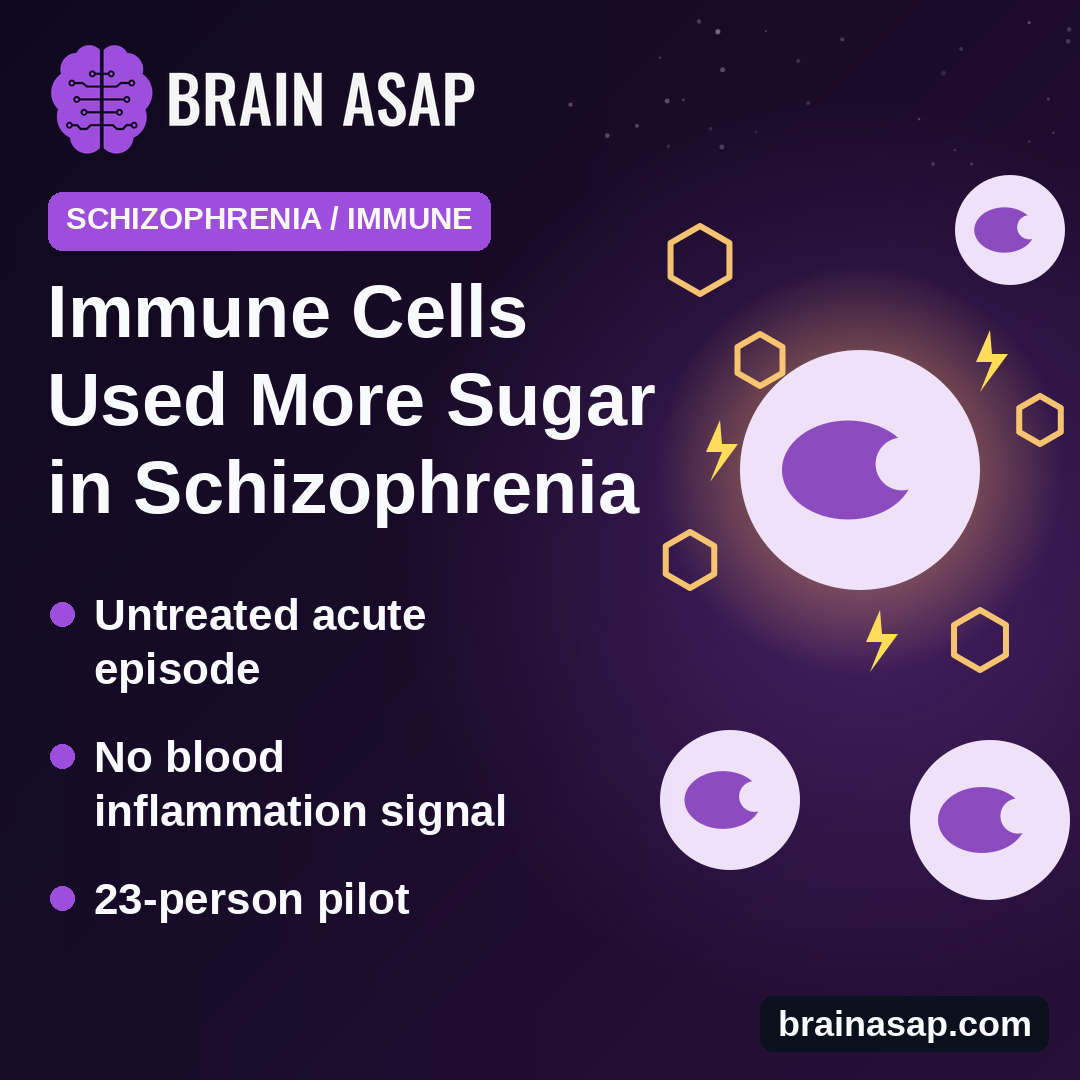
TL;DR: In a small pilot study, immune cells from people in an untreated schizophrenia episode made more of their energy by burning sugar than cells from healthy people or from patients stable on medication. There was no sign of higher inflammation in the blood.
Key Findings
- 23 people in 4 groups: Healthy volunteers, untreated acutely ill patients, and stable patients on olanzapine or on risperidone/paliperidone.
- More sugar-based energy when acutely ill: Higher than all three other groups.
- Mitochondria looked similar: Overall “health scores” did not differ.
- No blood inflammation signal: Cytokines, CRP and white cell counts did not differ after correction.
- Lowest sugar use on olanzapine: But drug and recovery effects can’t be separated.
Source: European Archives of Psychiatry and Clinical Neuroscience (2026) | Debska-Vielhaber et al.
Schizophrenia is a brain disorder, but blood tests often show changes in the immune system and in how the body handles energy, sometimes before any medication. A team at Otto-von-Guericke University in Magdeburg, Germany, asked how immune cells themselves produce energy in people with schizophrenia.
Their answer, from a very small sample, points to a shift in fuel use during acute illness rather than broken cell power plants.
Measuring How Blood Immune Cells Make Energy
Cells make energy two main ways. Mitochondria, the cell’s power plants, burn fuel with oxygen. Cells can also break down sugar quickly without oxygen, a process called glycolysis. Immune cells tend to lean on glycolysis when they are switched on.
The researchers drew fasting morning blood from 23 adults:
- Healthy volunteers: 6 people.
- Untreated acute patients: 6 people in an acute episode who had never taken antipsychotic medicine.
- Stable on olanzapine: 6 people.
- Stable on risperidone or paliperidone: 5 people, all men.
They isolated a mix of white blood cells called PBMCs, rested them for 24 hours in a dish, then used a Seahorse analyzer to measure oxygen use and acid output in real time.
Sugar-Burning Was Higher in Untreated Patients
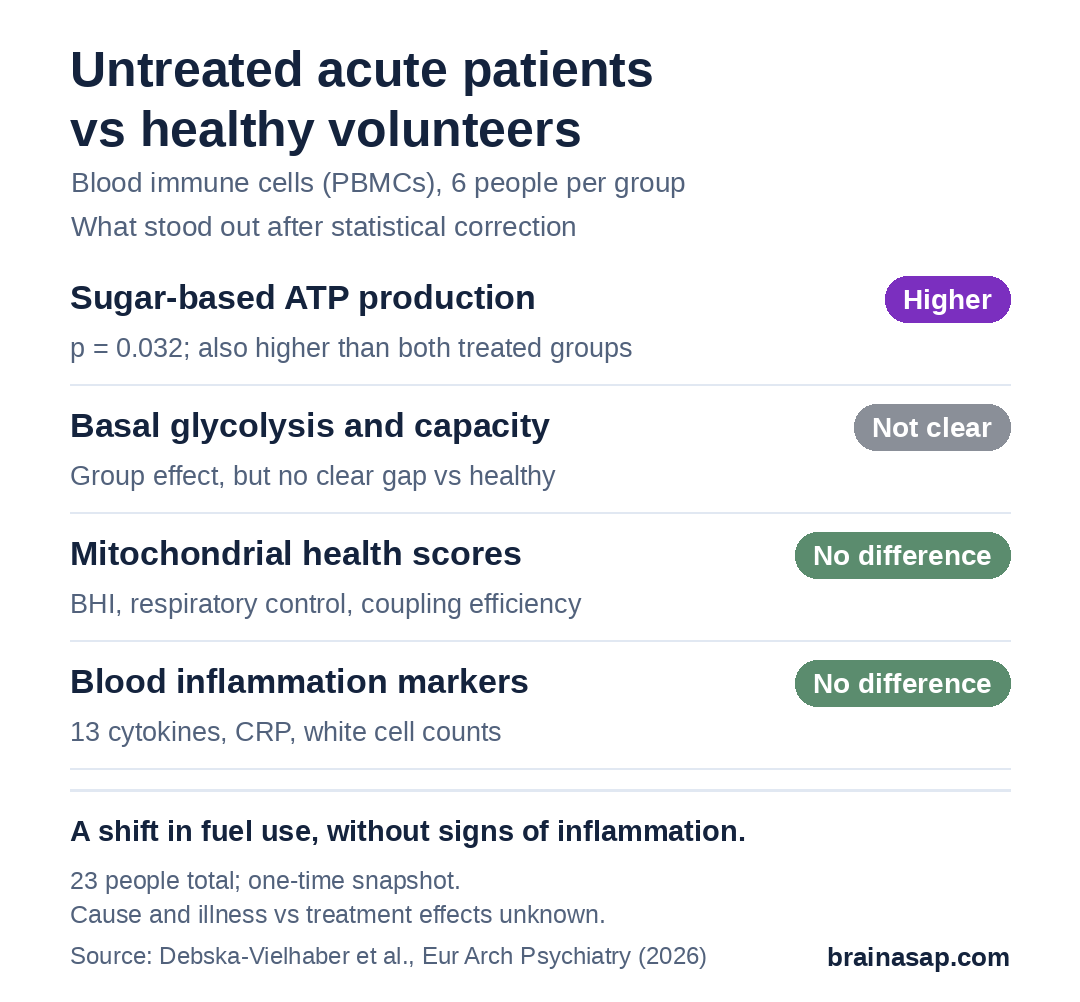
The clearest finding was in ATP, the cell’s energy currency. Cells from untreated acute patients made more ATP through glycolysis than cells from healthy volunteers (p = 0.032), patients on olanzapine (p = 0.005) and patients on risperidone or paliperidone (p = 0.016).
The pattern was spread across several patients, not driven by one extreme person. Basal glycolysis and maximum glycolytic capacity also differed across the groups, but the direct comparison with healthy volunteers did not hold up after statistical correction.
Power Plants Looked Normal, and So Did Inflammation
Most mitochondrial measures were similar across groups. Three summary scores of mitochondrial health did not differ. One measure, the share of oxygen use tied to ATP production, was lower in untreated patients than in healthy volunteers.
Thirteen inflammatory signals measured in blood and in fluid from the resting cells showed no group differences after correction. CRP and white cell counts were also similar. So the authors say the sugar shift should not be read as inflammation. Brain inflammation was not measured at all.
Medication or Recovery? The Study Can’t Say
Patients stable on olanzapine had the lowest sugar-based energy of any group, close to healthy volunteers. That is surprising, since olanzapine is known for causing weight gain and blood sugar problems. The authors warn against reading it as protective. It could reflect recovery, the drug acting on blood cells, or who ended up in each group.
- Tiny groups: 5 or 6 people each.
- Uneven groups: Untreated patients averaged 31.5 years old versus 42 to 48 in the others.
- One snapshot: No one was followed from illness to recovery.
- Cells rested a day in a dish: May not match their state in the body.
- Mixed cell types: Can’t tell which immune cells drove the shift.
A Lead Worth Following, Not a Blood Test
This pilot hints that immune cells may change their fuel use during an acute episode of schizophrenia, without obvious inflammation. It does not show the shift causes symptoms, and it is far from a diagnostic test.
The next question is whether the same people show the shift when acutely ill and lose it after treatment, which only a study following patients over time can answer.
Citation: DOI: 10.1007/s00406-026-02372-1. Debska-Vielhaber G, Borucki K, Guest PC, et al. Peripheral immune-cell bioenergetics in acute and stable schizophrenia. Eur Arch Psychiatry Clin Neurosci. 2026.
Study Design: Cross-sectional pilot comparing blood immune-cell energy use (Seahorse extracellular flux) across four groups.
Sample Size: 23 adults (6 healthy, 6 untreated acute, 6 olanzapine, 5 risperidone/paliperidone).
Key Statistic: Glycolytic ATP production higher in untreated acute patients than healthy volunteers (p = 0.032).
Caveat: Very small, cross-sectional; age and sex imbalances; illness and treatment effects can’t be separated.