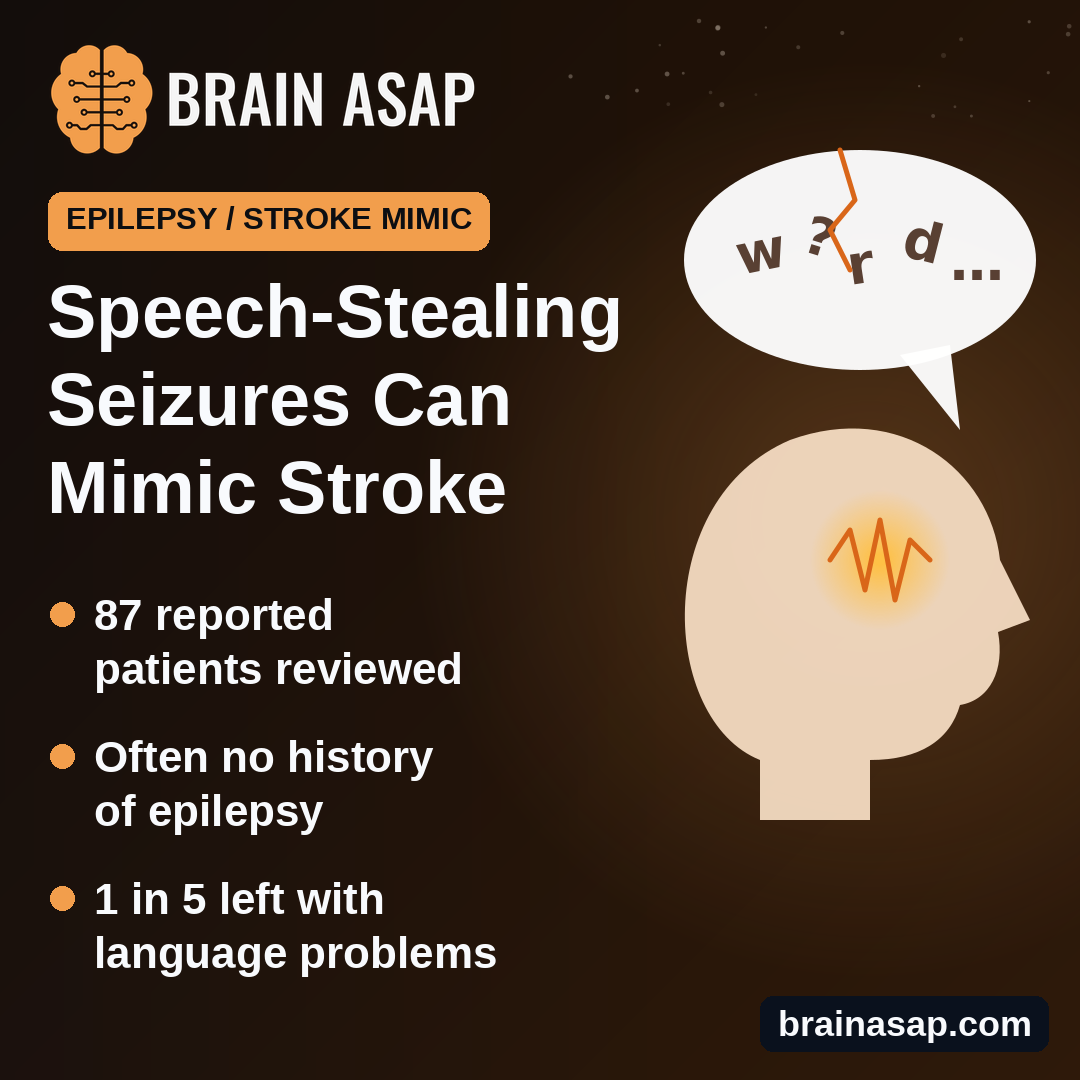
TL;DR: Seizures can sometimes steal a person’s ability to speak or understand language for hours or days without causing convulsions, and they can look just like a stroke. A review of 87 reported patients found that 1 in 5 attacks left lasting language problems, often after treatment was delayed.
Key Findings
- 87 patients, 92 attacks: Collected from 41 published reports.
- Looked like stroke: Language loss resembled stroke types, and brain scans often showed stroke-like spots.
- Often no epilepsy history: 39% had no known epilepsy or convulsions.
- Slow treatment was common: About 1 in 4 attacks waited more than a week.
- Lasting damage in 1 in 5: 18 of 92 attacks left language problems.
Source: Internal Medicine (2026) | Inatomi, Nakajima & Yonehara
Sudden trouble finding words or understanding speech is a classic warning sign of stroke. But sometimes the cause is a seizure that keeps going, quietly affecting only the brain’s language areas. The person stays awake and alert, with no shaking, just unable to talk or understand properly.
This condition is called aphasic status epilepticus. Neurologists in Kumamoto, Japan, reviewed every well-described case they could find to see how it presents and what happens to patients.
87 Cases Gathered From the Medical Literature
The authors searched PubMed up to September 2025 and found 41 reports describing 87 patients with enough detail to analyze, including five people who had two attacks. Patients averaged 58 years old, and about half were men.
Because these are published case reports, they are not a random sample. Unusual or dramatic cases are more likely to be written up.
Language Loss That Looks Like a Stroke
The kinds of language problems matched those seen in stroke:
- Global aphasia: Trouble both speaking and understanding. 48% of attacks.
- Motor aphasia: Mainly trouble producing speech. 32%.
- Sensory aphasia: Mainly trouble understanding. 12%.
Brain scans added to the confusion. Diffusion MRI, the scan used to spot fresh strokes, showed bright spots in 59% of attacks, and blood-flow scans were abnormal in 89%. Usually the seizure area had extra blood flow, while a stroke reduces it, but scans done later could show the opposite. One patient in the review was first diagnosed with a stroke.
Just under half the patients had a history of epilepsy, and 39% had neither epilepsy nor any convulsions, so nothing pointed to a seizure.
Slow Treatment Went With Lasting Problems
In 16 of 67 attacks with timing reported, treatment started more than a week after symptoms began. Overall, 18 of 92 attacks left lasting language problems, and 6% of patients died in the acute phase.
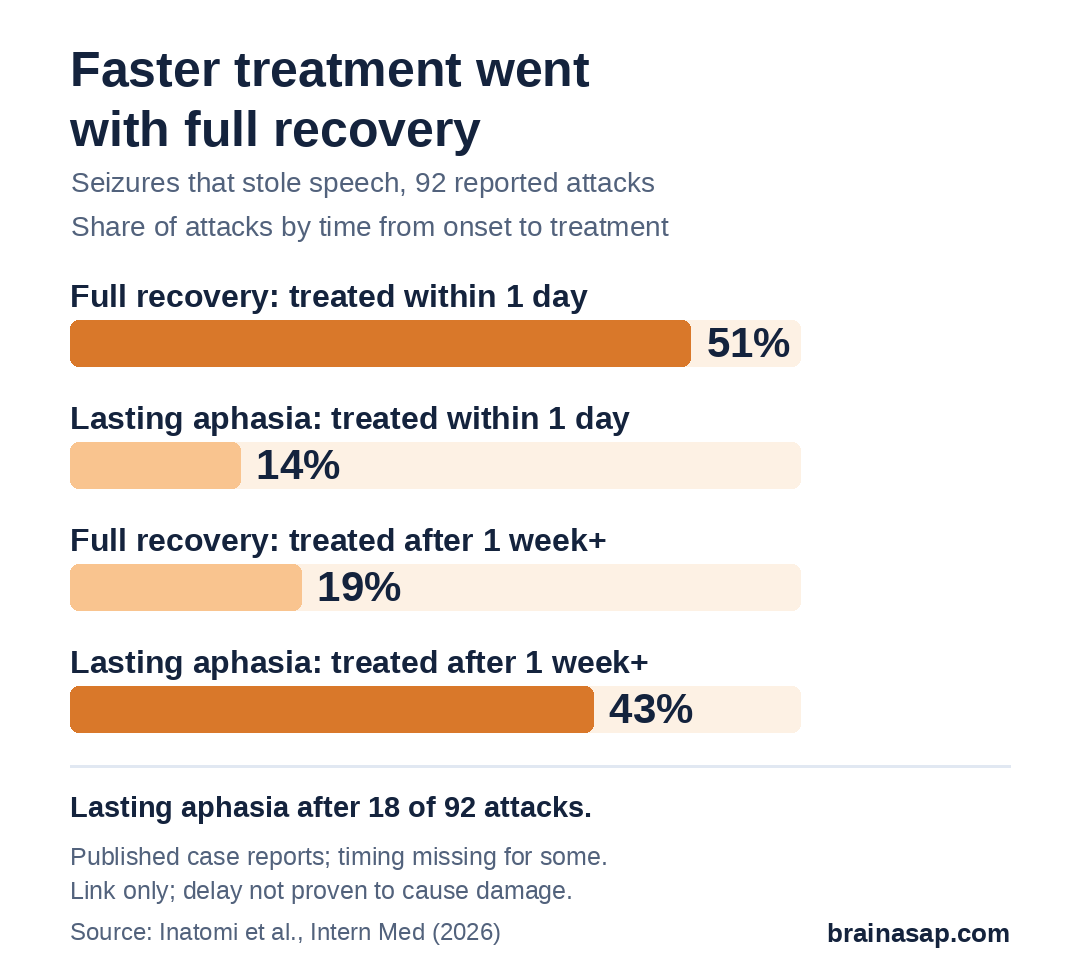
Among attacks that ended in full recovery, about half were treated within a day. Among those that left lasting problems, only 14% were. Early treatment and recovery went together, though case reports can’t prove the delay caused the damage.
EEG Isn’t Always Available or Conclusive
Diagnosis officially needs an EEG to show the seizure, but many hospitals can’t do one around the clock. Short EEGs can also miss it: in one earlier study, a 30-minute recording caught seizure activity in only 5 of 9 patients, while continuous monitoring caught it in all.
The authors propose a tentative protocol that includes MRI to check for stroke, or CT and blood-flow imaging when MRI is unsuitable. For suspected aphasic status epilepticus, they recommend prompt benzodiazepine treatment without waiting for EEG or specialized blood-flow imaging.
What a Literature Review Can’t Settle
- Published cases only: Likely skewed toward unusual cases.
- Missing details: Treatment timing was reported for only 67 of 92 attacks.
- No comparison group: Can’t compare with patients who actually had strokes.
- Quick drug response wasn’t the rule: Only 36% improved right after benzodiazepines.
How often seizures are mistaken for strokes in everyday emergency care, and whether faster treatment truly prevents lasting damage, would need prospective studies of patients arriving with sudden language loss.
Citation: DOI: 10.2169/internalmedicine.7824-26. Inatomi Y, Nakajima M, Yonehara T. Aphasic Status Epilepticus as a Stroke Mimic: A Literature Review. Intern Med. 2026 (advance publication 22 Sept 2026).
Study Design: Literature review of published case reports and series (PubMed to September 2025).
Sample Size: 87 patients, 92 attacks, from 41 reports.
Key Statistic: Lasting aphasia after 18 of 92 attacks (20%); treatment delayed over 1 week in 16 of 67 (24%).
Caveat: Published case reports only; possible selection bias; incomplete data.