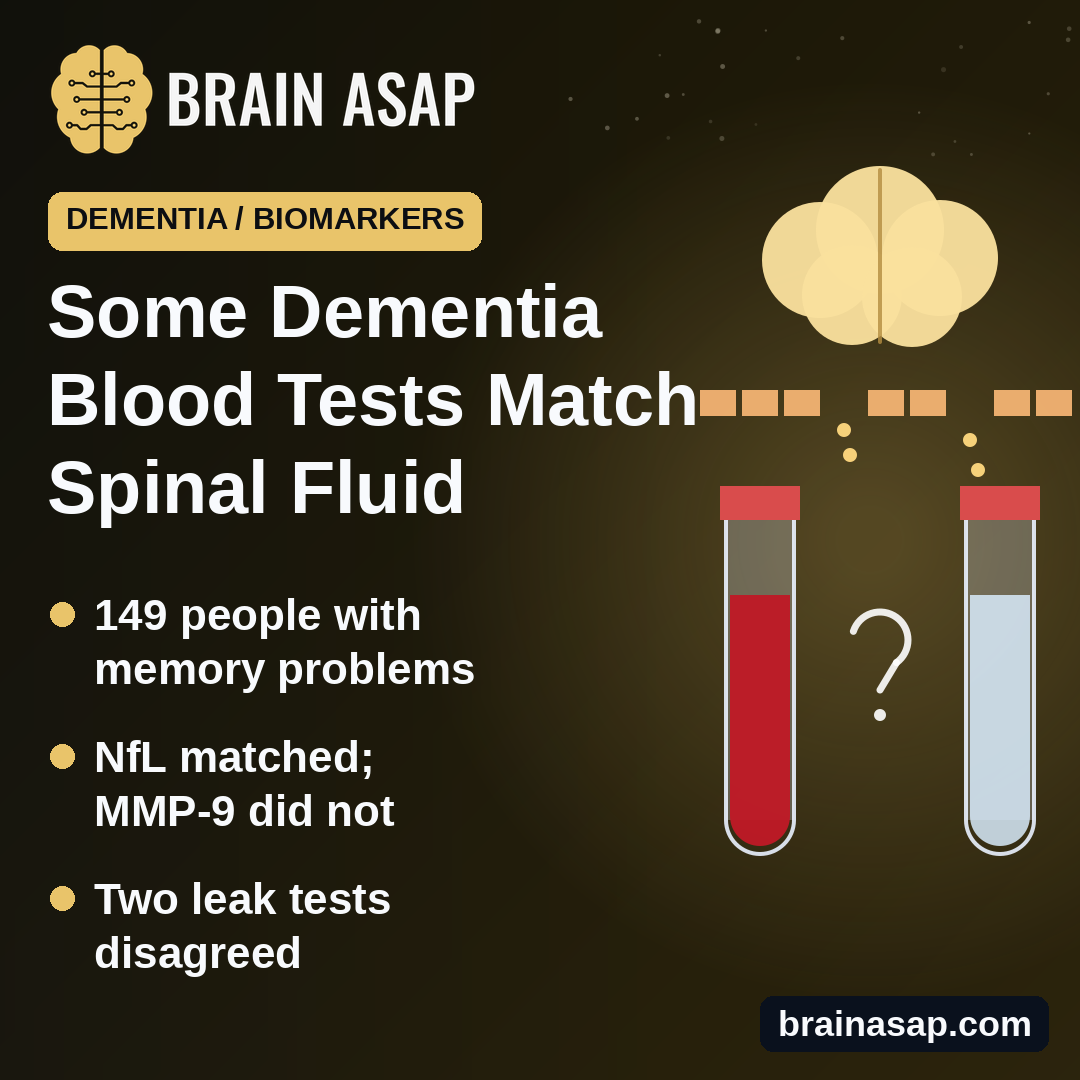
TL;DR: In 149 people with memory problems or dementia, blood levels of some brain markers tracked spinal fluid levels well, but others did not match at all. Two common measures of a leaky blood-brain barrier also did not agree with each other.
Key Findings
- Blood vs spinal fluid varied by marker: NfL matched well (r = 0.74); MMP-9 not at all (r = -0.03).
- Two leak tests disagreed: A spinal fluid ratio and an MRI scan measure were not significantly correlated in 66 people.
- Spinal fluid explained leakage best: Five markers accounted for about half the variation in the spinal fluid leak measure.
- Most models were shaky: Only one held up in cross-checks.
- No link to thinking: A combined inflammation score did not track memory or thinking tests.
Source: Frontiers in Aging (2026) | Golduzian et al.
Blood tests for dementia are getting a lot of attention because they are cheaper and easier than a spinal tap. But a blood level is only useful if it reflects what is happening in the brain. And for some processes, like inflammation and leaks in the blood-brain barrier, nobody is quite sure which test to trust.
Researchers at the University of New Mexico compared blood, spinal fluid and MRI measures in the same people to see how well they line up.
Blood, Spinal Fluid and Scans in the Same People
The study drew 149 participants from two research programs on memory and vascular dementia. Diagnoses included Alzheimer’s disease, vascular dementia, mixed dementia, white matter disease and milder memory impairment.
Not everyone had every test. The researchers measured blood-brain barrier leakage two ways:
- Albumin ratio: How much of a blood protein, albumin, has crossed into spinal fluid. A whole-brain leak measure.
- Contrast MRI: How fast an injected dye seeps into brain tissue in specific regions.
They also measured inflammation-related proteins, markers of nerve and support-cell damage, Alzheimer’s proteins, and white matter health on MRI.
Blood Matched Spinal Fluid for Some Markers, Not Others
When the same protein was measured in both blood and spinal fluid, the match ranged widely. NfL, a marker of nerve damage, matched well. So did the immune signal IL-13. GFAP and the Alzheimer’s marker pTau181 matched moderately. The enzyme MMP-9 showed no relationship, and VEGF-C, a blood vessel growth factor, ran slightly in opposite directions.
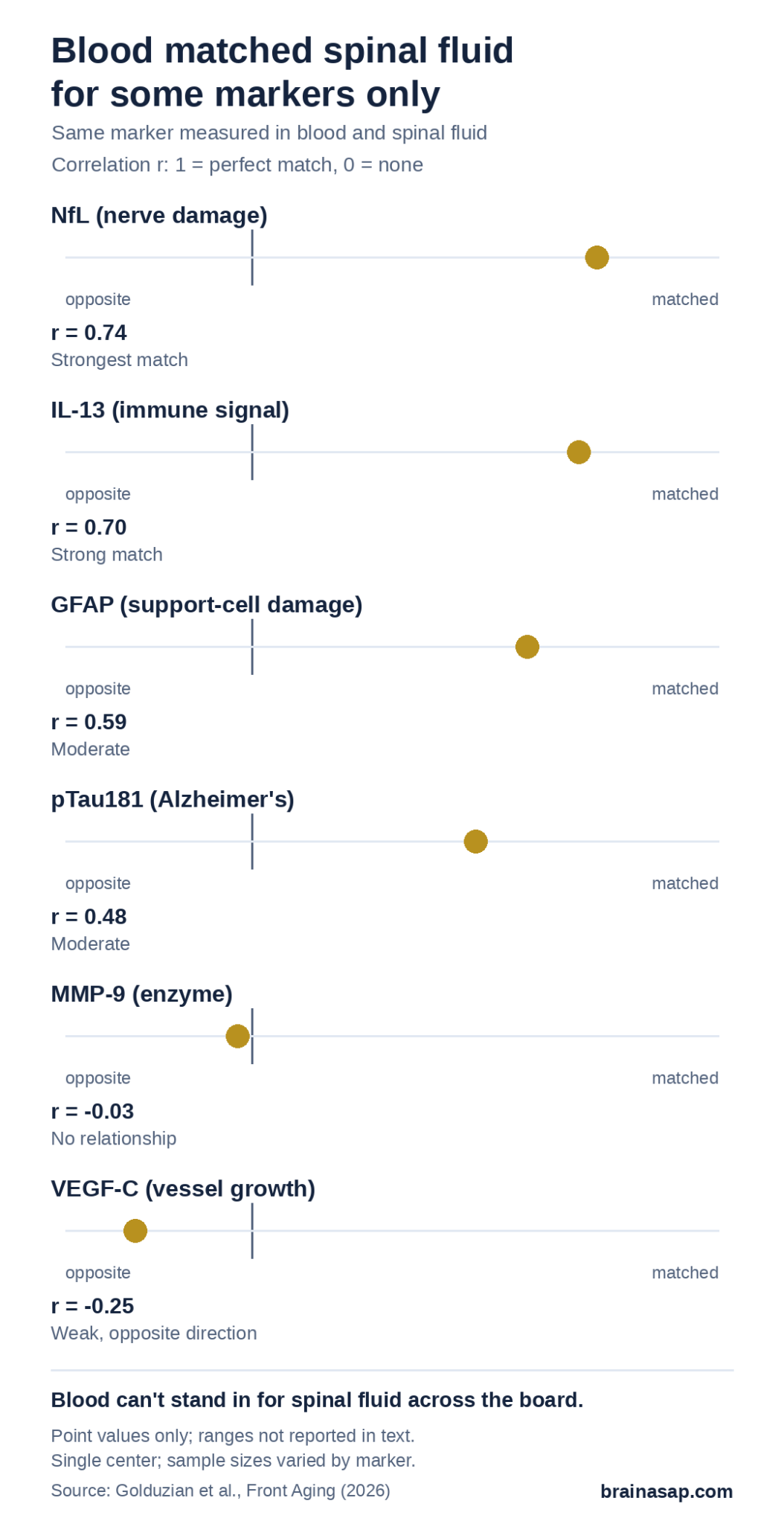
The takeaway, the authors say, is that blood cannot be assumed to stand in for spinal fluid marker by marker.
Two Leak Tests Measured Different Things
In the 66 people who had both leak tests, the albumin ratio and the MRI measure barely moved together (rho = 0.14, not significant). The authors suggest they capture different sides of barrier problems, one whole-brain and one regional, so they should be used together rather than swapped.
Spinal fluid markers did the best job of explaining the albumin ratio. Five of them, including GFAP, NfL and the inflammatory signal IL-8, explained about half its variation. Blood markers explained about a third. For the MRI measure, white matter damage on scans was the most consistent link.
Exploratory Results With Shaky Models
- Snapshot: Can’t tell whether inflammation causes leaks or the reverse.
- Small subgroups: Models used 35 to 82 people because tests were missing.
- Overfitting risk: Only the spinal fluid albumin model held up in cross-validation, and even it explained less on new data.
- One center: Heavy on white matter disease, reflecting the clinic’s focus.
- Not direct inflammation measures: Leak tests may reflect other processes.
Blood Tests Need Checking Marker by Marker
For people following the rise of dementia blood tests, this study is a reminder that some markers, like NfL, travel well between spinal fluid and blood, while others do not. Each one needs its own validation.
Whether an inflammation measure can join the amyloid, tau and nerve-damage markers already used to classify dementia will depend on larger studies that follow people over time.
Citation: DOI: 10.3389/fragi.2026.1923046. Golduzian A, Erhardt EB, Caprihan A, et al. Explanatory limitations of CSF, plasma, and MRI biomarkers for inflammation and blood–brain barrier disruption in dementia. Front Aging. 2026;7:1923046.
Study Design: Cross-sectional biomarker study from two overlapping research cohorts (MarkVCID, UNM ADRC).
Sample Size: 149 participants; 66 with both permeability measures; models used 35 to 82.
Key Statistic: CSF–plasma correlation was r = 0.74 for NfL and r = -0.03 for MMP-9.
Caveat: Exploratory, single center, cross-sectional; most models unstable out of sample.