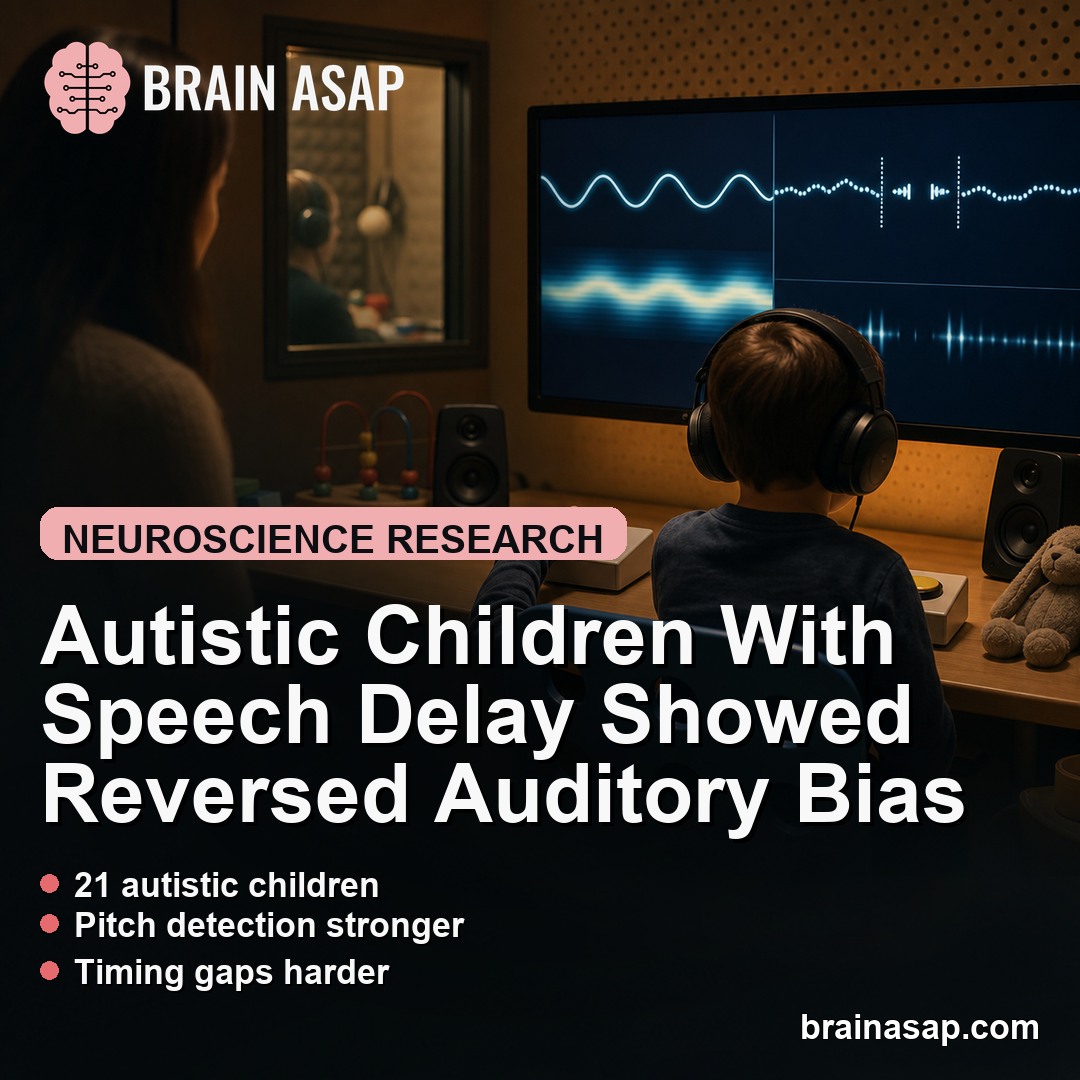
TL;DR: A 2026 study in Autism Research found that autistic children with early speech delay needed longer sound gaps to detect timing changes, but detected smaller pitch-frequency changes than typically developing peers.
Key Findings
- 21 autistic children were compared with 23 typically developing children: The autism group had early language delay and early autistic manifestations, so the result applies to that narrower profile, not the whole autism spectrum.
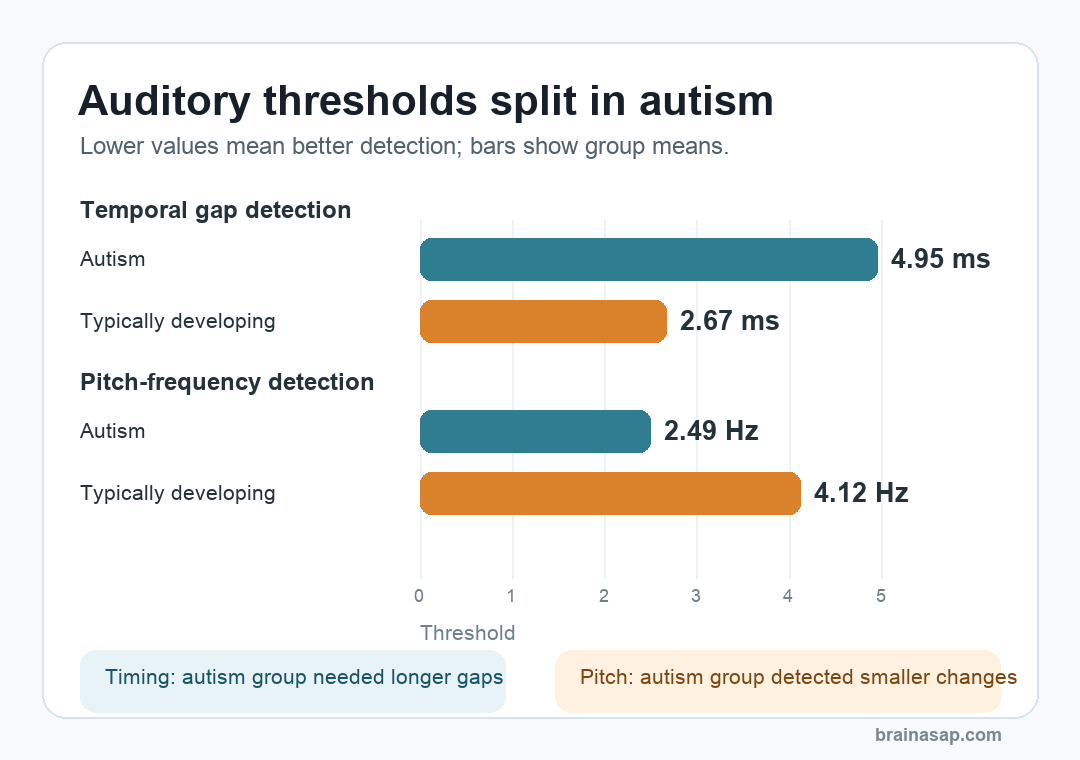
- Gap detection was poorer in the autism group: Autistic children needed a mean sound gap of 4.95 ms to detect a break, compared with 2.67 ms in the typically developing group.
- Pitch-change detection was better in the autism group: Autistic children detected smaller frequency-modulation changes, with a 2.49 Hz threshold versus 4.12 Hz in typically developing peers.
- The Auditory Bias Index moved in opposite directions: The autism group averaged 1.69, suggesting a spectral-over-temporal bias, while the typically developing group averaged 0.58.
- Language links were correlational: Better timing and pitch-frequency resolution were associated with receptive language in the autism group, but the study cannot show causation.
Source: Autism Research (2026) | Yu et al.
The central split was auditory: one task measured rapid timing, and the other measured subtle frequency change. The autism group struggled more with the timing task but performed better on the pitch-frequency task.
Speech is not one sound skill. Understanding spoken language depends on both when acoustic events happen and which frequencies carry pitch, tone, and vowel information.
The analysis asked whether those two dimensions split apart in school-age autistic children with delayed early language development.
Two Sound Tasks Tested Timing and Pitch Sensitivity
The study used two child-friendly psychoacoustic tasks. Both were two-choice listening tests, with cartoons used to help children understand what they were choosing.
- Temporal gap detection: Children heard two noise sounds and had to identify which one contained a tiny silent break. Longer required breaks mean poorer auditory timing resolution.
- Frequency-modulation detection: Children heard two tones and had to identify which one had a subtle pitch-frequency wobble. Smaller required changes mean better spectral resolution.
The final analyzed sample included 21 autistic children and 23 typically developing children, all about 8 to 12 years old. The groups were matched on age, but the typically developing group had higher nonverbal IQ, receptive language, and expressive language scores.
The autism group was deliberately narrow. Children had a clinical autism diagnosis, observable early developmental atypicalities before age 2, and delayed language development, defined as no two-word phrases by age 2.
Autistic Children Needed Longer Sound Gaps
On the timing task, autistic children needed longer silent breaks before they could reliably hear that a sound had been interrupted. Their mean gap detection threshold was 4.95 ms, compared with 2.67 ms in typically developing peers.
The difference was statistically strong: p < 0.001. Random noise is an unlikely explanation for the group contrast in this sample.
In practical terms, this points to weaker resolution for rapid sound timing. Speech uses fast temporal cues for consonants, syllable boundaries, and speech-in-noise listening.
A child who needs a longer silent interval to detect a break may have more difficulty extracting those rapid cues from ordinary speech.
The study also found that, within the autism group, better gap detection was associated with better receptive language. After age was controlled, the relationship still had Bayesian support, with rho = -0.38 and BF10 = 3.60.
Pitch-Frequency Detection Was Better in the Autism Group
The pitch-frequency task moved in the opposite direction. Autistic children detected smaller frequency-modulation changes than their typically developing peers.
The autism group had a mean FM detection threshold of 2.49 Hz, compared with 4.12 Hz in the typically developing group. Lower is better on this measure, so the autism group showed stronger sensitivity to subtle frequency variation.
This split fits earlier work suggesting that some autistic children show heightened pitch perception. It is not simply a global sensory deficit.
In this sample, the same children who had weaker timing resolution had stronger spectral resolution.
The language association also complicated a simple impairment story. In the autism group, better pitch-frequency detection was associated with nonverbal IQ and receptive language after controlling for age.
The Auditory Bias Index Captured the Split
To compare timing and pitch-frequency processing on one scale, the researchers created an Auditory Bias Index (ABI). The index divides normalized timing performance by normalized spectral performance.
An ABI near 1 suggests balanced development across the two sound domains. An ABI above 1 suggests a stronger spectral-over-temporal profile, while a value below 1 suggests stronger timing performance relative to spectral performance.
The groups diverged sharply:
- Autism group: Mean ABI was 1.69, consistent with a spectral-over-temporal bias.
- Typically developing group: Mean ABI was 0.58, consistent with stronger fine timing relative to pitch-frequency detection.
- Group difference: The ABI contrast was significant at p < 0.001.
The pattern is preliminary evidence for a reversed auditory processing bias in this form of autism. Instead of treating auditory atypicalities as a single deficit, the data point to a different balance between sound timing and sound frequency.
Language Implications Should Stay Narrow
The interpretation needs restraint. Stronger pitch-frequency sensitivity might help some autistic children track prosodic or phonological regularities in more repetitive, less socially demanding input.
The discussion names screen-based speech and other nonsocial pathways as possible contexts.
This does not show that pitch sensitivity causes language development. It also does not show that auditory training would automatically improve language outcomes.
The study’s evidence supports a narrower claim: in this autism subgroup, better sound timing and better pitch-frequency sensitivity were each linked with receptive language, while the overall auditory profile differed from typically developing peers.
Small Sample and Narrow Autism Profile Limit the Result
The sample was small, with 44 children in the final analysis. The autism group included almost all boys.
The study also excluded Asperger-like profiles without early language delay, syndromic autism, global developmental delay, and known hearing impairment.
The tasks were also selective. Spectral resolution was measured at low frequency using frequency modulation, and temporal resolution was measured with gap detection.
Other auditory timing skills, such as temporal order judgment, were not tested.
Most importantly, the correlations do not establish direction. Early language delay could shape auditory experience, auditory bias could affect language learning, or both could develop together.
The useful reading is specific: a small 2026 study found a measurable split in auditory processing among autistic children with early speech delay. Timing resolution was weaker, while pitch-frequency resolution was stronger.
That reversed balance may help explain why language development in this subgroup can follow a different route.
Citation: DOI: 10.1002/aur.70248. Yu et al. Autistic Children With Speech Onset Delay Show Reversed Bias in Spectral Versus Temporal Auditory Processing. Autism Research. 2026;19:e70248.
Study Design: Cross-sectional psychoacoustic study comparing auditory temporal gap detection and frequency-modulation detection.
Sample Size: 21 autistic children with early speech delay and 23 typically developing children.
Key Statistic: Gap detection thresholds were 4.95 ms versus 2.67 ms, while FM detection thresholds were 2.49 Hz versus 4.12 Hz.
Caveat: Small, narrow autism subgroup; correlations with language do not establish causality.