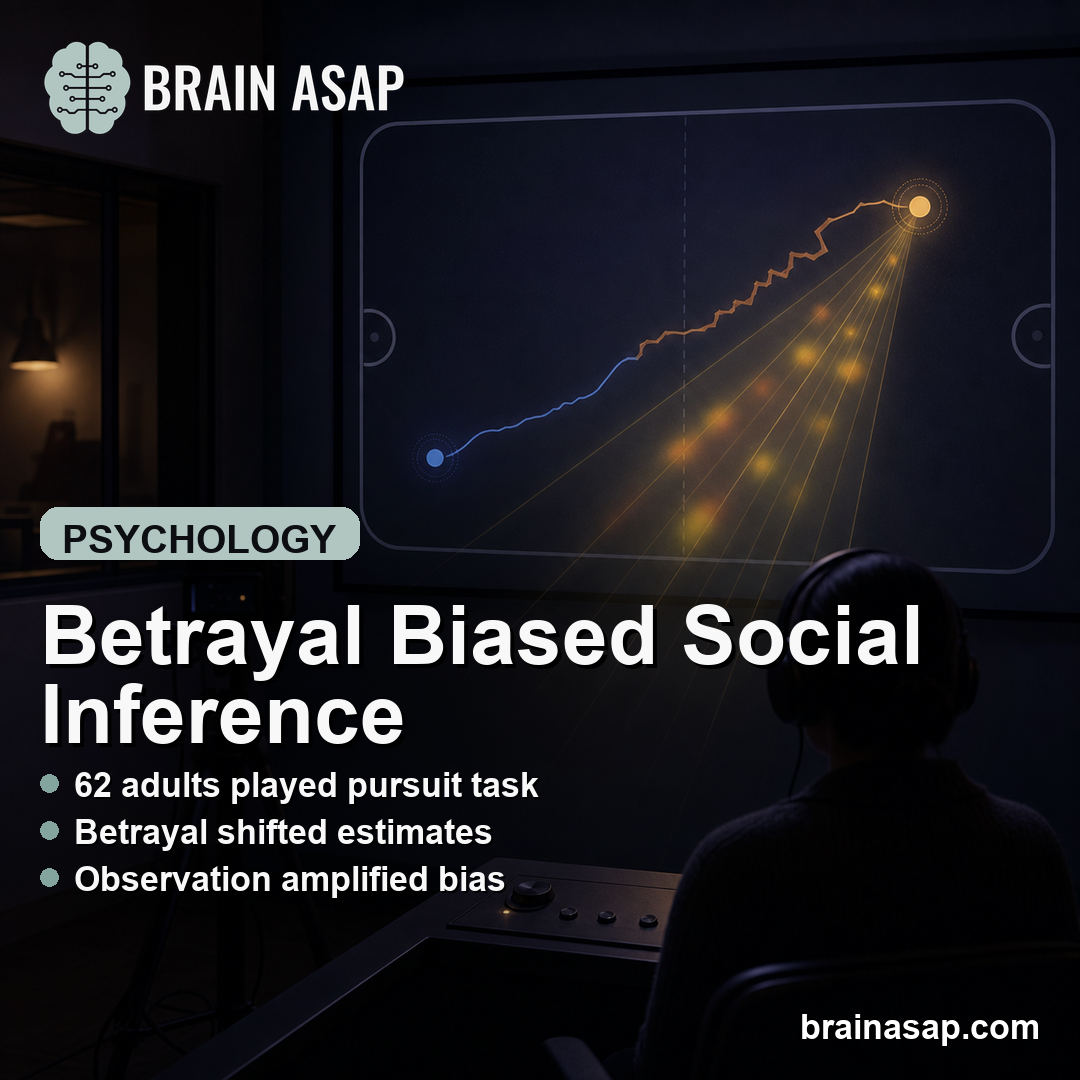
TL;DR: A 2026 study in PLOS Computational Biology found that people overestimated an opponent’s competitiveness after betrayal, especially when they chose to watch the opponent instead of controlling their own avatar.
Key Findings
- 62-person social task: 62 adults played a 2D prey-pursuit game with a computerized opponent whose hidden friendliness changed over time.
- Betrayal shifted inference: Participants overestimated competitiveness after an opponent became more competitive than expected.
- Help did not mirror betrayal: Unexpected cooperation did not produce the same size bias in the opposite direction.
- Observation choice mattered: Biases grew stronger when participants chose to observe the opponent instead of their own avatar.
- Attention had a cost: Watching the opponent reduced precise self-control, showing that social monitoring competed with action control.
Source: PLOS Computational Biology (2026) | Son and Yoo
Social inference often happens with incomplete information. People do not see every action, intention, and outcome; they choose what to watch, and that choice can shape the story they build about another person.
This experiment turned that everyday problem into a controlled game. Participants had to catch a fleeing target while deciding whether a computerized opponent was acting competitively or cooperatively.
62 Participants Estimated Opponent Competitiveness in a 2D Pursuit Task
The task included 62 participants who controlled an avatar in a 2D game. Their goal was to catch prey that moved away from both the participant and a computerized opponent.
The opponent’s behavior was governed by a hidden friendliness parameter. A more cooperative opponent herded the prey toward the participant, while a more competitive opponent intercepted the prey for itself.
- Inference phase: Participants watched a short interaction and estimated the opponent’s likely intention.
- Pursuit phase: They acted in real time while the opponent’s behavior could become more competitive or more helpful.
- Reward rule: Catching the prey faster produced more reward, so reading the opponent carried practical value.
The design mattered because the opponent’s behavior changed across phases. In the betrayal condition, the opponent looked helpful at first and then became competitive.
In the unexpected-help condition, the sequence moved in the opposite direction.
The task also separated two decisions that often get blended in social life. Participants had to decide what they believed about the opponent, and they had to decide where to spend visual attention while still trying to control their own movement.
Betrayal Produced a Stronger Bias Than Unexpected Help
The main psychological result was asymmetric. After betrayal, participants shifted toward seeing the opponent as more competitive. Unexpected help did not create an equally strong correction toward seeing the opponent as cooperative.
That asymmetry fits a familiar social pattern without turning the finding into a clinical claim. A negative surprise can become sticky because it changes what people monitor next and how they interpret later evidence.
The paper described the pattern as similar to hysteresis, a form of path dependence. In plain terms, the final belief depended not only on the current behavior but also on the path that led there.
- Same evidence, different history: A later behavior could be interpreted differently depending on whether it followed betrayal or help.
- Negative surprise weighted more: Competitive shifts after expected cooperation produced stronger inference changes.
- Belief updating stayed path-dependent: Participants did not simply average recent behavior in a neutral way.
Choosing to Watch the Opponent Increased the Bias
The experiment also tested what happened when participants chose what to observe. Watching the opponent gave more information about social intention, but it came with a trade-off: less precise control over the participant’s own avatar.
This is the study’s strongest contribution. It treats attention as limited, not free. A person who spends more attention monitoring another agent may lose detail about their own action state.
In the model and task results, selective observation amplified the post-betrayal bias. Participants who looked more at the opponent were not just gathering neutral data; they were feeding the very inference process that could become skewed by prior negative experience.
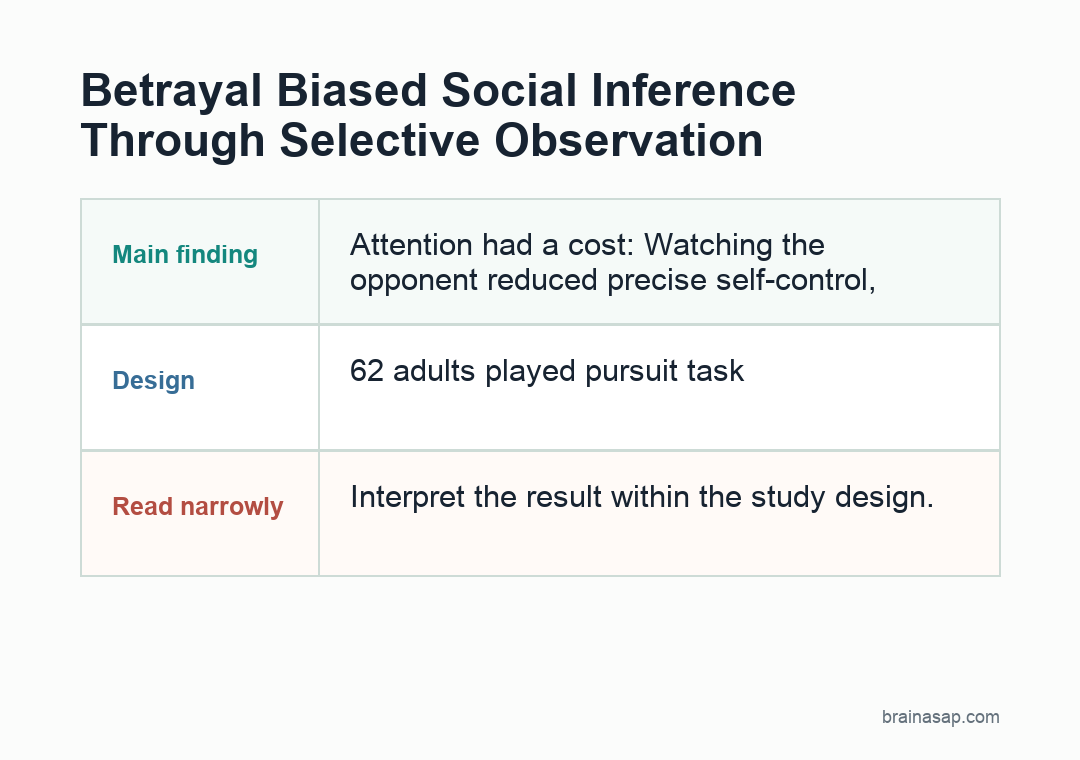
Opponent-Focused Attention Amplified Competitiveness Estimates
The result does not prove that betrayal in real relationships works exactly like a computer game. The task strips social life down to moving agents, hidden intentions, and reward feedback.
The stripped-down design isolates one mechanism: what someone chooses to observe can change how later intentions are inferred. The bias is not only about memory or emotion; it is also about sampling.
This sampling idea gives computational psychiatry a measurable bridge between attention and belief. A mistrustful belief can be studied not only as a fixed interpretation, but as the product of observations selected after a negative interaction.
- Theory of mind: People infer hidden mental states from partial cues, not complete access.
- Attention limits: Watching another person can reduce attention to self-action or other context.
- Negative history: A betrayal-like sequence can alter later interpretation even when current behavior is mixed.
The task is relevant to social cognition research, computational psychiatry, and conflict behavior. In each domain, persistent mistrust may partly reflect what people continue to sample after a negative interaction.
The Task Was Controlled, Not a Full Model of Mistrust
The main limitation is ecological. The opponent was computerized, the interaction was brief, and the social stakes were monetary reward in a game rather than friendship, workplace trust, or trauma.
The study also does not show that biased inference is always irrational. In a dangerous environment, watching a potentially competitive agent can be adaptive.
The cost appears when the sampling pattern keeps reinforcing a narrow interpretation.
The narrow point is that social beliefs are not built from all available evidence. They are built from selected evidence, and betrayal can change what people choose to monitor next.
Citation: DOI: 10.1371/journal.pcbi.1014200. Son et al. Selective observation following betrayal shapes the social inference landscape. PLOS Computational Biology. 2026;22(4):e1014200.
Study Design: Behavioral and computational social-inference experiment using a two-dimensional prey-pursuit task.
Sample Size: 62 adult participants.
Key Statistic: Participants overestimated competitiveness after betrayal, and this bias increased when they chose to observe the opponent.
Caveat: A controlled game cannot capture the emotional and relational complexity of real-world betrayal.