TL;DR: A 2026 meta-analysis in BMC Psychiatry found a moderate cross-sectional association between body dysmorphic disorder symptoms and perfectionism across 34 studies and 13,107 participants.
Key Findings
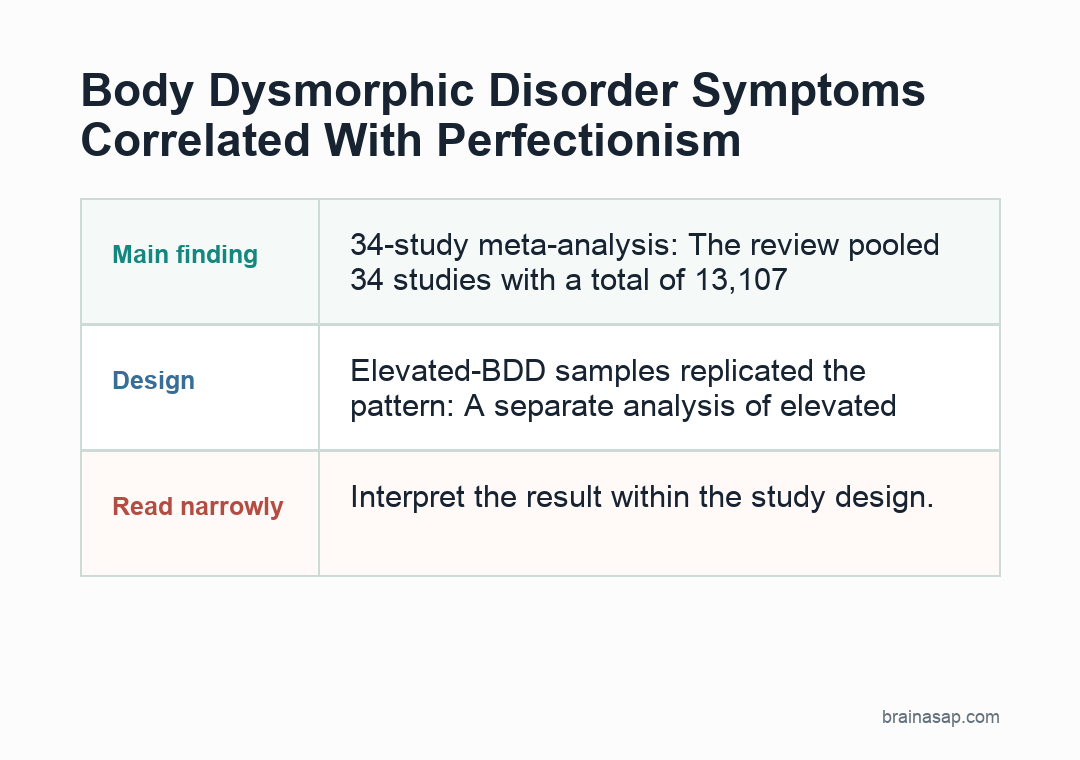
- 34-study meta-analysis: The review pooled 34 studies with a total of 13,107 participants.
- Moderate main association: Body dysmorphic disorder symptoms correlated with perfectionism at r = .32, 95% CI [.28, .36].
- Muscle dysmorphia was similar: The association was comparable in individuals with muscle dysmorphia, at r = .34.
- Elevated-BDD samples replicated the pattern: A separate analysis of elevated BDD symptoms found r = .35, 95% CI [.22, .47].
- Heterogeneity was high: The meta-analysis reported I2 = 81% and evidence of publication bias, so the average effect should not be treated as uniform.
Source: BMC Psychiatry (2026) | Stranz et al.
Body dysmorphic disorder (BDD) involves persistent distress and preoccupation with perceived flaws in appearance. Perfectionism has long been suspected as part of the clinical pattern, but individual studies have varied in size, measures, and conclusions.
This meta-analysis quantified the relationship. It did not ask whether perfectionism causes BDD; it asked how strongly BDD symptoms and perfectionism are linked across the existing cross-sectional literature.
BDD Symptoms and Perfectionism Were Linked Across 13,107 Participants
The review included 34 studies and 13,107 participants. Studies had to assess BDD symptoms and perfectionism with validated instruments, which helped keep the analysis focused on comparable constructs.
The main pooled correlation was r = .32, with a 95% confidence interval from .28 to .36. In behavioral research, that is a moderate association rather than a small incidental link.
- BDD symptoms: Measures captured appearance-related preoccupation and distress.
- Perfectionism: Measures included concern-related and striving-related dimensions.
- Cross-sectional design: Most included data measured symptoms and traits at the same time.
The association stayed broadly stable across age groups, sample types, and gender categories. That consistency supports perfectionism as a transdiagnostic correlate of BDD-related distress.
The result also gives clinicians a clearer scale for the link. A correlation of r = .32 is not so large that perfectionism can stand in for BDD screening, but it is large enough that perfectionistic self-evaluation should not be treated as a side issue when appearance distress is prominent.
Perfectionistic Concerns Fit BDD Better Than Simple High Standards
Perfectionism is not one thing. The most clinically relevant dimension is often perfectionistic concerns, such as fear of mistakes, doubts about actions, and harsh self-evaluation.
That maps closely onto BDD, where the core concern is not simply wanting to look good. The distress often centers on perceived defect, threat, scrutiny, and the belief that appearance must meet an exacting standard to be acceptable.
Perfectionistic strivings, such as setting high personal standards, can also matter, but they are not always as strongly pathological. The paper’s framing supports separating high standards from self-critical concern when clinicians assess appearance-related distress.
This difference is practical. A patient who values grooming or fitness is not necessarily showing pathological perfectionism.
The clinical signal is stronger when high standards become fused with shame, checking, avoidance, or the belief that a perceived flaw makes social life unsafe.
- Concern pathway: Fear of mistakes and self-criticism may intensify appearance checking and avoidance.
- Striving pathway: High standards may matter most when they become rigid and appearance-focused.
- Depression overlap: Some of the association weakened after controlling for depressive symptoms.
Muscle Dysmorphia Showed a Comparable Perfectionism Link
The meta-analysis also found a similar association in muscle dysmorphia, with a pooled estimate of r = .34. Muscle dysmorphia involves preoccupation with insufficient muscularity or body size, even when others do not see the same deficit.
The muscle-dysmorphia result is important because this presentation can look different from stereotypical appearance concern. It may involve exercise routines, diet rules, body checking, supplement use, and distress about muscularity rather than facial or skin features.
The comparable effect size suggests perfectionism may operate across BDD presentations, not only in one appearance domain.
It also argues against a narrow cosmetic reading of BDD. The shared thread is not the specific body part. It is the rigid evaluation of appearance against a personally threatening standard.
Depression and Publication Bias Temper the Interpretation
The relationship weakened when analyses controlled for depressive symptoms. Depression, self-criticism, and body dissatisfaction can overlap in ways that inflate simple correlations.
The review also reported I2 = 81%, meaning effect sizes varied substantially across studies. Evidence of publication bias was detected as well, although sensitivity analyses still supported the basic association.
- Not one effect size for every patient: The average correlation hides meaningful study-to-study variation.
- Not proof of causality: Cross-sectional data cannot show whether perfectionism precedes BDD symptoms.
- Not independent of depression: Shared depressive distress may explain part of the link.
Those limits do not make the finding weak. They make it clinically specific: perfectionism is a meaningful correlate, but it should be assessed alongside depression, anxiety, compulsive behaviors, and appearance-checking patterns.
Treatment Models May Need to Target Appearance-Based Self-Criticism
The paper supports a treatment question rather than a simple screening rule. If perfectionistic concerns maintain BDD symptoms, therapy may need to address rigid standards, intolerance of perceived flaws, and repeated checking or reassurance seeking.
That aligns with cognitive-behavioral approaches that challenge appearance-related beliefs and reduce compulsive behaviors. The meta-analysis suggests those interventions may benefit from explicitly naming perfectionistic self-evaluation when it is present.
Future longitudinal studies need to test sequence. The key question is whether perfectionism increases later BDD symptoms, whether BDD increases perfectionistic concern, or whether both reflect broader vulnerability to self-critical distress.
Until that timing is clearer, the safest clinical interpretation is moderate and actionable: perfectionism is not the whole disorder, but it is common enough to assess directly when BDD symptoms are present.
Citation: DOI: 10.1186/s12888-026-08044-7. Stranz et al. The cross-sectional relationship between body dysmorphic disorder and perfectionism: a meta-analysis. BMC Psychiatry. 2026;26:338.
Study Design: Random-effects meta-analysis of cross-sectional studies.
Sample Size: 34 studies with 13,107 participants.
Key Statistic: BDD symptoms correlated with perfectionism at r = .32, 95% CI [.28, .36].
Caveat: High heterogeneity, publication bias, and cross-sectional designs limit causal interpretation.