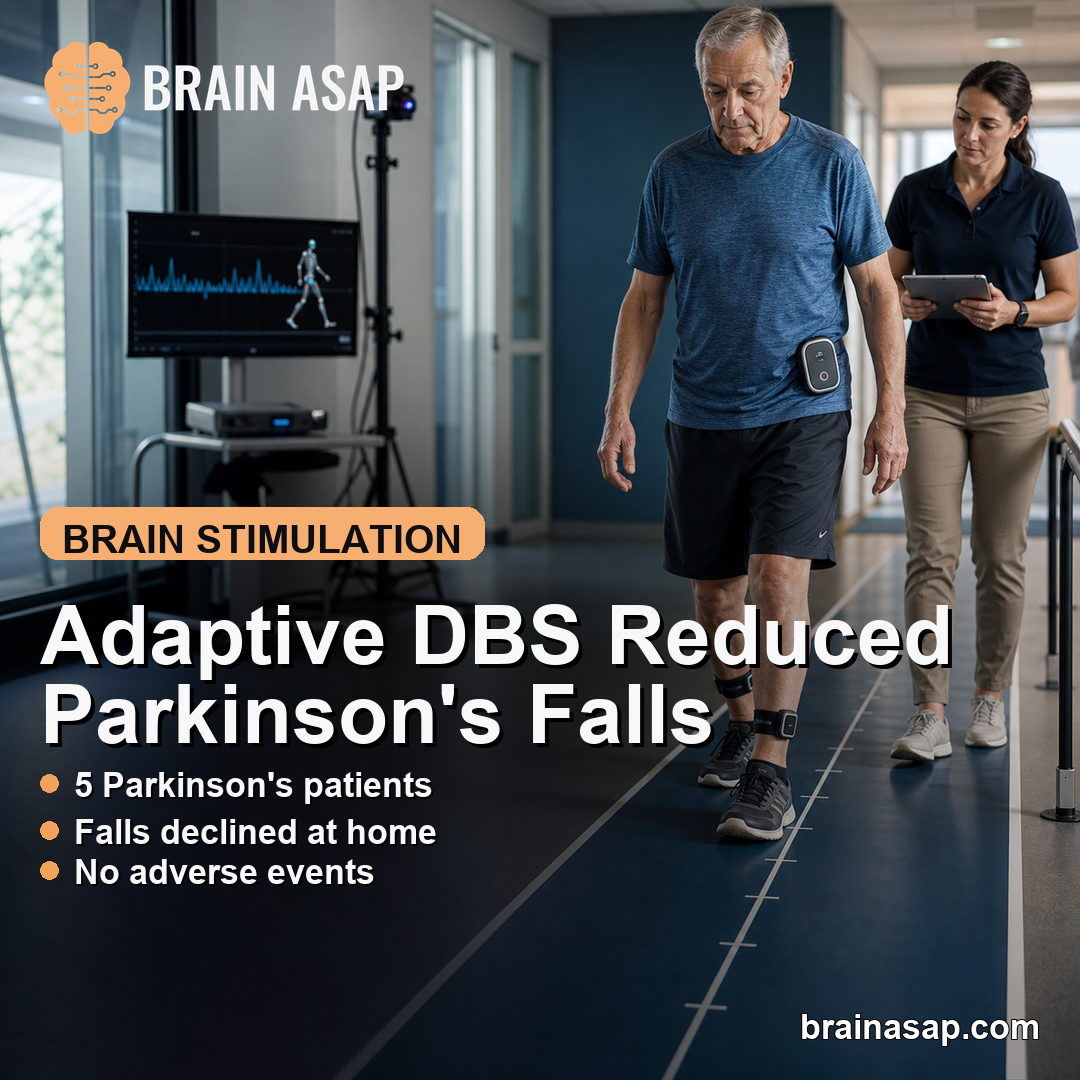
TL;DR: A 2026 randomized feasibility trial in Nature Medicine found that gait-synchronized adaptive deep brain stimulation was feasible and safe in 5 people with Parkinson’s disease, with early findings of improved gait symmetry, lower variability, and fewer reported falls than continuous stimulation.
Key Findings
- 5 Parkinson’s patients: The 1-center feasibility trial enrolled people with Parkinson’s disease, gait problems, pallidal DBS, and cortical recording electrodes.
- Biomarkers found in all 5: Patient-specific neural markers of contralateral leg swing were identified from cortical or pallidal field potentials in every participant.
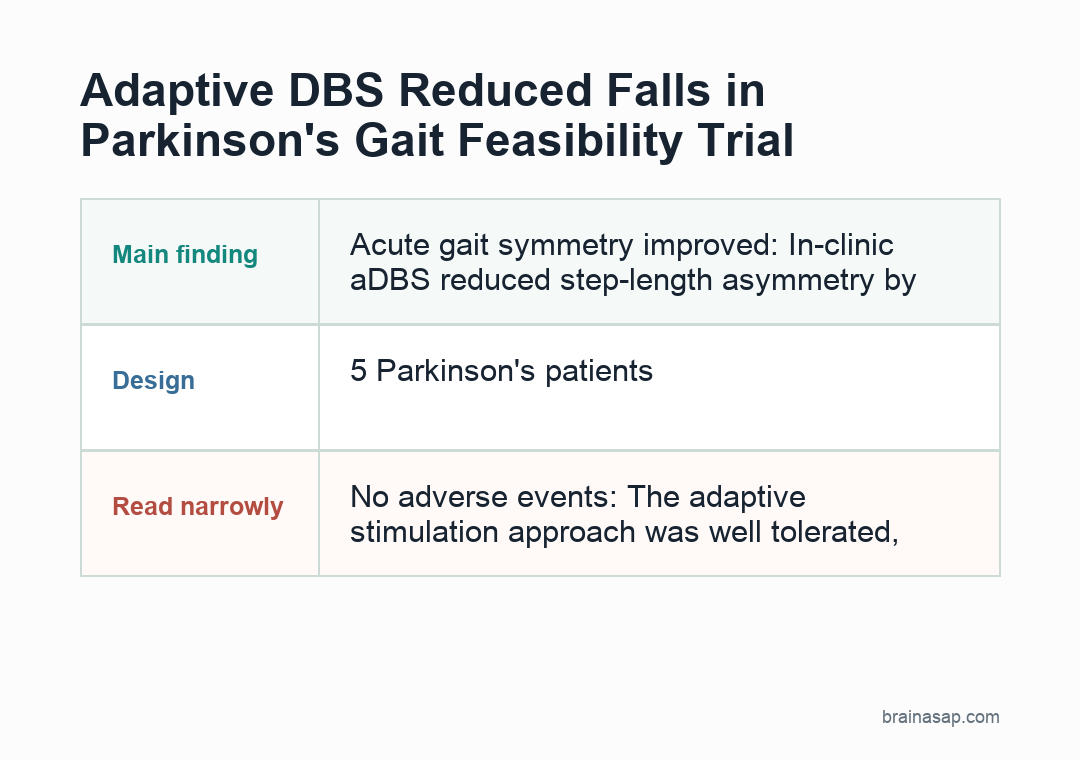
- Acute gait symmetry improved: In-clinic aDBS reduced step-length asymmetry by 3.5% and reduced step-time variability in both legs.
- 3 completed home crossover: In the blinded multi-day phase, ramp-up aDBS reduced reported falls versus continuous DBS, OR = 4.35, p = .047.
- No adverse events: The adaptive stimulation approach was well tolerated, but the trial was too small to prove clinical efficacy.
Source: Nature Medicine (2026) | Louie et al.
Adaptive deep brain stimulation (aDBS) adjusts stimulation in response to real-time neural markers. In this study, the marker was tied to gait phase, so stimulation changed as each leg moved through the walking cycle.
That is different from ordinary continuous deep brain stimulation (cDBS), which delivers stimulation at a steady setting. Continuous stimulation can improve some Parkinson’s symptoms, but gait and falls often remain difficult to treat.
Gait-Synchronized aDBS Used Patient-Specific Neural Biomarkers
The trial enrolled 5 people with Parkinson’s disease who had gait problems and were undergoing pallidal DBS. Participants also had subdural cortical electrode paddles, allowing researchers to record neural activity during walking.
The main feasibility question was whether each patient had a usable neural marker of contralateral leg swing. Contralateral swing means the leg opposite the recording hemisphere is in the air during the gait cycle.
- Recording sites: Biomarkers came from the internal globus pallidus or motor cortical areas, depending on the patient and hemisphere.
- Frequency ranges: Useful neural markers appeared across theta, alpha, beta, and low-gamma ranges rather than 1 universal band.
- Device control: The selected biomarker was embedded into a bidirectional neurostimulator to change stimulation during walking.
The personalized design followed the data because the optimal biomarker differed across patients and sometimes across hemispheres within the same patient. A fixed universal marker would likely miss some gait-phase information.
Adaptive DBS Improved Step Symmetry During Clinic Walking
During acute in-clinic testing, patients initially used clinically optimized cDBS and then switched to individualized aDBS. The adaptive setting ramped stimulation from 0.5x to 1.0x of the optimized amplitude during contralateral leg swing.
Compared with cDBS, aDBS improved group-level gait symmetry. Step-length asymmetry decreased by 3.5%, and step-time asymmetry variability decreased even when median step-time asymmetry changed only slightly.
Step variability also moved in the intended direction. Median step-length variability decreased by 39.1% on the left and 31.6% on the right, while step-time variability decreased by 16.0% and 26.6%.
Individual responses varied. 3 patients had significant step-length symmetry improvements, while 1 patient worsened on median step-length symmetry but improved variability.
Home Crossover Testing Found Fewer Reported Falls With Ramp-Up aDBS
Only 3 patients completed the double-blinded multi-day home crossover phase. They tested continuous DBS, ramp-up aDBS, and ramp-down aDBS in randomized order for 8 to 10 days per condition.
In daily motor diaries, ramp-up aDBS was associated with lower fall-frequency categories compared with cDBS. The cumulative link model reported OR = 4.35, p = .047, and a 95% CI of 1.07 to 20.22.
- Falls: Ramp-up aDBS reduced reported fall frequency at the group level.
- Freezing: No group-level reduction in freezing episodes was observed.
- Stiffness: Patient-reported stiffness was more likely to be rated worse during both adaptive settings.
- Tremor and dyskinesia: No significant group-level effects were observed.
Wearable ankle sensors also suggested gait changes at home. Both adaptive settings improved stride length and step symmetry compared with cDBS, while walking speed and cadence changed only minimally at the group level.
Adaptive DBS Mostly Preserved General Parkinson’s Motor Control
The trial also checked whether gait-focused adaptive stimulation disrupted broader Parkinson’s motor control. Blinded in-clinic assessments at the end of each home phase used the Movement Disorder Society Unified Parkinson’s Disease Rating Scale part III, or MDS-UPDRS-III.
Patients 2 and 3 had lower, better motor scores under both adaptive settings than under cDBS. Patient 4 had a slight worsening of 1 to 3 points under adaptive stimulation.
- Stride length: At-home wearable data showed larger gains with ramp-down aDBS, about 4.7%, than with ramp-up aDBS, about 0.9%.
- Step asymmetry: Ramp-up aDBS produced the larger reduction, about 2.37%, compared with 0.36% for ramp-down aDBS.
- Walking speed: Group-level speed changes were small, around 0.01 to 0.04 m/s.
Those mixed results fit the feasibility design. The system could change gait metrics without obvious loss of general motor control, but the preferred adaptive setting may differ by outcome and patient.
Small Sample Size Keeps the Parkinson’s DBS Result Preliminary
The study is best read as a feasibility and mechanism trial. It shows that gait-phase biomarkers can drive a stimulation system in real patients, but 5 participants and 3 home-crossover completers are not enough to establish clinical efficacy.
- 1 center: The trial used a highly specialized surgical and engineering setup.
- Small crossover phase: The home comparison depended on 3 patients, with patient-specific responses.
- Straight-line walking focus: Biomarkers were optimized for straight walking, while turning behavior remained less specifically controlled.
- Mixed symptom tradeoffs: Falls improved under ramp-up aDBS, but stiffness ratings worsened under adaptive settings.
The next clinical question is whether a larger randomized trial can reproduce the fall and gait improvements without worsening other Parkinson’s symptoms. The current evidence supports further testing, not routine clinical adoption.
Citation: DOI: 10.1038/s41591-026-04434-2. Louie et al. Adaptive deep brain stimulation for dynamic gait control in Parkinson’s disease: a randomized feasibility trial. Nature Medicine. 2026.
Study Design: 1-center blinded randomized feasibility trial with acute in-clinic testing and a small double-blinded multi-day crossover phase.
Sample Size: 5 people with Parkinson’s disease enrolled; 3 completed the home crossover phase.
Key Statistic: Ramp-up adaptive DBS reduced reported fall-frequency categories versus continuous DBS, OR = 4.35, p = .047, 95% CI 1.07 to 20.22.
Caveat: The sample was very small, highly instrumented, and designed for feasibility rather than definitive clinical efficacy.