TL;DR: A 2026 randomized phase 2 trial in Nature Medicine found that three targeted drugs added to radiotherapy did not improve overall survival for children with diffuse intrinsic pontine glioma (DIPG), a lethal brainstem tumor, although everolimus caused fewer treatment-stopping side effects.
Key Findings
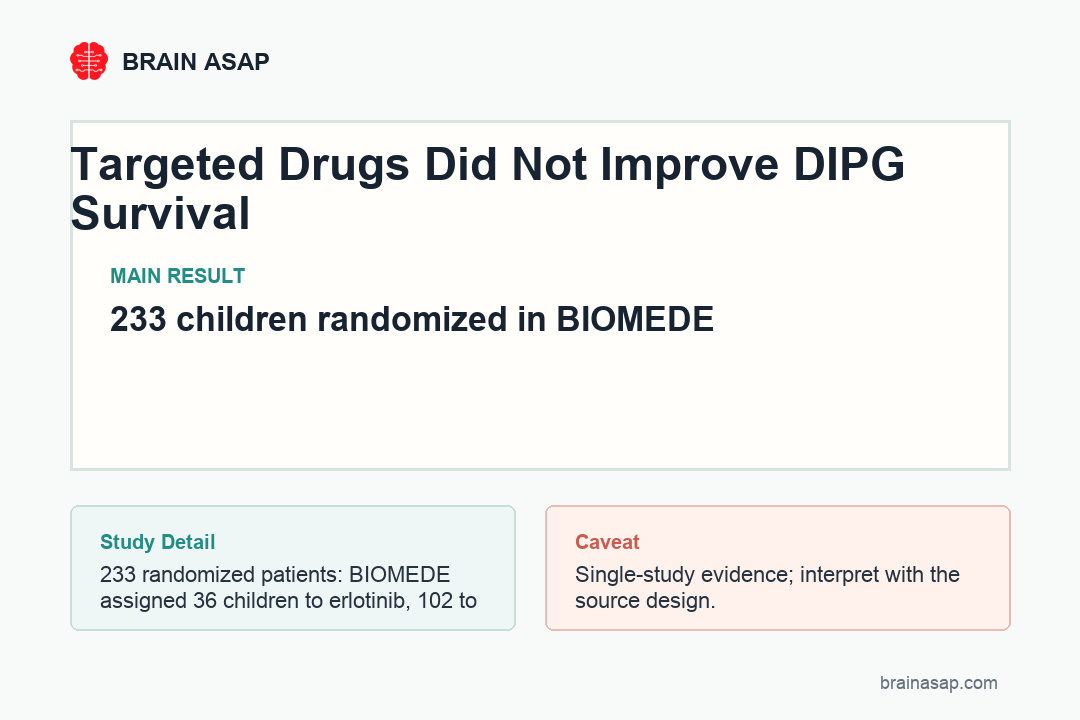
- 233 randomized patients: BIOMEDE assigned 36 children to erlotinib, 102 to dasatinib, and 95 to everolimus, each combined with radiotherapy.
- No survival separation: Median overall survival was 9.7 months with erlotinib, 9.9 months with dasatinib, and 11.9 months with everolimus.
- Historical control stayed similar: A 66-child comparison cohort had median overall survival of 10.8 months.
- Everolimus was better tolerated: Treatment stopped for toxicity in 3% of everolimus patients, compared with 20% for erlotinib and 14% for dasatinib.
- TP53 mutation predicted worse survival: TP53-mutated tumors had a multivariable hazard ratio of 2.84 for death and median survival of about 8 months versus 15 months for TP53-wild-type tumors.
Source: Nature Medicine (2026) | Debily et al.
Diffuse intrinsic pontine glioma (DIPG) grows in the pons, a brainstem region that controls essential functions such as breathing, swallowing, and movement pathways. Surgery is not a realistic curative option for most patients, so radiotherapy has remained the central treatment even though survival usually stays short.
BIOMEDE Tested Erlotinib, Dasatinib, and Everolimus With Radiotherapy
Researchers designed BIOMEDE as a biomarker-driven randomized phase 2 trial. Tumors were assessed for EGFR overexpression and PTEN loss, along with whole-exome and RNA sequencing.
The trial compared three targeted therapies with radiotherapy: erlotinib, an EGFR inhibitor; everolimus, an mTOR inhibitor; and dasatinib, a multitarget tyrosine kinase inhibitor.
Randomization depended on tumor biomarker status:
- EGFR-positive without PTEN loss: Patients could be randomized between erlotinib and dasatinib.
- PTEN loss without EGFR overexpression: Patients could be randomized between everolimus and dasatinib.
- Both markers present: Patients could be randomized among erlotinib, everolimus, and dasatinib.
All patients received radiotherapy at 54 Gy. The primary endpoint was overall survival, meaning time from biopsy or randomization until death from any cause, depending on the analysis.
Targeted Therapy Did Not Improve DIPG Overall Survival
The trial stopped randomization for futility after review by the independent data monitoring committee. Survival did not clearly improve in any of the three targeted-drug arms.
From biopsy, median overall survival was 9.7 months for erlotinib, 9.9 months for dasatinib, and 11.9 months for everolimus. The historical control cohort had median survival of 10.8 months.
That historical-control group came from patients treated before BIOMEDE at Gustave Roussy, and the paper reports that most received radiotherapy plus temozolomide.
Pairwise randomized comparisons also did not show a significant survival advantage:
- Erlotinib versus dasatinib: Hazard ratio 0.87, with median survival of 9.0 versus 8.5 months in the randomized comparison.
- Erlotinib versus everolimus: Hazard ratio 0.94, with median survival of 10.2 versus 10.5 months.
- Everolimus versus dasatinib: Hazard ratio 0.89, with median survival of 11.3 versus 9.4 months.
Everolimus Had Fewer Toxicity Stops Than the Other Arms
Everolimus did not prove a survival advantage in the whole randomized trial, but it did look easier to tolerate. The paper reported fewer ocular, renal, skin, gastrointestinal, and infectious adverse events with everolimus than with the other drugs.
Treatment discontinuation for toxicity was especially different. Toxicity stopped therapy in 20% of erlotinib patients, 14% of dasatinib patients, and 3% of everolimus patients.
The tolerability difference affects future trial design because DIPG treatment already includes radiotherapy, neurologic symptoms, and a short disease course. A drug that does not extend survival in an unselected group may still be useful as a better-tolerated control arm or as a candidate for biomarker-selected testing.
TP53 Mutation Marked Higher-Risk DIPG Biology
BIOMEDE also produced a large molecular dataset. TP53 mutation was the strongest adverse prognostic marker in the planned multivariable analysis.
Patients with TP53-mutated tumors had a hazard ratio of 2.84 for death after adjustment. Median survival was about 8 months for TP53-mutated tumors versus 15 months for TP53-wild-type tumors.
The TP53-mutated tumors also showed broader genomic instability. Researchers reported a median proportion of genome altered of 26% in TP53-mutant tumors compared with 13% in TP53-wild-type tumors.
mTOR-Pathway Tumors May Need Separate Everolimus Testing
The trial’s broad survival result was negative, but the exploratory biomarker analysis pointed toward a narrower hypothesis. Tumors with mTOR-pathway activation or PIK3/AKT/MTOR pathway mutations appeared more likely to benefit from everolimus than from dasatinib.
In that subgroup-oriented reading, BIOMEDE separates two claims that should not be blended:
- Whole-trial claim: Targeted therapy plus radiotherapy did not improve survival for unselected biopsy-proven DIPG.
- Drug-selection claim: Everolimus had a better tolerability profile than erlotinib or dasatinib.
- Biomarker claim: mTOR-pathway features may help identify patients for future everolimus-focused trials.
Four long-term survivors treated with an mTOR inhibitor were alive and off treatment for more than 6 years. That observation is not proof of efficacy by itself, but it gives future trial design a concrete molecular direction.
The narrower mTOR hypothesis also follows from the trial design. A broadly negative targeted-therapy trial can still identify which molecular subgroups should be separated instead of averaged together in the next study.
The BIOMEDE Result Is Negative, but Not Empty
For families and clinicians, the main result is painful but clear: these three targeted drugs did not change the overall survival picture for DIPG when added to radiotherapy in the full randomized trial.
For researchers, BIOMEDE still narrows the next step. TP53 status should be treated as a major prognostic factor, everolimus is the better-tolerated comparator among the tested drugs, and mTOR-pathway tumors deserve more specific study.
The result also supports biopsy and molecular profiling as research tools in DIPG. The targeted drugs did not rescue the overall survival endpoint, but the molecular data helped explain risk, tolerability, and which pathway should be tested with a cleaner biomarker-selected design.
Citation: DOI: 10.1038/s41591-026-04354-1. Debily et al. Targeted therapies plus radiotherapy for diffuse intrinsic pontine glioma: the randomized phase 2 BIOMEDE trial. Nature Medicine. 2026.
Study Design: Biomarker-driven randomized phase 2 trial with molecular profiling and historical-control comparison.
Sample Size: 233 randomized patients with biopsy-proven DIPG, plus a 66-child historical control cohort.
Key Statistic: Median overall survival was 9.7 months for erlotinib, 9.9 months for dasatinib, 11.9 months for everolimus, and 10.8 months in the control cohort.
Caveat: The trial stopped for futility on the primary survival endpoint, while biomarker-response findings were exploratory.