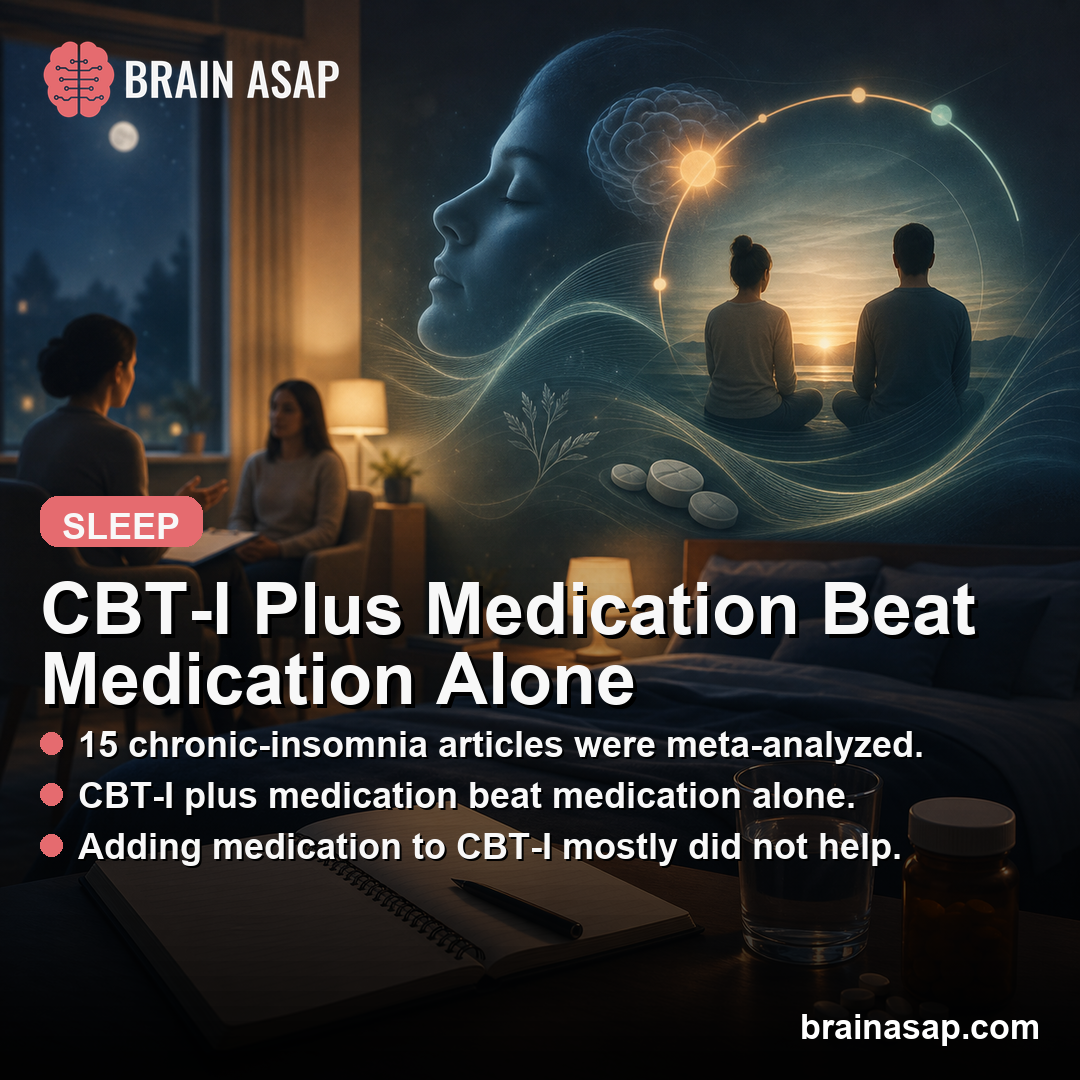
TL;DR: A 2026 systematic review in Journal of Clinical Sleep Medicine found that cognitive behavioral therapy for insomnia (CBT-I), a structured behavioral sleep treatment, plus sleep medication improved chronic insomnia more than medication alone, but adding medication to CBT-I did not improve the critical insomnia outcomes.
Key Findings
- 15 analyzable articles: Researchers screened 1,179 articles, and 15 provided data suitable for meta-analyses of chronic insomnia combination treatment.
- Medication-alone comparison favored combination treatment: Versus pharmacological treatment alone, combination treatment improved global insomnia severity with a standardized mean difference of -0.67 across 178 participants.
- Sleep continuity improved versus medication alone: Combination treatment was linked to sleep efficiency that was 3.5 percentage points higher, sleep onset latency (SOL), or time needed to fall asleep, that was 7.6 minutes faster, and wake after sleep onset (WASO), or time awake after initially falling asleep, that was 13.9 minutes lower.
- CBT-I-alone comparison did not favor combination treatment: Versus CBT-I alone, combination treatment showed little to no difference in global insomnia severity, with Insomnia Severity Index (ISI) scores about 0.45 points higher in the combination group.
- Total sleep time was the main possible add-on benefit: Combination treatment increased diary total sleep time by 13.81 minutes versus CBT-I alone, but the review treated total sleep time as important rather than critical evidence.
Source: Journal of Clinical Sleep Medicine (2026) | Buysse et al.
CBT-I plus sleep medication is common in real-world insomnia care because patients often want fast relief while also learning behavioral sleep skills. The American Academy of Sleep Medicine review asked whether that combined approach works better than either treatment by itself.
The Review Asked Two Different Insomnia Treatment Questions
Combination treatment can sound like one simple clinical idea: use CBT-I and medication together. The review separated that idea into two comparisons because the answer depends on what the alternative is.
- Combination versus medication alone: This asks whether adding a behavioral-psychological treatment improves outcomes for adults who would otherwise receive sleep medication by itself.
- Combination versus CBT-I alone: This asks whether adding medication improves outcomes for adults who are already receiving CBT-I or a similar behavioral sleep treatment.
The comparison depends on the active treatment being tested because CBT-I is not a sleep-tip handout. It usually includes stimulus control, sleep restriction or sleep compression, sleep-hygiene counseling, relaxation methods, and cognitive work around unhelpful sleep beliefs.
Medication can reduce symptoms quickly, but CBT-I targets the behaviors and learned associations that keep insomnia going. The central question was whether using both at the same time adds enough benefit to justify the added cost, time, and treatment burden.
CBT-I Plus Medication Improved Insomnia More Than Medication Alone
Against medication alone, the combination approach performed better on the review’s critical sleep outcomes.
Four randomized controlled trials contributed to the global insomnia severity analysis, using measures such as the Pittsburgh Sleep Quality Index (PSQI), a self-rated sleep-quality questionnaire, the Insomnia Severity Index (ISI), a symptom-severity questionnaire, and the Sleep Impairment Index.
The pooled result showed a clinically meaningful improvement in global insomnia severity for the combination group. Re-expressed on the PSQI scale, combination treatment was associated with a score about 2.5 points lower than medication alone, clearing the review’s one-point clinical-meaningfulness threshold.
Sleep continuity also favored combination treatment. Across four randomized trials, the combined approach produced a clinically meaningful advantage over medication alone:
- Sleep efficiency: The percentage of time in bed spent asleep was 3.5 points higher, matching the review’s threshold for a meaningful change.
- Sleep onset latency: Participants fell asleep 7.6 minutes faster, just past the seven-minute threshold.
- Wake after sleep onset: Participants spent 13.9 fewer minutes awake after initially falling asleep, also past the seven-minute threshold.
Total sleep time did not clearly favor the combination approach versus medication alone. The diary-based estimate was 15.48 minutes lower in the combination group, with a confidence interval wide enough to include benefit in either direction.
Adding Medication to CBT-I Did Not Improve Critical Outcomes
The clinical picture changed when CBT-I was the comparator. In that analysis, adding medication did not improve the critical outcomes that mattered most to the task force: global insomnia severity, sleep continuity, and daytime symptoms.
For global insomnia severity, the pooled estimate showed little to no difference between combination treatment and CBT-I alone. Re-expressed on the ISI scale, the combination group scored about 0.45 points higher, with a confidence interval that crossed small benefit and small harm.
Sleep continuity showed the same pattern. Compared with CBT-I alone, the combination group had sleep efficiency 1.28 points higher, fell asleep 2.63 minutes faster, and spent 4.48 fewer minutes awake after initially falling asleep.
Those estimates numerically favored combination treatment, but none reached the review’s pre-specified thresholds for clinical meaning. The differences were too small and too uncertain to show that medication added a meaningful improvement once CBT-I was already in place.
Total Sleep Time Was the Main Possible Add-On Benefit
The strongest reason someone might still prefer combination treatment over CBT-I alone was total sleep time. Diary data from four randomized trials showed 13.81 more minutes of total sleep time for combination treatment versus CBT-I alone.
The task force treated total sleep time as important, but not as a critical outcome for the main recommendation.
That choice keeps the interpretation grounded: sleeping a little longer may matter to some patients, but it did not override the lack of clear advantage on insomnia severity, sleep continuity, or daytime outcomes.
Daytime outcomes were also mixed. Versus medication alone, combination treatment did not produce a clinically meaningful daytime improvement; re-expressed on the Beck Depression Inventory (BDI), a depression-symptom scale, the combination group scored 1.5 points lower, below the review’s 2.5-point threshold.
Versus CBT-I alone, daytime symptom estimates did not support a combination advantage. The review also found no treatment-side-effect data for the CBT-I-alone comparison, leaving a practical evidence gap for patients weighing medication add-ons.
Cost and Treatment Burden Shape the Insomnia Decision
If the real alternative is medication alone, adding CBT-I or a behavioral-psychological treatment can improve insomnia severity and sleep continuity.
If the real alternative is CBT-I alone, medication is not clearly adding enough benefit on the critical outcomes. A patient who mainly wants longer sleep early in treatment may still reasonably choose combination care, but the evidence does not make that the default superiority claim.
Cost is part of that decision. The review cited CBT-I costs of about $100 to $200 per session, while generic medications listed in the review were priced in cents per dose.
Insurance coverage, time, clinician access, and willingness to do behavioral sleep work can therefore affect which treatment is realistic.
The medication-alone comparison should not be read as a reason to skip CBT-I. It says the opposite: adding behavioral treatment to medication did better than medication by itself on the main sleep outcomes.
Small Older Trials Limited the Combination-Treatment Evidence
The review rated the overall certainty of evidence as low for both main comparisons, mostly because of risk of bias and imprecision. Clinicians can use the estimates for decision-making, but the evidence should not be treated as a final answer for every insomnia patient.
- Small trial base: Most studies in the final analytic sample had fewer than 100 participants, and the largest had 160.
- Older methods: Many included studies were more than 10 years old, before some current trial-reporting standards were routine.
- Narrow treatment sequence: The review focused on concurrent combination treatment, not common real-world sequences such as starting CBT-I first and adding medication only for nonresponse.
- Limited subgroup evidence: The literature did not adequately address race, ethnicity, comorbid mental health conditions, medical illness, or other patient characteristics that may change treatment choice.
CBT-I plus medication looks better than medication alone for chronic insomnia, but medication does not clearly improve the main outcomes when CBT-I is already the comparator.
Citation: DOI: 10.1007/s44470-025-00039-7. Buysse et al. Combination treatment for chronic insomnia disorder in adults: an American Academy of Sleep Medicine systematic review, meta-analysis, and GRADE assessment. Journal of Clinical Sleep Medicine. 2026;22:58.
Study Design: Systematic review, meta-analysis, and GRADE assessment supporting an American Academy of Sleep Medicine clinical practice guideline.
Sample Size: 1,179 screened articles; 15 articles contributed data suitable for meta-analyses.
Key Statistic: Versus medication alone, combination treatment improved global insomnia severity (SMD -0.67; 95% CI -0.97 to -0.36; n = 178), but versus CBT-I alone it showed little to no difference (SMD 0.10; 95% CI -0.17 to 0.37; n = 228).
Caveat: Overall certainty was low because the evidence base was small, older, and limited by risk of bias and imprecision.