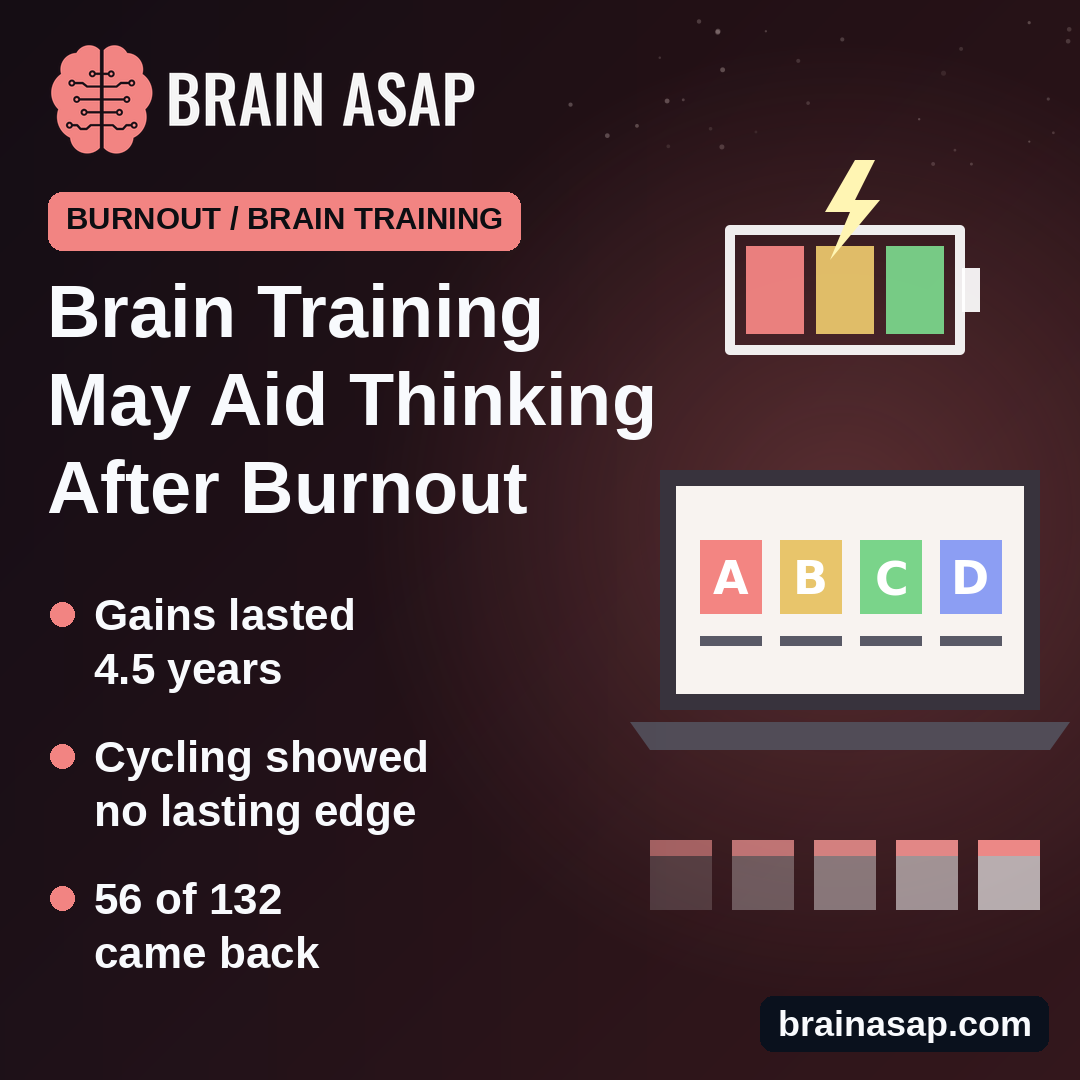
TL;DR: People recovering from stress-related exhaustion who did 12 weeks of computer brain training showed larger gains in thinking scores over 4.5 years than people who got rehab alone. Indoor cycling did not show the same lasting edge, but only 56 of 132 people came back.
Key Findings
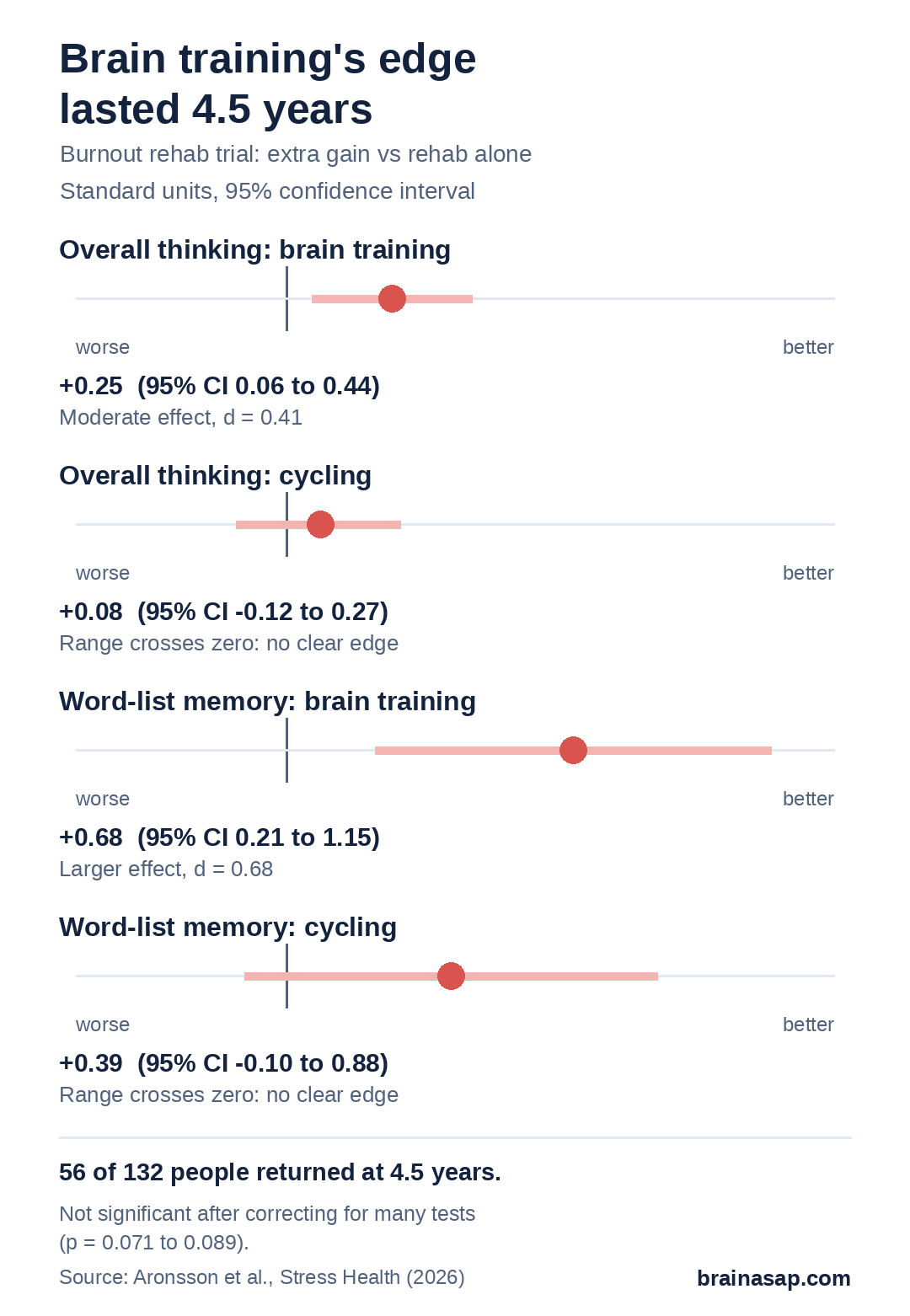
- Brain training held up: Bigger gains than rehab alone on overall thinking score (p = 0.011) and memory for word lists (p = 0.005) after 4.5 years.
- Cycling did not: No lasting edge on any thinking test.
- Gains were stable: No real change in either group between year 1 and year 4.5.
- Fragile statistics: After correcting for testing many outcomes, no thinking result stayed significant (p = 0.071 to 0.089).
- Heavy dropout: 56 of 132 starters returned, only 16 in the cycling group.
Source: Stress and Health (2026) | Aronsson et al.
Burnout does not always end when the exhaustion lifts. Many people say their memory and focus stay foggy for years afterward. So can anything done during recovery still help several years down the line?
A Swedish team went back to patients from a rehab trial 4.5 years after it ended to find out.
Three Groups in a Swedish Stress Clinic
All participants had exhaustion disorder, the Swedish medical diagnosis for clinical burnout. They were 18 to 60, employed, on sick leave, and enrolled in a 24-week group rehab program based on cognitive behavioral therapy at a university hospital clinic between 2010 and 2013.
Halfway through rehab, 132 people were randomly split three ways for 12 weeks:
- Rehab only: The standard program and nothing else.
- Brain training: Rehab plus an online program of about 20 minutes per session, with adaptive tasks for memory, updating and switching between tasks. Most sessions were done at home.
- Cycling: Rehab plus 40-minute instructor-led indoor cycling classes at moderate to vigorous intensity.
Everyone took the same battery of nine thinking tests and filled in symptom questionnaires before the extra training, right after it, one year later and 4.5 years later.
The Brain Training Group Kept Its Edge
Compared with rehab only, the brain training group improved more on an overall thinking score built from all nine tests. The difference was moderate in size (Cohen’s d = 0.41). Memory for lists of words showed a larger gap (d = 0.68). The group also stayed better at the letter-memory task it had practiced, which is less surprising.
Between the one-year and 4.5-year visits, scores in both groups barely moved, so the training gains looked stable rather than fading or growing.
Cycling Helped Fitness Early but Did Not Last for Thinking
Cycling gave no lasting edge on the overall score (d = 0.13) or any single thinking area. That matches the team’s one-year results, when the early gains from cycling had already faded. The authors suspect most people simply stopped exercising regularly once the classes ended.
Executive function, working memory, processing speed and reasoning showed no lasting difference for either training group.
Burnout Scores Improved, but Dropout Muddies Them
On questionnaires, both training groups reported larger drops in burnout than the rehab-only group. The cycling group also reported less anxiety and better work ability, and both training groups reported fewer everyday memory slips on one of two memory questionnaires.
The authors urge caution here. These mood and work gains in the cycling group appeared between year 1 and year 4.5, not right after training. The researchers found it more likely that people who were doing worse stopped coming back than that cycling had a delayed effect. In the brain training group, those who dropped out had reported more burnout, fatigue and depression at earlier visits.
Small, Shrinking Groups Limit What This Shows
- Most people left: 56 of 132 came back; 49% of rehab-only, 45% of brain training and 34% of cycling.
- Corrections erase significance: After adjusting for many tests, the thinking results fell to p = 0.071 to 0.089.
- Returners differed: People who completed the final visit had higher verbal ability at the start.
- One clinic in Sweden: Results may not carry over to other burnout care.
Worth Testing in a Larger Burnout Trial
The pattern is encouraging: a short, home-based training program added to rehab was linked to better thinking scores years later, and the gains did not fade between year 1 and year 4.5. But with so many people lost and results that weaken after correction, this is a reason to test brain training in a bigger burnout trial, not proof that it works.
The open question is whether these lasting gains hold up when most participants stay in the study to the end.
Citation: DOI: 10.1002/smi.70218. Aronsson I, Stigsdotter Neely A, Boraxbekk CJ, Eskilsson T, Gavelin HM. Extended long-term effects of cognitive and aerobic training on cognitive function in patients with stress-related exhaustion disorder: a 4.5-year follow-up of a randomized controlled trial. Stress Health. 2026;42:e70218.
Study Design: 4.5-year follow-up of the RECO randomized controlled trial (three arms) at a Swedish university hospital stress clinic.
Sample Size: 132 randomized; 56 returned at 4.5 years (21 rehab only, 19 brain training, 16 cycling).
Key Statistic: Brain training vs rehab only, overall thinking score: β = 0.25 (95% CI 0.06 to 0.44), p = 0.011, d = 0.41.
Caveat: High attrition; no thinking outcome remained significant after false-discovery-rate correction.