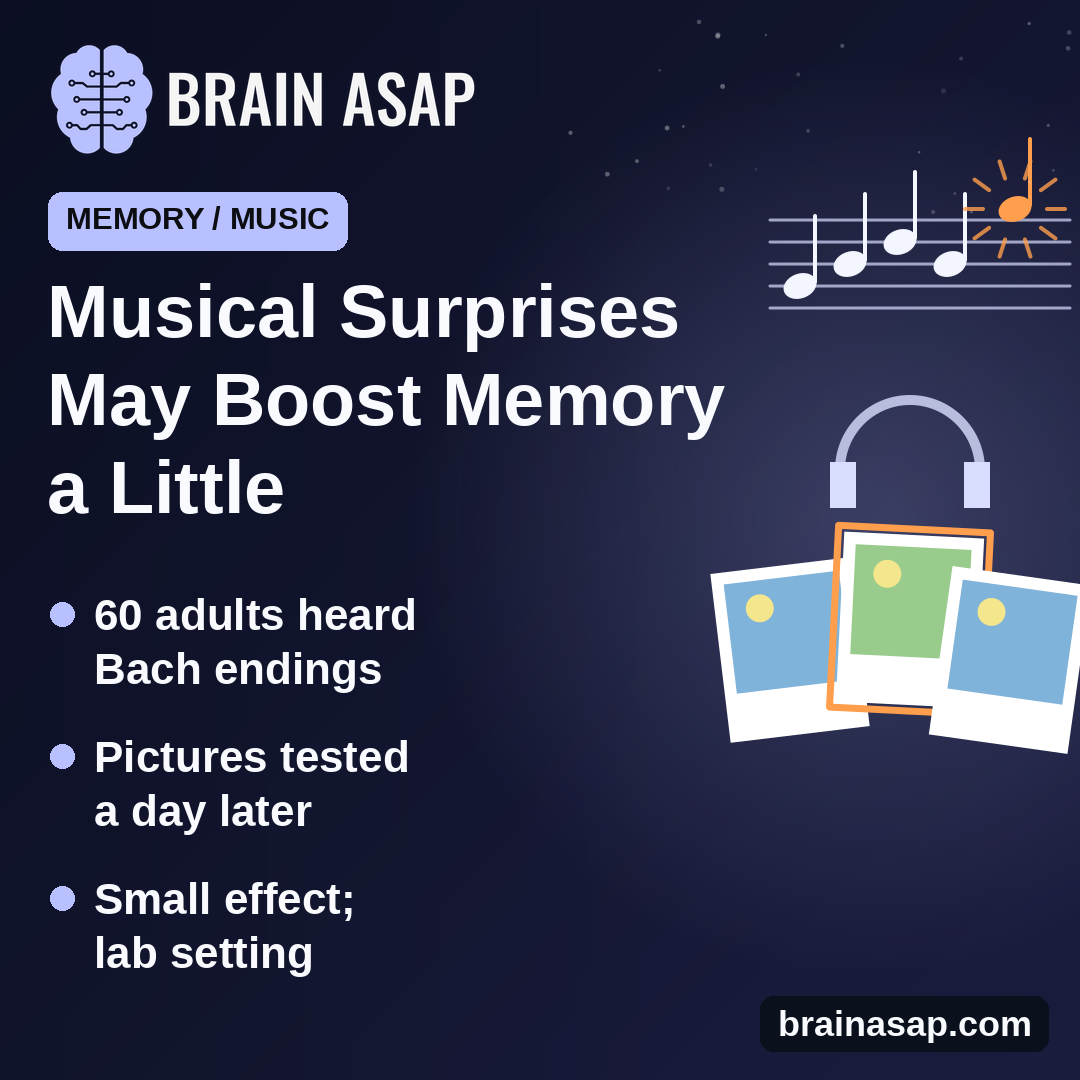
TL;DR: When a piece of music ended differently than people expected, they were a bit more likely to remember pictures they saw around that moment a day later. The effect was small and showed up in trial-by-trial analyses, not in simple group averages.
Key Findings
- 60 young adults: Listened to Bach chorales while viewing neutral pictures.
- Instruments set expectations: One usually ended sweetly, the other usually ended off-key.
- Bigger surprise, better memory: Picture recognition rose with how unexpected the ending was.
- Confidence too: Especially for pictures seen just before the ending.
- Group averages showed no clear gain: The link appeared only trial by trial.
Source: Psychonomic Bulletin & Review (2026) | Benes et al.
Part of what makes music moving is expectation: we sense where a melody is heading, and feel it when the music surprises us. Surprise is also known to help memory. When something doesn’t go as predicted, the brain flags it as worth storing.
Researchers at the University of Haifa in Israel asked whether musical surprises also help people remember unrelated things they see at the same moment.
Bach Endings That Went Sweet or Sour
Sixty adults, average age about 24, listened to 40 short Bach chorales, each about 26 seconds long. Every chorale ended either with a normal, pleasant chord or a deliberately clashing, off-key one.
The instrument hinted at the ending:
- One instrument: Ended pleasantly 75% of the time.
- The other instrument: Ended off-key 75% of the time.
So each ending was either expected or a surprise. During each piece, people saw four neutral pictures, two just before the ending and two just after. A day later, they took a memory test for the pictures and rated their confidence.
People Clearly Heard the Clashes
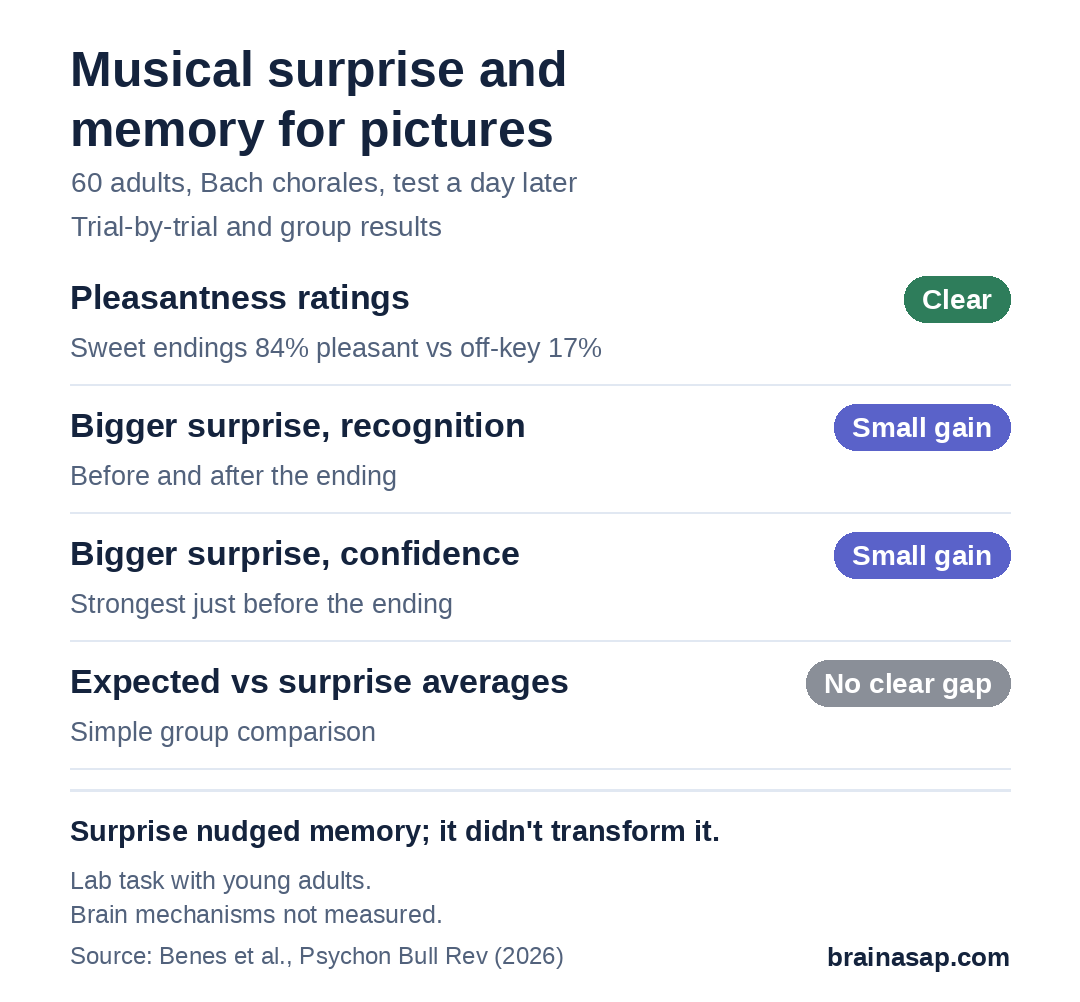
About 84% of pleasant endings were rated pleasant, versus 17% of off-key endings. People also responded faster to off-key endings. So the music was doing its job.
Bigger Surprises, Slightly Better Memory
The researchers used a learning model to estimate how surprising each ending was for each person, trial by trial, based on what they had heard before. The more surprising the ending, the more likely people were to correctly recognize the pictures from that piece a day later. This held for pictures shown both before and after the ending.
Surprise also went with higher confidence. That link was stronger for pictures seen just before the ending, while people were anticipating it.
Small Effects, Lab Conditions
- Averages showed little: Simply comparing expected versus surprising endings gave no clear memory difference.
- Small effect: Surprise nudged memory rather than transforming it.
- Surprise and change mixed: The study couldn’t fully separate surprise from the music simply changing.
- Mechanism not measured: Brain activity and dopamine weren’t recorded.
- Young volunteers in a lab: Mostly women, all with normal hearing.
Not a Case for Study Music, Yet
This doesn’t mean background music will help you study. It suggests that the brain’s surprise signal from music can spill over to what we see at the same time. Whether that holds outside the lab, with music people actually choose to listen to, is still an open question.
Citation: DOI: 10.3758/s13423-026-03020-4. Benes N, Panitz DY, Gabay S, Mendelsohn A. Musical expectations modulate declarative memory formation. Psychon Bull Rev. 2026;33:245.
Study Design: Within-subject laboratory experiment with 24-hour delayed recognition test and trial-level mixed-effects models.
Sample Size: 60 healthy adults analyzed (61 enrolled).
Key Statistic: Unsigned prediction error predicted recognition accuracy (b = 0.058, 95% CI 0.005 to 0.111, p = 0.032).
Caveat: Small trial-level effects; condition averages not significant; lab paradigm.