TL;DR: A 2026 preprint birth-cohort study in medRxiv found that 91.1% of children had experienced violence by age 8, while age-8 violence exposure was associated with higher internalizing, externalizing, total problem scores, and disorder odds.
Key Findings
- Evidence map: a South African birth-cohort analysis using violence reports and child mental health assessment.
- Study group: 974 children in the Drakenstein Child Health Study.
- Main result: 91.1% of children had experienced violence by age 8.
- Second result: Age-8 violence exposure was associated with higher internalizing, externalizing, total problem scores, and disorder odds.
- Caution: Longitudinal links from age 4.5 to age 8 were weaker than same-time associations.
Source: medRxiv (2026) | Bailey et al.
Childhood violence is often studied in high-income settings, even though many children in low- and middle-income countries face high exposure to community and domestic violence.
This preprint used the Drakenstein Child Health Study to connect violence exposure with mental health symptoms and psychiatric disorder assessment at age 8.
The central number is stark: 91.1% of children had experienced violence by age 8. In this South African cohort, violence exposure was common enough to be a core mental-health context rather than a rare adverse event.
Violence Exposure Was Measured Across Four Child Domains
Design: a South African birth-cohort analysis using violence reports and child mental health assessment. Study group: 974 children in the Drakenstein Child Health Study.
The birth-cohort design measured violence exposure across domains and linked it with child mental health at different ages. That design separates same-time associations from weaker longitudinal prediction.
- Community witnessed: Children saw violence in the surrounding community.
- Community victimization: Children were directly victimized outside the home.
- Domestic witnessed: Children witnessed violence in the home.
- Domestic victimization: Children were directly victimized in the domestic setting.
The four-domain setup matters because childhood violence is not one exposure. Witnessing community violence, being directly victimized in the community, witnessing domestic violence, and being victimized at home can differ in frequency, proximity, caregiver involvement, and the child’s ability to avoid the threat.
The mental-health side was also broader than one symptom scale. Researchers assessed internalizing symptoms, externalizing symptoms, total problem scores, and disorder-level outcomes, so the result speaks to both symptom burden and diagnostic risk.
- Internalizing symptoms: anxiety, withdrawal, and mood-related problems.
- Externalizing symptoms: behavior problems, aggression, and rule-breaking patterns.
- Total problem score: a broader measure of child mental-health burden.
- Disorder odds: whether symptom patterns crossed a clinical threshold.
The timing result is important for prevention. If recent age-8 violence tracks most strongly with same-age mental health, then screening needs to capture current exposure rather than only early-life history.
91% of Children Had Violence Exposure by Age 8
The main result is the age-8 exposure burden: 91.1% had experienced violence. This keeps the mental-health analysis about an almost population-level exposure in this cohort.
Age-8 exposure was associated with higher internalizing, externalizing, total problem scores, and disorder odds. Earlier exposure at age 4.5 did not predict age-8 outcomes as strongly.
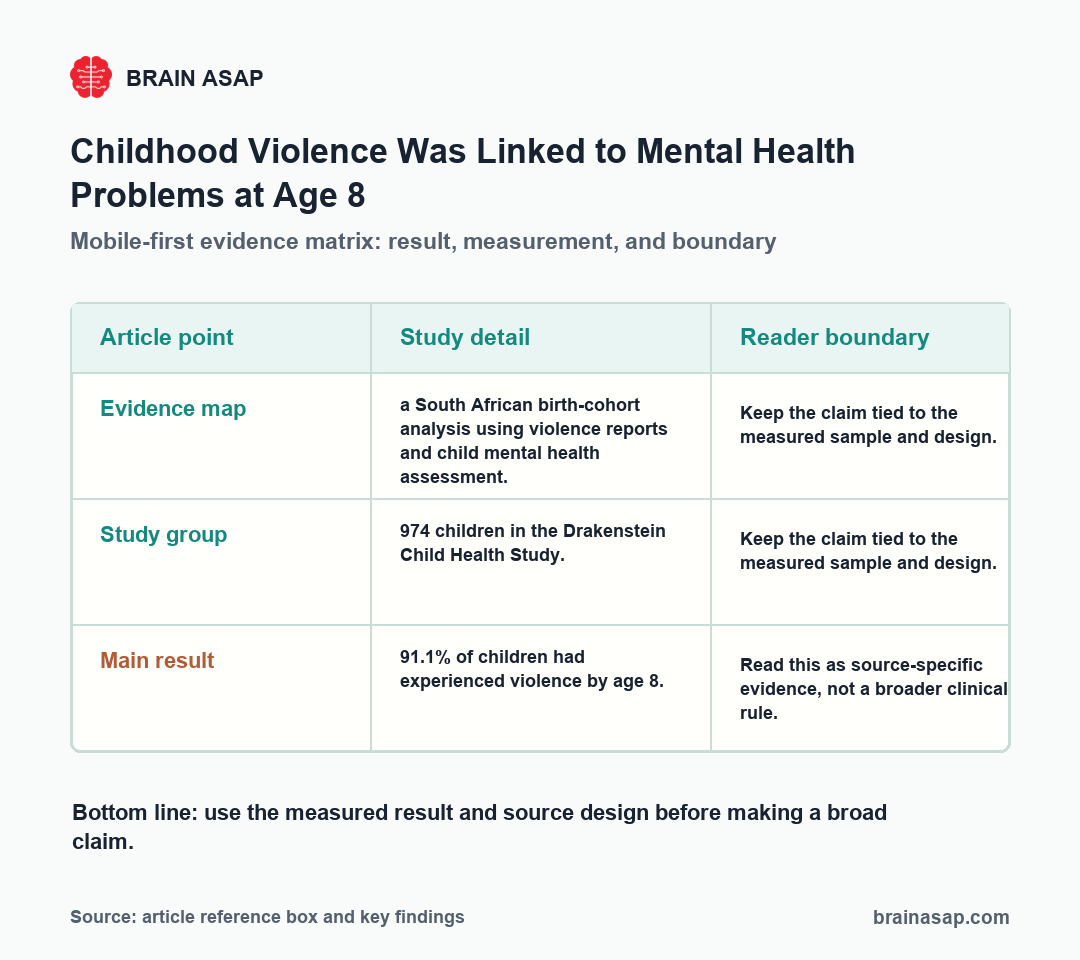
Age-8 Violence Linked to Mental Health Problems
Timing is central. Same-time violence and mental health measures are easier to connect than early exposure predicting later symptoms after several years of changing family and community conditions.
The safe interpretation is that recent violence exposure was linked to worse child mental health at age 8. The study does not make every earlier exposure path equally strong.
Breaking violence into types also helps. Witnessed community violence, domestic exposure, and multiple exposure types may carry different mental-health implications.
The design also separates exposure burden from prediction strength. A very high lifetime exposure number shows how common violence was in this cohort, but the strongest mental-health associations came from violence measured closer to the outcome.
This distinction is important for intervention planning. Services need to know whether a child is dealing with past exposure, current exposure, or repeated exposure across time.
- Past exposure: may still shape symptoms, safety, trust, and stress physiology.
- Current exposure: can keep the child in an active threat environment.
- Repeated exposure: can combine community and domestic threats across development.
The safest reading is therefore not a single violence score. It is a timing-aware mental-health signal in a cohort where exposure was extremely common.
Earlier Violence Showed Weaker Longitudinal Prediction
Main limitation: longitudinal links from age 4.5 to age 8 were weaker than same-time associations.
- Cross-sectional strength: Same-time associations were stronger than earlier-to-later prediction.
- Reporter limits: Caregiver reports may miss some exposures.
- Context: The findings come from one birth cohort.
- Causality: The design cannot assign one exposure as the sole cause of one disorder.
The main caveat is not whether violence is relevant; it is how timing, type, reporting, and confounding shape the size of the association.
The finding also supports a practical intake habit: ask separately about community violence and domestic violence, and ask whether the child witnessed violence or was directly harmed.
Those distinctions can shape safety planning, family support, school coordination, and referral urgency. A single yes-or-no adversity item would miss much of the clinical detail in this cohort.
Child Mental Health Programs Need Violence Timing and Type
Practical takeaway: child mental-health screening should ask about violence timing and violence type.
- Best use: Use the 91.1% figure to understand exposure burden in this cohort.
- Do not overread: Do not flatten the result into a simple lifetime-exposure claim; same-time age-8 associations were stronger.
- Next question: Follow whether reductions in recent violence exposure change internalizing and externalizing symptoms over time.
The framing stays concrete: high exposure, measurable mental-health links, and timing that should stay visible.
Citation: DOI: 10.64898/2026.04.20.26351289. Bailey et al. Violence Exposure and Mental Health Problems Among School-Aged Children in a South African Birth Cohort. medRxiv. 2026.
Study Design: A South African birth-cohort analysis using violence reports and child mental health assessment.
Sample Size: 974 children in the Drakenstein Child Health Study.
Key Statistic: 91.1% of children had experienced violence by age 8.
Caveat: Same-time age-8 associations were stronger than earlier-to-later prediction, so timing and confounding matter.