Savoring Together: The Secret Couples Overlook
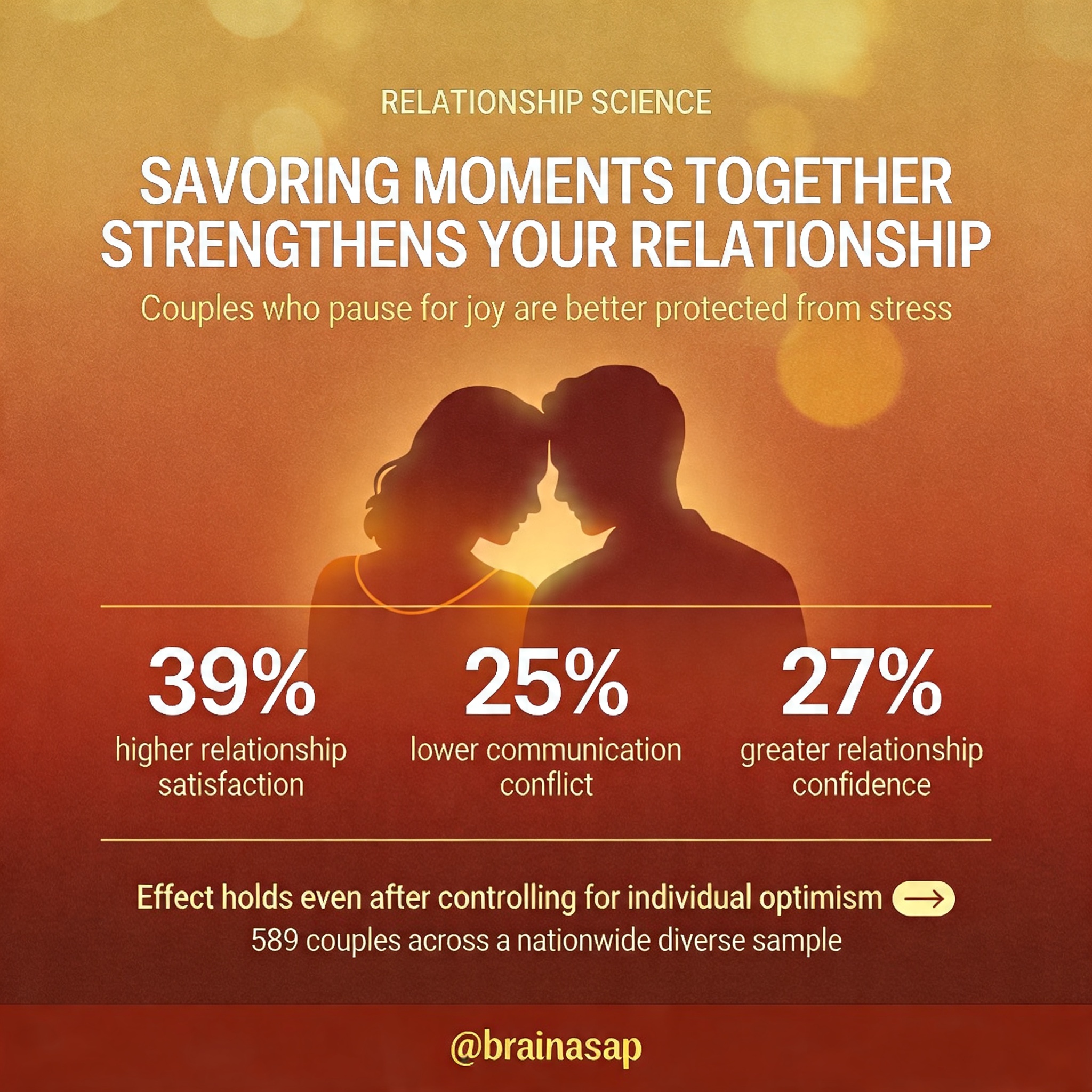
TL;DR: Couples who deliberately focus attention on shared positive experiences—a practice called joint savoring—report higher relationship satisfaction, greater confidence in their future together, and better protection from stress, even when controlling for general optimism.
Most relationship advice emphasizes managing conflict or deepening communication. But researchers at the University of Illinois discovered something simpler: when partners pause together to fully experience a moment of joy—laughing at a joke, watching a sunset, celebrating a win—it doesn’t just feel good. It rewires how couples handle stress and strengthens the relationship itself.
Key Findings
- Direct relationship boost: Couples with higher joint savoring reported 39% greater relationship satisfaction (B = 0.39, p < 0.01) and 27% higher relationship confidence (B = 0.27, p < 0.01).
- Communication improved: Joint savoring was associated with 25% lower communication conflict (B = −0.25, p < 0.01), independent of general savoring ability.
- Stress buffering effect: At low levels of perceived stress, the negative impact on relationship confidence was nearly eliminated for high joint savoring couples compared to low savoring couples (slope = −0.02 vs. −0.10, p < 0.01).
- Quality of life gains: Joint savoring correlated with 17% greater life satisfaction (B = 0.01, p < 0.01), though this link did not reach significance for depression or health perceptions.
- Independent of general savoring: These benefits persisted after controlling for individuals’ ability to savor alone (r = −0.63, p < 0.01), showing joint savoring offers unique protective value.
- Sample strength: Findings derived from 589 couples (1,178 individuals) across a nationwide diverse sample, validating the effect across relationship types and demographics.
Source: Contemporary Family Therapy (2025) | Larsen, Barton, Ogolsky
The Gap Between Individual and Relational Joy
Psychologists have long understood that savoring—the ability to deliberately attend to and amplify pleasure—improves mental health and life satisfaction. But nearly all that research has focused on personal savoring: how well individuals extract joy from their own experiences.
The hidden insight is that couples do something different. When partners share a positive moment, they don’t simply experience it as two separate minds. Joint savoring is a mutual process, a deliberate focusing of attention on a shared experience. It’s distinct from capitalization (telling someone about something good that happened) because it targets the experience itself—the moment unfolding between them—rather than the telling of it.
How Joint Savoring Differs From Other Relationship Practices
The researchers drew careful boundaries around what joint savoring actually is. It’s not general optimism or the ability to enjoy life. It’s not communication about positive experiences. It’s not gratitude practice or mindfulness in the abstract.
Instead, joint savoring involves three key dimensions: focusing on events internal to the relationship itself (shared memories, private jokes, inside references), attending to past, present, or future moments together, and deliberately enhancing the emotional resonance of those moments as a team.
Consider the difference. One couple returns from vacation and one partner excitedly tells the other about a memorable moment (capitalization). Another couple pauses mid-walk, both noticing the same view, and consciously holds the moment together—making eye contact, smiling, maybe not even speaking. That’s joint savoring. The second couple, according to this research, gains something the first couple misses.
Who Savors Better Together Stays Together (Longer)
The study tested three core claims. The first two held up cleanly: couples reporting higher joint savoring had significantly greater couple satisfaction, lower communication conflict, and higher relationship confidence, even after the researchers controlled for general savoring ability and personality traits like optimism.
The effect sizes were meaningful. A one-point increase on the joint savoring scale predicted a 0.39-point increase in couple satisfaction and a 0.27-point boost in relationship confidence on standardized measures. For individuals in the study, those weren’t small shifts.
The psychological picture became clearer in the moderation analysis. Perceived stress typically erodes relationship confidence—when life feels overwhelming, people withdraw or blame their partners. But couples high in joint savoring showed remarkable resilience. At low stress levels, the drop in relationship confidence was essentially flat for high-savoring couples, while it plummeted for low-savoring pairs.
[Insert image: line graph showing relationship confidence declining with stress, with steeper decline for low joint savoring couples vs high savoring couples]
The Third Finding That Surprised
The researchers hypothesized that joint savoring would also protect against depression and improve health perceptions—a third layer of benefit beyond relationship outcomes. That didn’t happen. Quality of life showed a modest association, but psychological distress and health perceptions were unrelated to joint savoring.
This matters because it narrows the mechanism. Joint savoring appears to work primarily as a relationship enhancement and stress buffer for couples, not as a general mental health booster. When couples attend together to positive moments, they’re strengthening the bond and their confidence in that bond. They’re not necessarily becoming happier individuals overall.
Why This Matters for Relationship Science
The finding challenges a common assumption in relationship maintenance research: that better coping and stress management strategies protect relationships equally for everyone. The data suggest otherwise. High joint savoring couples seem to have built a separate reservoir—a private well of shared positive emotion that insulates them from the typical stress-relationship erosion cycle.
This opens new territory for therapy and coaching. If couples learned to deliberately pause and co-attend to joy—not just discuss happiness, but inhabit it together—they might interrupt the stress-and-distance feedback loop before it hardens into resentment.
Limitations and What’s Next
The study is cross-sectional, so causation remains uncertain. Do couples who savor together build stronger relationships, or do couples in strong relationships naturally savor more? Both could be true.
The measure relied entirely on self-report from one partner in each couple, which introduces the possibility of bias or misperception. Future work using dyadic data—both partners reporting independently—would strengthen the claims.
Additionally, the researchers couldn’t distinguish between what couples savor and how they savor it. Do specific strategies matter? Is verbal savoring (sharing joy out loud) more powerful than silent co-attention? These questions remain open.
The sample, while nationwide and diverse, skewed toward higher relationship functioning and reported relatively low stress overall. Findings from couples in crisis or experiencing trauma might look different.
The Practical Bottom Line
For couples navigating ordinary stress—work pressures, parenting demands, life transitions—this research suggests a simple tool: pause together. Notice the small joys. Lock eyes during a laugh. Let your partner catch you noticing something beautiful. Don’t rush past the good moment to the next task.
It’s not a cure for relationship problems, and it won’t prevent serious conflicts. But the data show it’s a genuine protective factor, one that works independently of personality and operates even as life gets harder. In a world that emphasizes fixing what’s broken, joint savoring is about tending what’s already good.
Citation: Larsen, N. B., Barton, A. W., & Ogolsky, B. G. Joint savoring in romantic relationships: Correlates and protective effects. Contemporary Family Therapy. 2025. DOI: 10.1007/s10591-025-09769-5
Authors’ affiliations: University of Illinois Urbana-Champaign, Urbana, United States.