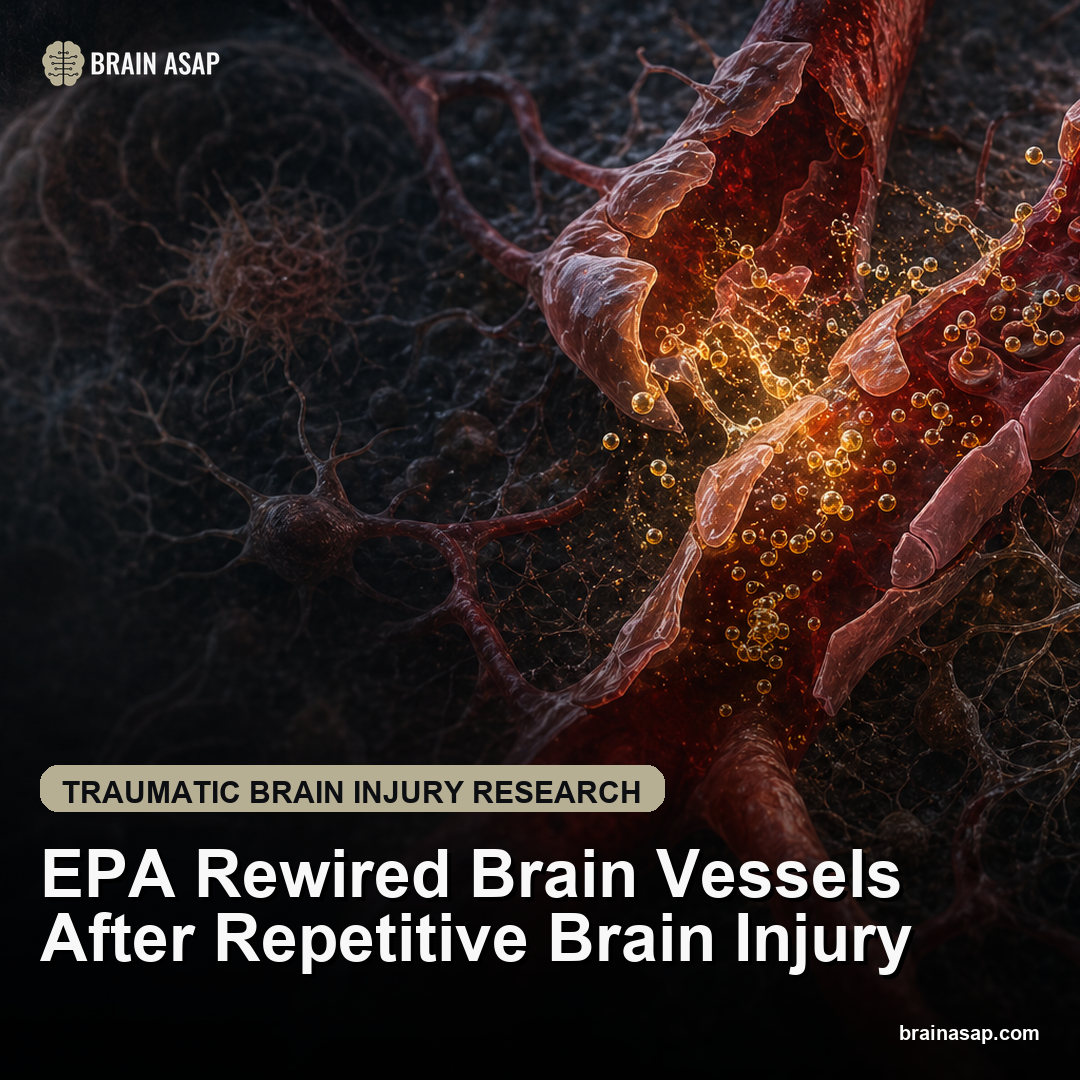
EPA Rewired Brain Vessels After Repetitive Brain Injury
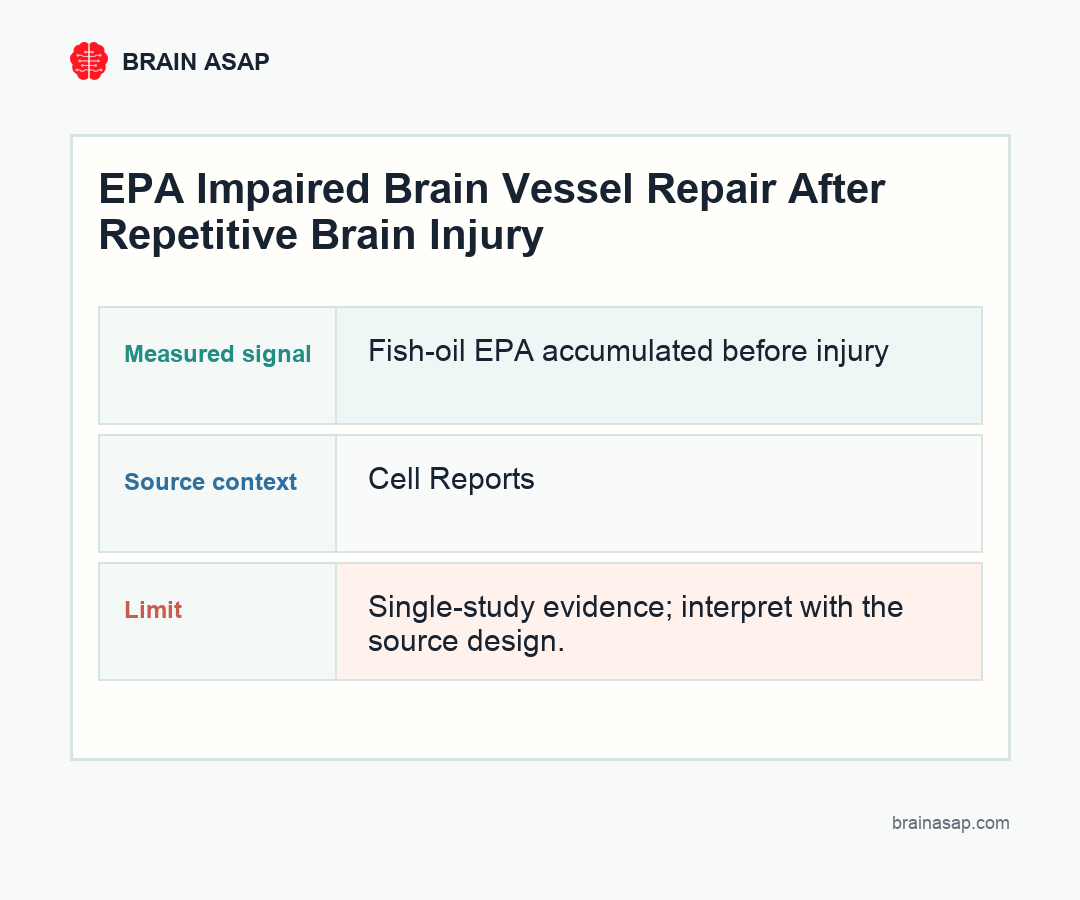
TL;DR: Fish-oil-derived EPA looked less like a simple neuroprotective supplement and more like a lipid signal that changed brain-vessel repair after repetitive mild traumatic brain injury.
Key Findings
- EPA accumulated before injury: In a fish-oil diet model, eicosapentaenoic acid built up in the brain at baseline rather than acting as a neutral background nutrient.
- Repetitive mild TBI depleted EPA: After injury, EPA was selectively depleted, consistent with mobilization during metabolic remodeling.
- Vessel repair programs weakened: Cortical transcriptomics showed reduced angiogenic programs alongside increased fatty-acid metabolism.
- Endothelial repair was impaired: Mechanistic endothelial-cell experiments suggested EPA could selectively interfere with reparative function.
- CTE tissue echoed the pattern: Postmortem chronic traumatic encephalopathy tissue showed parallel vascular and metabolic gene-expression changes.
Source: Cell Reports (2026) | Karakaya et al.
Fish oil has an almost automatic reputation as brain-protective. This study complicates that reputation by focusing on EPA, a fish-oil-derived fatty acid, in the setting of repetitive mild traumatic brain injury. EPA accumulated in the brain before injury, then shifted during injury-linked remodeling in ways tied to endothelial degeneration, weaker angiogenic programs, and impaired neurovascular function.
Fish Oil Was Not a Passive Background Nutrient
The striking point is not simply that EPA changed after brain injury. It is that EPA appeared to become part of the injury response itself. The study describes cerebral EPA accumulation at baseline, followed by selective depletion after repetitive mild traumatic brain injury.
Selective depletion suggests that EPA was mobilized, used, or converted into downstream lipid signals during the injury response. It was not just sitting in the tissue as a supplement residue. It was part of the metabolic state that followed injury.
Brain Vessel Repair Became the Main EPA Signal
The study frames repetitive mild traumatic brain injury as a vascular problem as much as a neuronal one. Brain vessels have to maintain barrier function, blood flow, matrix structure, and repair capacity after mechanical stress.
In the fish-oil model, the EPA-linked state coincided with matrix remodeling, endothelial degeneration, and impaired neurovascular function. That is exactly the kind of result that can get lost when omega-3s are discussed only as inflammation-lowering nutrients.
The central question becomes more specific: what happens when a brain enriched with EPA has to rebuild damaged microvessels after repeated injury?
Angiogenic Repair Programs Moved in the Wrong Direction
The transcriptomic result is the mechanistic hinge. The cortex showed reduced angiogenic programs while fatty-acid metabolism increased. That pairing points toward a brain processing lipid stress while vessel-repair machinery is less available.
Angiogenesis is not a side issue after injury. It helps damaged tissue restore oxygen delivery and stabilize the microenvironment. If those programs are muted, the recovery landscape changes.
The endothelial-cell experiments sharpened the interpretation. In metabolically adapted cells, EPA selectively impaired reparative function. The point is not that every omega-3 exposure is harmful; it is that EPA may behave differently when the brain is trying to repair injured blood vessels.
Postmortem CTE Tissue Strengthened the Preclinical Link
Animal and cell studies often stall at the translational question. The authors addressed that by looking at postmortem brain tissue from chronic traumatic encephalopathy.
The human tissue analysis showed parallel vascular and metabolic gene-expression changes. That does not prove that fish oil causes CTE pathology. It means the preclinical model and human disease tissue shared a vascular-metabolic pattern worth testing more directly.
This Is Not a Simple Anti-Fish-Oil Verdict
The paper challenges a broad assumption, not every clinical use of omega-3 supplements. EPA can have different effects depending on dose, timing, injury status, baseline diet, vascular health, and whether the brain is actively repairing damage.
The careful reading is not that EPA is universally bad for the brain. It is that uniform omega-3 neuroprotection is too simple, especially after repetitive brain injury, when the vascular system is under repair pressure.
For athletes, military populations, and anyone with repeated head impacts, the study raises a sharper research question than “is fish oil good?” The better question is when EPA supports resilience, when it becomes metabolically engaged, and when it might interfere with the vascular repair the injured brain needs.
EPA Timing Changed the Repetitive Brain-Injury Question
The study is best read as a timing problem. A lipid can look helpful in one biological state and harmful in another if the tissue environment changes. Repetitive mild traumatic brain injury is exactly that kind of environment: blood vessels are stressed, repair programs are being recruited, and inflammatory and metabolic signals are in motion.
The baseline accumulation result is important because EPA was already present before injury, but the injury state appeared to pull it into a different role. The brain was no longer simply enriched with omega-3 fatty acid; it was trying to respond to damage while that fatty-acid pool was being remodeled.
The practical point is not to panic about every capsule. It is to stop treating fish oil as biologically inert just because it is familiar. A supplement can be common and still have context-dependent effects in an injured brain.
The CTE Link Is Translational, Not a Causation Claim
The postmortem chronic traumatic encephalopathy result gives the study translational relevance, but it should not be overread. CTE tissue cannot show what caused the disease. It can show whether a biological pattern in the model resembles a pattern in human disease tissue.
When the same vascular-metabolic pattern appears in CTE tissue, the animal and cell findings become a more plausible window into the vascular side of repetitive brain injury.
The right headline is therefore narrower and stronger: EPA-linked cerebrovascular metabolism needs direct study in repetitive brain injury. That is different from saying fish oil causes CTE or that people with head injuries should stop a supplement without medical guidance.
What Would Make This Clinically Actionable
The missing clinical pieces are dose, timing, and patient subgroup. The key questions are concrete:
- Exposure timing: Was EPA high before injury, introduced after injury, or present chronically across repeated impacts?
- Fatty-acid balance: Does risk depend on EPA alone or on the ratio of multiple omega-3 and omega-6 lipid species?
- Repair readouts: Do human imaging or blood markers show weaker vascular repair after concussion in people with high EPA exposure?
A future human study would need to connect supplement history, blood or cerebrospinal fluid lipid measures, imaging markers of vascular repair, and longitudinal outcomes after concussion or repeated head impacts.
Until then, the study should change the question more than the recommendation. It pushes the field away from “omega-3 equals neuroprotection” and toward a mechanistic model: the injured brain may use lipids differently from the healthy brain.
The Safer Public Message Is About Uncertainty, Not Alarm
Supplements often get discussed as if they sit outside pharmacology. They do not. The more biologically active a compound is, the more likely its effects depend on the tissue state it enters.
This study gives a specific reason for caution rather than a vague warning. After repetitive mild brain injury, EPA was tied to vascular repair biology, which is relevant to concussion research, athletic exposure, and CTE mechanisms without turning the result into a blanket anti-omega-3 claim.
Paper: Eicosapentaenoic acid reprograms cerebrovascular metabolism and impairs repair after brain injury, with relevance to chronic traumatic encephalopathy. Cell Reports. 2026. DOI: 10.1016/j.celrep.2026.117135
Authors: Karakaya et al.
Study Design: Preclinical repetitive mild traumatic brain injury model with lipidomics, transcriptomics, endothelial-cell mechanistic experiments, and postmortem CTE tissue analysis.
Sample Size: Fish-oil diet model, endothelial-cell experiments, and postmortem human CTE tissue; exact animal and tissue counts should be checked in the full paper before publication.
Key Statistic: EPA accumulated at baseline, was selectively depleted after repetitive mild TBI, and was linked to reduced angiogenic programs plus parallel CTE vascular-metabolic gene-expression changes.
Important Caveat: The study does not show that fish oil causes CTE or that people should change supplements without medical guidance; it identifies a repair mechanism that needs direct human testing.