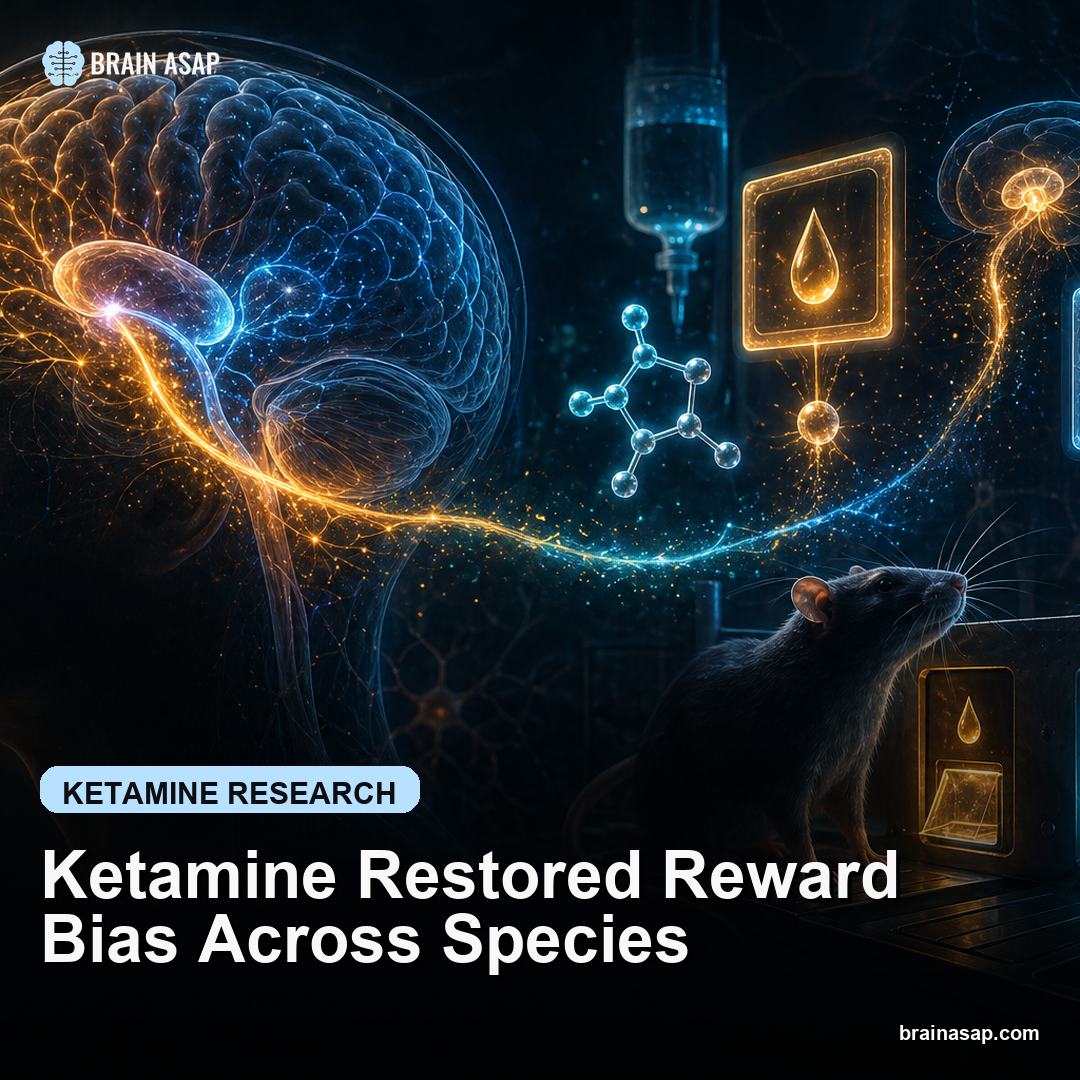
Ketamine Restored Reward Bias Across Species
TL;DR: Ketamine restored reward-learning bias in both treatment-resistant depression and chronically stressed rats while leaving basic discrimination unchanged.
Key Findings
- Reward bias increased: Ketamine significantly increased response bias toward the more frequently rewarded stimulus in both species.
- Healthy-control levels returned: The reward-bias effect reached levels comparable with healthy controls 24 hours after administration.
- Discriminability did not shift: Ketamine did not improve general task discrimination, pointing to reward learning rather than broad performance enhancement.
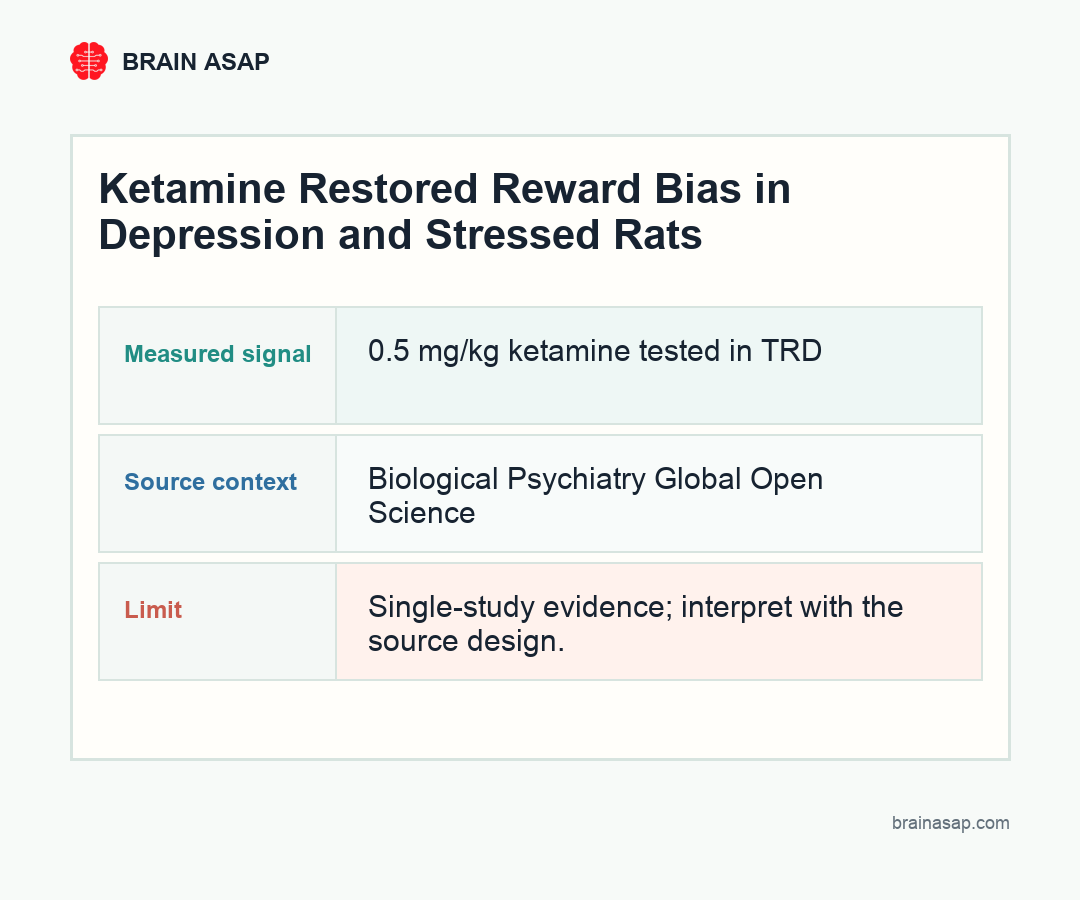
- TRD dose was subanesthetic: People with treatment-resistant depression received 0.5 mg/kg ketamine and completed the probabilistic reward task within 48 hours.
- Rat data bridged the mechanism: Chronically stressed rats received 10 mg/kg ketamine and showed the same reward-bias direction in a matched task.
Source: Biological Psychiatry Global Open Science (2026) | Bogdanov et al.
Ketamine can lift depressive symptoms quickly, but many patients are most disabled by anhedonia: the loss of reward, motivation, and the ability to learn from positive outcomes. This study tested that symptom domain directly with a probabilistic reward task designed to work in both humans and rats.
Anhedonia Needed a Cross-Species Test
Ketamine research has a translation problem. Rodent studies can identify mechanisms, but the behavioral readout often fails to match the symptom patients actually describe.
The probabilistic reward task helps close that gap. It measures whether a participant develops a response bias toward the stimulus rewarded more often, testing whether the nervous system starts favoring the option that has been paying off.
The task is relevant to anhedonia because reward learning can be measured without asking someone to summarize their mood. It also gives animal work a behavioral bridge to human depression.
The Human and Rat Tasks Pointed the Same Way
The study tested people with treatment-resistant depression and rats exposed to chronic stress. The human ketamine dose was 0.5 mg/kg, while the rat dose was 10 mg/kg. The point was not to treat those doses as directly equivalent, but to ask whether the same behavioral signature moved in the same direction.
Ketamine increased response bias toward the more frequently rewarded stimulus in both species. By 24 hours after administration, reward bias reached levels comparable with healthy controls.
The 24-hour window is part of the signal because ketamine’s clinical effects often appear before slower antidepressant mechanisms would be expected. A reward-learning shift within that window supports the idea that rapid synaptic or circuit-level changes can alter how positive feedback shapes behavior.
Reward Learning Changed, Not General Task Skill
The important negative result was discriminability. Ketamine did not appear to make participants or rats simply better at the whole task. It selectively changed the reward-learning component.
That distinction protects the interpretation. A drug that improves attention, speed, or compliance would inflate task performance without necessarily touching anhedonia. Here, the result points more directly toward reward responsiveness.
- Reward bias changed: response bias shifted toward the more frequently rewarded stimulus.
- Discriminability did not: the effect was not just better task performance.
- Anhedonia subgroup mattered: exploratory analyses suggested the effect was strongest in people with more pronounced baseline anhedonia.
Ketamine’s Antidepressant Effect May Include a Reward-Circuit Reset
The paper does not identify the full molecular mechanism. It supports a behavioral mechanism: ketamine can restore the brain’s ability to update choices from positive feedback.
That is more specific than saying ketamine rapidly reduces depression scores. It points to a patient-relevant question: does the drug reopen a window where reward becomes learnable again?
The Translational Win Still Needs Clinical Scale
The same task logic worked across species, which strengthens the translational claim. It is not enough to decide who should get ketamine or how long the reward-learning effect lasts.
Future work needs larger human samples, repeated follow-up, and symptom-level analysis that separates anhedonia from mood, anxiety, and global improvement. The strength of this study is narrower: it gives ketamine research a behavioral bridge between mechanism and lived symptom.
Why Reward Bias Is a Better Target Than Mood Alone
Depression rating scales mix many symptoms into one score. Sleep, appetite, guilt, anxiety, psychomotor change, sadness, and suicidality can all move together or apart. Anhedonia can remain even when total depression scores improve.
Reward bias narrows the question. It asks whether the brain is learning from positive feedback and tilting behavior toward reward. That is not the whole of depression, but it maps onto a problem patients recognize immediately: good outcomes stop pulling behavior forward.
For ketamine, a rapid antidepressant effect can involve several mechanisms at once. This task isolates one: the ability to update behavior from reward.
The No-Discriminability Result Narrows the Interpretation
The discriminability finding looks like a minor technical detail, but it protects the interpretation. If ketamine improved every aspect of task performance, the reward-bias result would be easier to explain as alertness, motor speed, attention, or practice.
Instead, the abstract reports no effect on discriminability. The participants and rats were not simply better at telling stimuli apart. The shift was in how strongly they favored the more frequently rewarded option.
The behavioral signal is therefore more specific. Ketamine did not just make the task easier. It appeared to change reward learning under uncertainty.
The Cross-Species Match Helps Mechanism Work
Many antidepressant mechanisms look elegant in animals and blurry in humans. The advantage here is that the investigators used functionally analogous tasks. The human and rat data are not identical, but they point at the same behavioral construct.
For drug development, the alignment is important. If a future compound changes the same probabilistic reward readout in rodents, researchers have a stronger reason to test it for anhedonia in patients. The task becomes a bridge rather than a loose metaphor.
The study also points to a possible clinical subgroup. If the ketamine effect is strongest in people with higher baseline anhedonia, reward-task measures become a logical way to identify who is most likely to benefit from ketamine’s reward-circuit effects.
That would be clinically useful because treatment-resistant depression is not one biology. A patient dominated by anhedonia may need a different readout from a patient whose main burden is anxiety, rumination, insomnia, or suicidal crisis.
What the Study Still Cannot Tell Patients
The paper does not show how long the reward-bias effect lasts, whether it tracks subjective pleasure, or whether repeated ketamine treatment keeps improving reward learning. It also does not prove that reward bias is the main driver of clinical response.
A stronger clinical study would pair reward-task changes with anhedonia scales, daily-life motivation measures, and longer follow-up after treatment. That would test whether the laboratory reward signal predicts the part of depression patients actually want back: the ability to feel drawn toward life again.
Reward Bias Can Become a Treatment-Response Readout
If reward bias tracks ketamine’s anhedonia effect, it becomes more than a laboratory outcome. It gives researchers a way to compare dosing schedules, adjunctive psychotherapy, or drugs meant to prolong ketamine’s benefits.
Anhedonia is often measured with questionnaires that compress many experiences into one score. A behavioral task can add a different layer: whether the patient is actually updating choices from reward.
The strongest version of the finding would show that early reward-bias improvement predicts later gains in motivation, pleasure, and real-world activity. That is the bridge from task performance to clinical meaning.
Paper: Ketamine Improves Anhedonic Phenotypes Across Species: Translational Evidence From the Probabilistic Reward Task. Biological Psychiatry Global Open Science. 2026. DOI: 10.1016/j.bpsgos.2026.100688
Authors: Bogdanov et al.
Study Design: Translational ketamine study using functionally analogous probabilistic reward tasks in humans and rats.
Sample Size: People with treatment-resistant depression, healthy controls, and chronically stressed rats.
Key Statistic: Ketamine increased reward response bias in both species 24 hours after dosing, without changing discriminability.