TL;DR: Healthy adults normally react a bit slower to a spot that recently caught their attention, a habit that helps attention move on. A single dose of a drug that boosts dopamine, and another that blocks it, both weakened this habit compared with placebo.
Key Findings
- 28 healthy adults, each tested on three visits.
- Both drugs sped returns: Reactions to an already-seen spot were 13 to 17 ms faster than on placebo.
- Not general speeding: Reactions in neutral trials did not change.
- Brain-wave measures: No clear drug differences.
Source: Experimental Brain Research (2026) | Whitaker et al.
After something catches your attention, you may react a little slower when another target appears in that same spot. This “inhibition of return” nudges attention toward new places instead of rechecking old ones, a handy trait when searching a scene.
People with Parkinson’s disease (too little dopamine) and some other conditions show a weaker version of this habit. A team at the University of Manchester asked what happens when dopamine is pushed up or down in healthy people.
Three Visits, Two Drugs and a Placebo
The researchers used a double-blind, placebo-controlled design in which each person served as their own comparison. On three visits at least a week apart, 31 eligible young adults (average age 22) took one of:
- Dopamine booster: Cabergoline 1.25 mg, which stimulates dopamine D2 receptors.
- Dopamine blocker: Amisulpride 400 mg, which blocks the same receptors.
- Placebo: A sugar pill.
They then did a computer task of about 1,000 trials, reacting to targets that appeared either where attention had just been drawn (cued) or on the other side (uncued), while EEG recorded brain activity. Data from 28 people went into the main analysis.
Both Drugs Weakened the Habit
Across conditions, people were about 19 ms slower to respond at the cued spot than the uncued one, the classic inhibition-of-return effect. The drugs changed that:
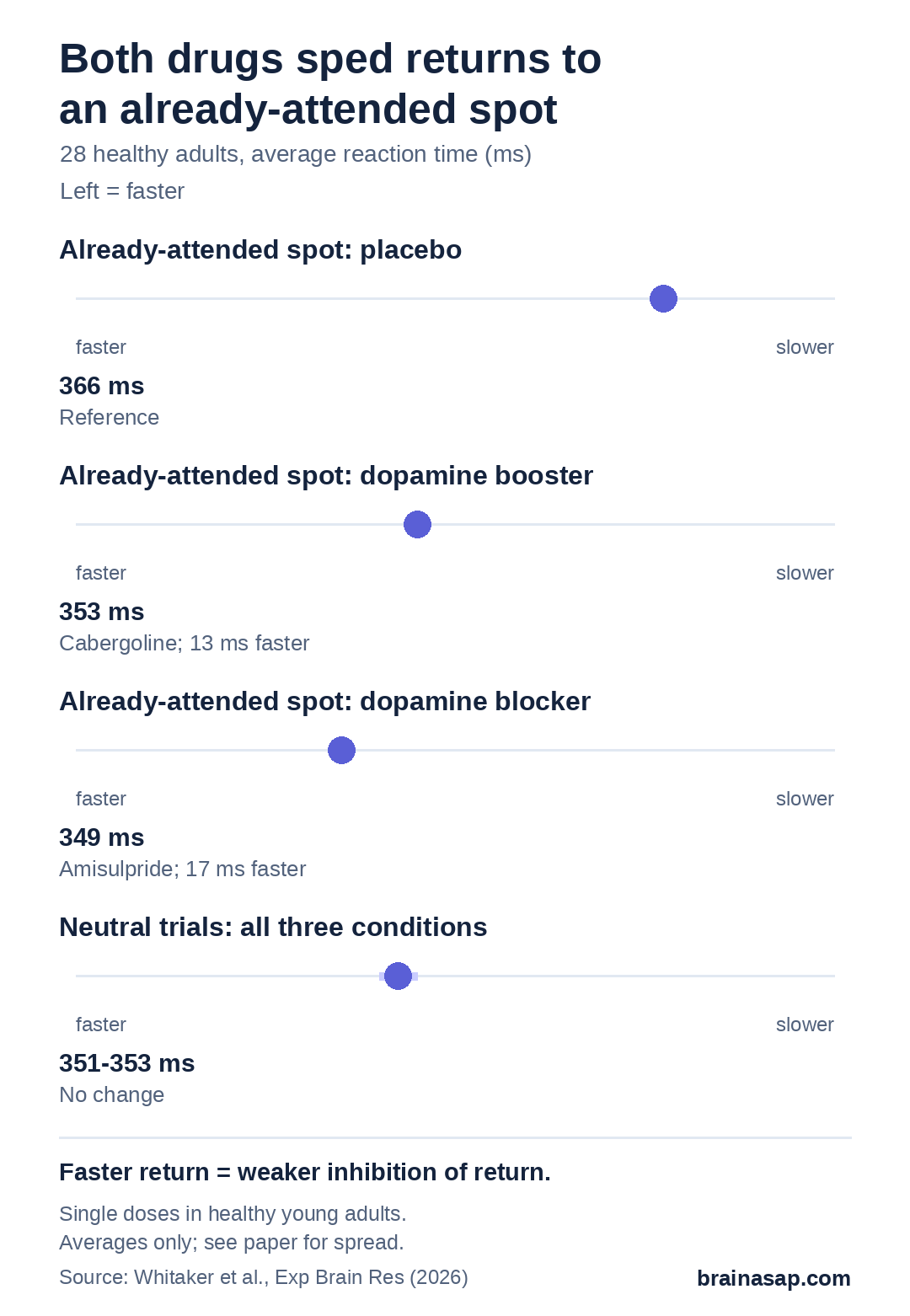
Responses at the already-attended spot were faster on the booster (353 ms) and the blocker (349 ms) than on placebo (366 ms), which means less inhibition of return. Both effects were statistically significant, and the pattern fit a curve rather than a straight line. Neutral trials barely moved (351 to 353 ms), so the drugs did not simply make people quicker overall.
A “Just Right” Level of Dopamine
The results fit an inverted-U idea: attention works best at a middle level of dopamine, and too much or too little upsets the balance between staying focused and moving on. Blink rate, a rough sign of dopamine activity, rose on the booster and fell on the blocker, suggesting the drugs worked as intended in the brain.
EEG measures of attention did not show clear drug differences, so the brain-wave side of the story remains unclear.
What to Keep in Mind
- Single doses in healthy young adults: Not a study of patients or long-term treatment.
- Small sample: 28 people in the main analysis, 25 for EEG.
- Indirect dopamine check: Blink rate is only a rough stand-in for brain dopamine.
- Lab task: Millisecond differences on a screen, not everyday attention.
Why It Matters for Dopamine Disorders
The study suggests that attention quirks seen in Parkinson’s disease, schizophrenia and ADHD may come from dopamine drifting away from a sweet spot in either direction. The open question is whether medicines that treat these conditions shift this attention habit back toward normal, or push it further off.
Citation: DOI: 10.1007/s00221-026-07355-1. Whitaker GA, Poliakoff E, Martin SL, Neill JC, Silverdale M, Kobylecki C, El-Deredy W. The effects of increasing and decreasing dopamine on inhibition of return: a psychopharmacological investigation. Exp Brain Res. 2026;244:205.
Study Design: Double-blind, placebo-controlled, repeated-measures crossover experiment with EEG.
Sample Size: 31 eligible; 28 in behavioral analyses, 25 in ERP analyses.
Key Statistic: Cued RTs: placebo 366 ms vs cabergoline 353 ms (d = 0.75) and amisulpride 349 ms (d = 0.63).
Caveat: Single doses, healthy young adults; eye-blink rate is an indirect dopamine proxy; null ERP effects.