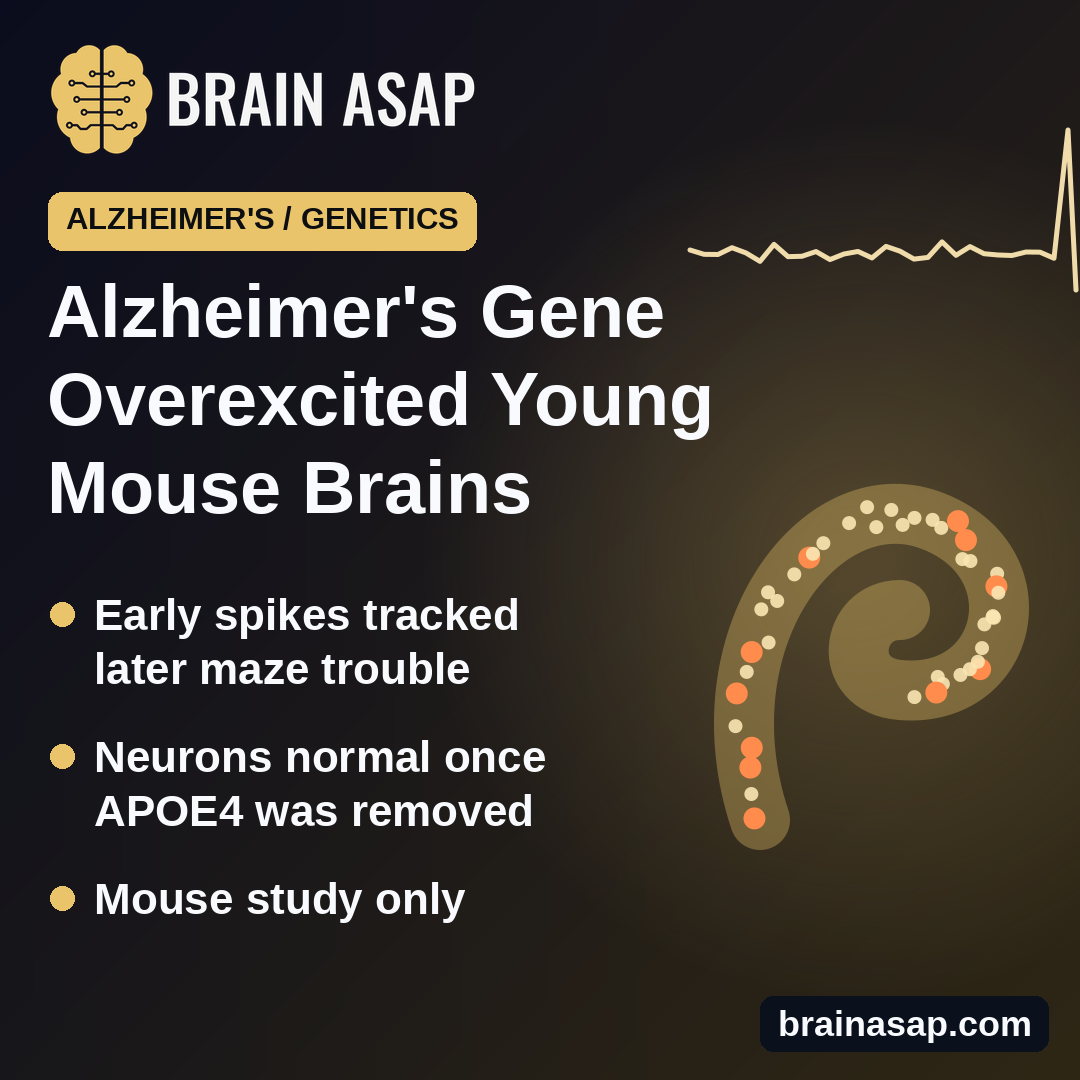
TL;DR: Young mice carrying the human APOE4 gene, the biggest genetic risk factor for Alzheimer’s, had overexcited memory circuits months before any memory trouble showed up. Removing APOE4 from their neurons returned those cells to normal.
Key Findings
- Early warning spikes: Young APOE4 mice had more abnormal electrical spikes in parts of the hippocampus.
- Spikes tracked later trouble: Mice with more spikes when young took longer to find a hidden platform when old.
- Smaller, jumpier neurons: Certain cells were shrunken and fired too easily.
- Neuron APOE4 was the driver: Deleting it from neurons normalized them.
- A gene target: Turning down a gene called Nell2 also calmed the cells.
Source: Nature Aging (2026) | Tabuena et al.
About 60 to 75% of people with Alzheimer’s carry at least one copy of the APOE4 gene variant. In people, carriers show memory changes years before diagnosis, and people with early Alzheimer’s often have hidden seizure-like activity in the brain.
A team at the Gladstone Institutes in San Francisco asked whether APOE4 overexcites the brain’s memory hub early in life, and whether that sets the stage for later decline.
Mice With Human APOE Genes
The researchers compared two groups of mice whose own APOE gene was swapped for a human version:
- APOE4 mice: Carrying the high-risk human APOE4 variant.
- APOE3 mice: Carrying APOE3, the common, neutral variant.
These mice do not build up amyloid plaques, so any changes come from APOE4 itself rather than plaques.
Early Spikes Came Before Memory Trouble
At 5 to 10 months old, APOE4 mice had more abnormal electrical spikes (brief bursts seen between seizures in epilepsy) in two hippocampus areas, CA3 and the dentate gyrus. At 6 to 8 months, they still learned a water maze normally. By 14 months, the same mice had clear trouble learning where a hidden platform was.
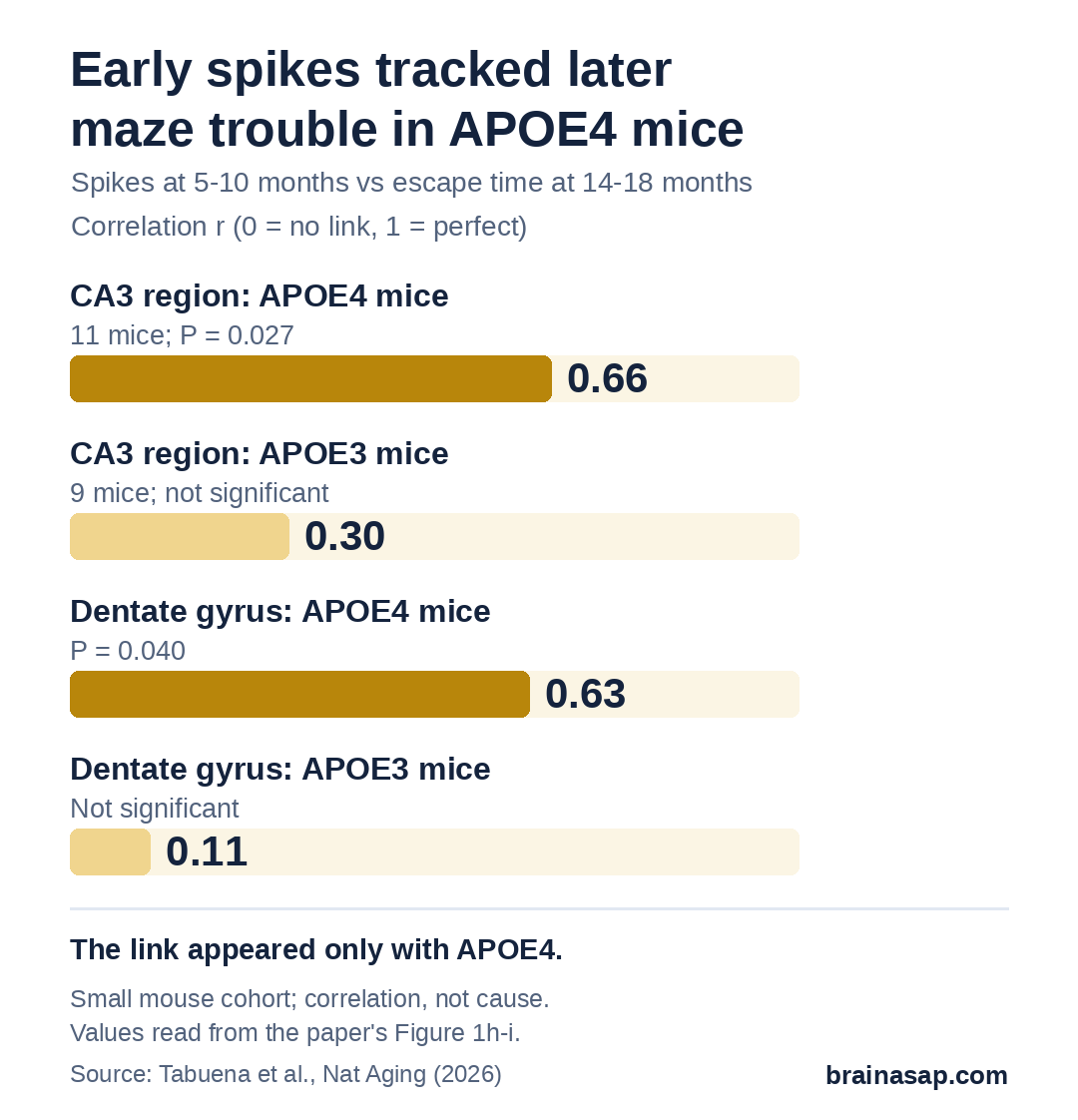
In a group followed over time, APOE4 mice with more spikes when young tended to take longer to find the platform when older. That link did not show up in APOE3 mice.
Shrunken Neurons That Fire Too Easily
Recording from single cells, the researchers found subgroups of smaller neurons in young APOE4 mice that fired more readily than normal. With age, more problems piled up in the dentate gyrus: overexcited granule cells, weakening inhibitory (braking) signals and an imbalance between excitation and inhibition.
Removing APOE4 From Neurons Fixed the Early Problem
APOE is made mainly by support cells called astrocytes, but neurons make it too under stress. The team used mice in which APOE4 could be deleted from neurons only. In those mice, the early cell shrinkage and overexcitability were fully normalized.
Gene activity analysis pointed to candidates behind the problem. One, Nell2, was more active in the affected neurons. Using a CRISPR tool to turn Nell2 down in those neurons returned their size and excitability toward normal.
What Mouse Circuits Can’t Tell Us Yet
- Mice, not people: This is not a screening test or treatment.
- A link, not proof: Early spikes tracked later maze trouble in only 11 APOE4 mice.
- Age and sex matter: Findings varied by cell type, age and sex.
- Nell2 is one candidate: The CRISPR test rescued excitability in recorded cells, not memory.
Could Calming Early Overactivity Help Carriers?
The study fits a growing idea that APOE4 harms the brain decades before Alzheimer’s symptoms, partly by overexciting memory circuits. The open question is whether reducing that early overactivity, through neuron-targeted treatments or genes like Nell2, would protect memory later in life.
Citation: DOI: 10.1038/s43587-026-01096-0. Tabuena DR, Jang SS, Grone B, et al. Neuronal APOE4-induced early hippocampal network hyperexcitability in Alzheimer’s disease pathogenesis. Nat Aging. 2026.
Study Design: Mouse experiments in human APOE3 and APOE4 knock-in mice: in vivo recordings, water maze, patch-clamp, single-nucleus RNA sequencing, neuron-specific APOE4 deletion and CRISPRi.
Sample Size: Longitudinal cohort 11 APOE4 and 9 APOE3 mice; other experiments used separate groups of mice and cells.
Key Statistic: Young CA3 spike rate vs later escape latency in APOE4 mice r = 0.66 (P = 0.027).
Caveat: Mechanistic mouse study; small longitudinal cohort; candidate gene tested on cell excitability only.