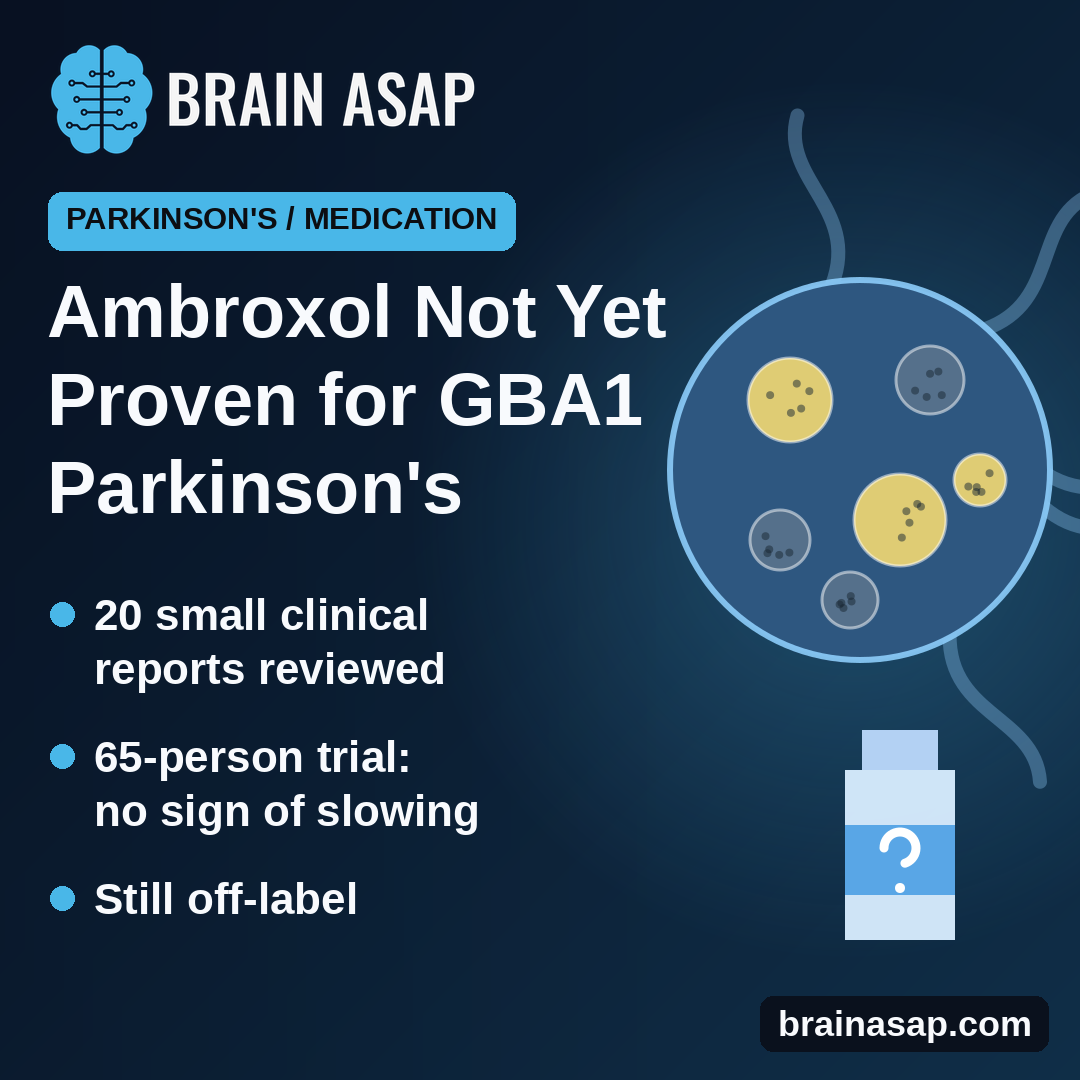
TL;DR: Ambroxol, an old cough medicine, can boost a key brain enzyme in lab studies, but a review of 20 clinical reports found no proven benefit in Gaucher disease or GBA1-linked Parkinson’s. In a randomized trial of people with GBA1-linked Parkinson’s, ambroxol did not improve thinking-test scores over 1 year; scores slightly favored placebo.
Key Findings
- 20 clinical reports, mostly small, uncontrolled and sometimes describing the same patients.
- Gaucher disease: Lab markers and symptoms improved in some patients, but results varied widely.
- GBA1 Parkinson’s trial (65 people, 1 year): No thinking-test benefit after 1 year; scores slightly favored placebo.
- Long-term high-dose safety is poorly known.
- Still off-label and experimental for both conditions.
Source: Acta Neurologica Belgica (2026) | Lipiński et al.
Ambroxol has been sold for decades to loosen mucus in a cough. Then lab studies found it could also help a faulty enzyme called glucocerebrosidase get to where it works inside cells. That enzyme is at the heart of two very different conditions, and families have pinned real hope on the drug.
A team of Polish specialists pulled together every clinical report through August 2026 to see how that hope holds up in people.
One Gene, Two Diseases
The GBA1 gene makes the enzyme. Problems with it show up in two ways:
- Gaucher disease: A rare inherited disorder when both gene copies are faulty. Fatty material builds up in cells. Some types affect the brain, often starting in childhood.
- GBA1-linked Parkinson’s: Carrying one faulty copy is the most common genetic risk factor for Parkinson’s.
Standard enzyme infusions for Gaucher disease do not reach the brain, and Parkinson’s drugs treat symptoms without fixing the enzyme pathway. Ambroxol gets into the brain, which is why it drew interest.
Gaucher Disease: Scattered Signals
The researchers found 20 reports with clinical outcomes. For Gaucher disease, most were case reports and small uncontrolled studies, some following the same patients over up to 10 years.
- Some improvements: Lower blood and spinal-fluid markers, and fewer seizures or muscle jerks in selected patients.
- Weak in a larger study: In a 600 mg/day study, only 16 of 40 patients finished a year, and just 3 of them had a meaningful drop in a key blood marker.
- A sobering case: An infant with the severe form got high-dose ambroxol from day 10 of life plus enzyme therapy, yet died at 95 days.
- No dose rule: Doses ranged widely, and no minimum effective dose could be defined.
The Parkinson’s Trial Did Not Show Slowing
The key new evidence is AMBITIOUS, a trial that randomly assigned 65 people with GBA1-linked Parkinson’s and no dementia to ambroxol 1.2 g a day or a placebo for 52 weeks. Its results are so far only a preprint, not yet peer reviewed.
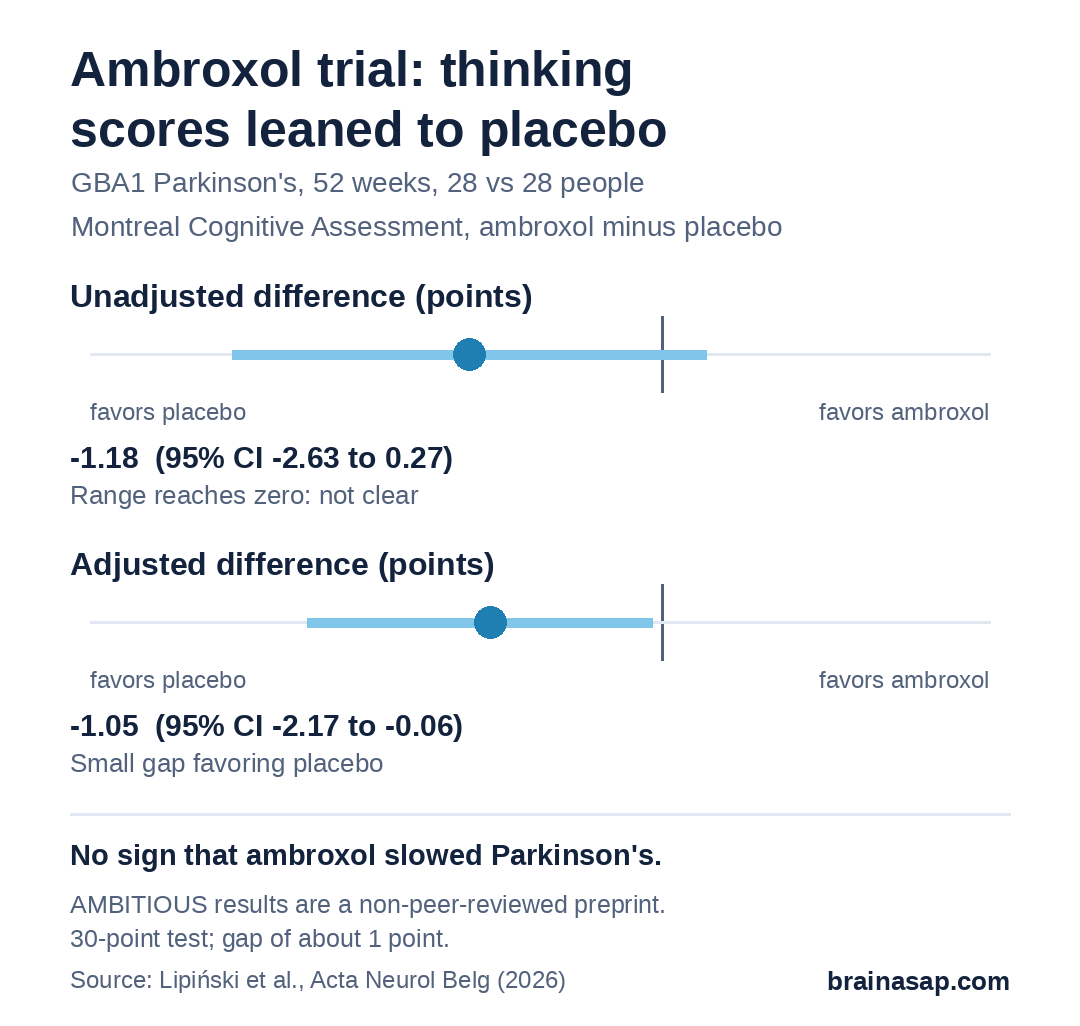
On a standard thinking test (the Montreal Cognitive Assessment), the ambroxol group did slightly worse than the placebo group. The adjusted gap was about 1 point on a 30-point scale.
People on ambroxol ended up on somewhat lower doses of other Parkinson’s medicine (about 111 mg a day less in levodopa terms). The review authors say that may reflect treatment decisions rather than a benefit.
Safety at High Doses Is Uncertain
The doses used here are far above cough-medicine doses. Serious side effects and deaths were uncommon and mostly judged unrelated to the drug, but the studies were far too small to rule out slow-building harm. Rare severe skin and allergic reactions are known risks with ambroxol products.
Why the Evidence Is So Thin
- Mostly case reports: Few studies had any comparison group.
- Overlapping patients: Some people appear in several reports.
- Markers are not outcomes: Enzyme and blood-marker changes did not reliably match how patients did.
- No meta-analysis possible: Studies were too different to pool.
- No registered protocol for the review itself.
Waiting on Larger Trials
For now, ambroxol for Gaucher disease or GBA1-linked Parkinson’s should be used only in trials or with specialist oversight. No gene variant or lab test can yet say who will respond.
The next answer may come from GREAT, a placebo-controlled trial testing a higher dose (1.8 g a day) in 80 people with early GBA1-linked Parkinson’s. Its main question is whether movement symptoms change by week 60.
Citation: DOI: 10.1007/s13760-026-03202-w. Lipiński P, Jezela-Stanek A, Tylki-Szymańska A. Ambroxol in Gaucher disease and GBA1-related Parkinson disease: an updated systematic review. Acta Neurol Belg. 2026.
Study Design: PRISMA 2020 systematic review with narrative synthesis; not prospectively registered.
Sample Size: 20 clinical outcome reports (41 full texts assessed).
Key Statistic: AMBITIOUS (preprint): adjusted MoCA difference -1.05 points (95% CI -2.17 to -0.06) favoring placebo at 52 weeks.
Caveat: Small, uncontrolled, overlapping reports; the randomized GBA1-linked Parkinson’s data are not yet peer reviewed.