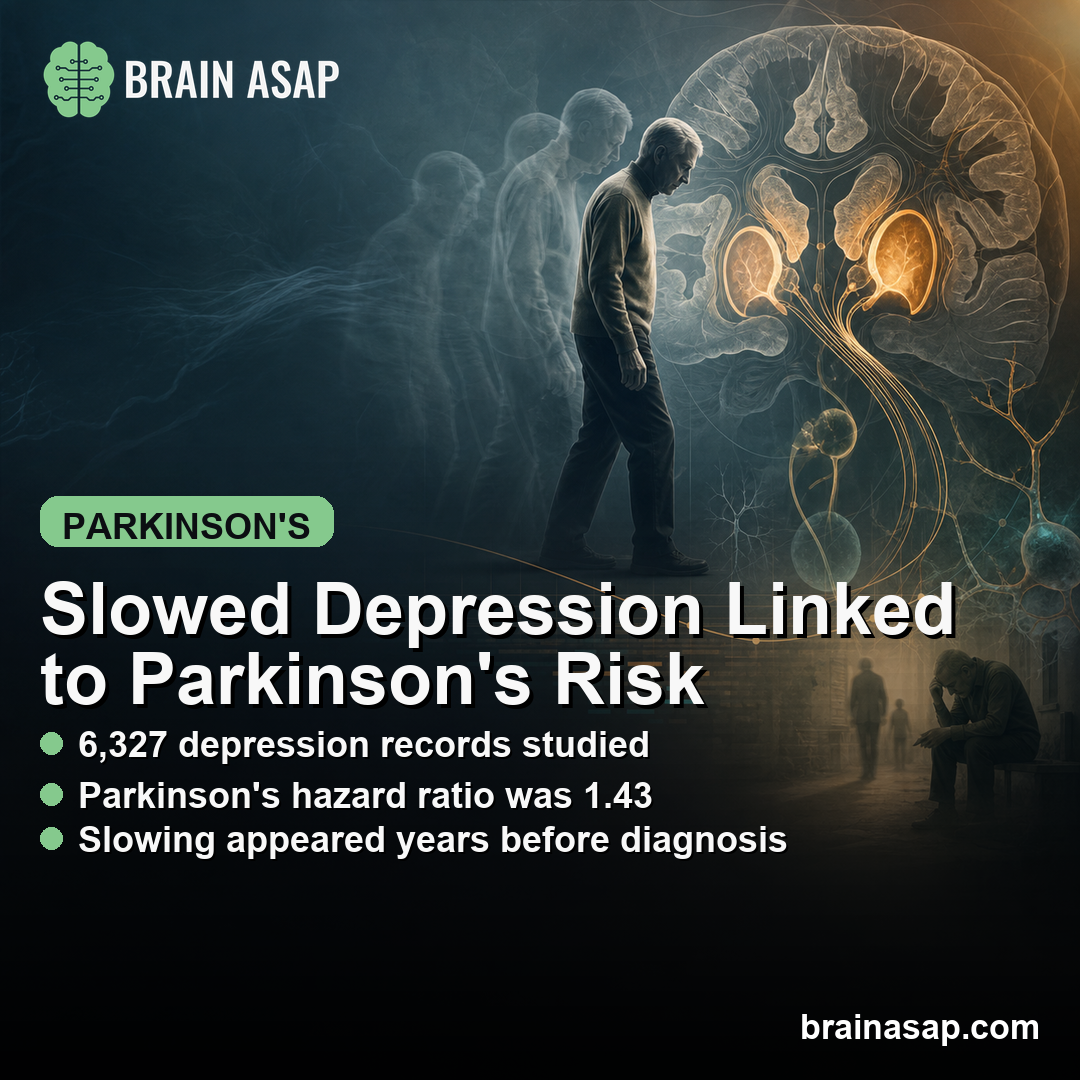
TL;DR: A 2026 medRxiv preprint found psychomotor retardation, meaning slowed movement, speech, and thinking during depression, was linked to higher later Parkinson’s diagnosis risk in 6,327 London mental-health records.
Key Findings
- Psychomotor retardation was common: Among 6,327 people with depression at age 40 or older, 2,402 patients, or 38.0%, had psychomotor retardation documented in records.
- Parkinson’s risk was higher: The adjusted hazard ratio for later Parkinson’s diagnosis was 1.43, with a 95% confidence interval from 1.02 to 2.01.
- The timing stretched back years: Secondary analysis found higher psychomotor-retardation incidence at least 10 years before Parkinson’s diagnosis.
- Misdiagnosis was not the only explanation: The long interval suggests the association was not limited to early Parkinson’s being mistaken for depression.
- Medication confounding remains important: Antipsychotic exposure also predicted Parkinson’s diagnosis and could include drug-induced parkinsonism or treatment-resistant depression effects.
Source: medRxiv (2026) | Morrin et al.
Psychomotor Retardation Means Slower Movement and Thought
Psychomotor retardation is not ordinary low mood. In depression, it means observable slowing in movement, speech, facial expression, thinking, or physical initiation.
The distinction is important because Parkinson’s disease can also involve slowed movement, quiet speech, reduced facial expressiveness, and other motor changes. The study asked whether that specific depressive feature, not depression in general, was linked to later Parkinson’s diagnosis.
Researchers used electronic health records from a large London mental health service. The cohort included people diagnosed with depression at age 40 or older, then linked records to general hospital data for Parkinson’s diagnoses from 2007 to 2023.
The record-linkage approach is useful for a question like this because Parkinson’s disease can emerge years after the psychiatric presentation. A short clinic sample would miss that long interval, while linked records can follow later hospital-coded diagnoses across time.
The study design had 3 core pieces:
- Depression cohort: 6,327 patients with depression in later adulthood.
- Psychomotor marker: clinical-record evidence of psychomotor retardation or slowing.
- Parkinson’s outcome: later diagnosis captured through mental health and hospital record linkage.
Slowing in Depression Predicted Later Parkinson’s Diagnosis
Among the 6,327 depression patients, 2,402 had psychomotor retardation. That means the feature appeared in 38.0% of the sample.
After adjustment, patients with psychomotor retardation had a higher hazard of later Parkinson’s diagnosis. The main estimate was hazard ratio 1.43, with a 95% confidence interval of 1.02 to 2.01 and p = 0.04.
A hazard ratio above 1 means the Parkinson’s diagnosis rate was higher in the psychomotor-retardation group during follow-up. It should not be read as 43% of slowed patients developing Parkinson’s disease.
The measured endpoint was also diagnosis, not a biomarker of Parkinson’s pathology. Real-world diagnostic coding can capture clinical practice patterns as well as biology, especially in a large service database.
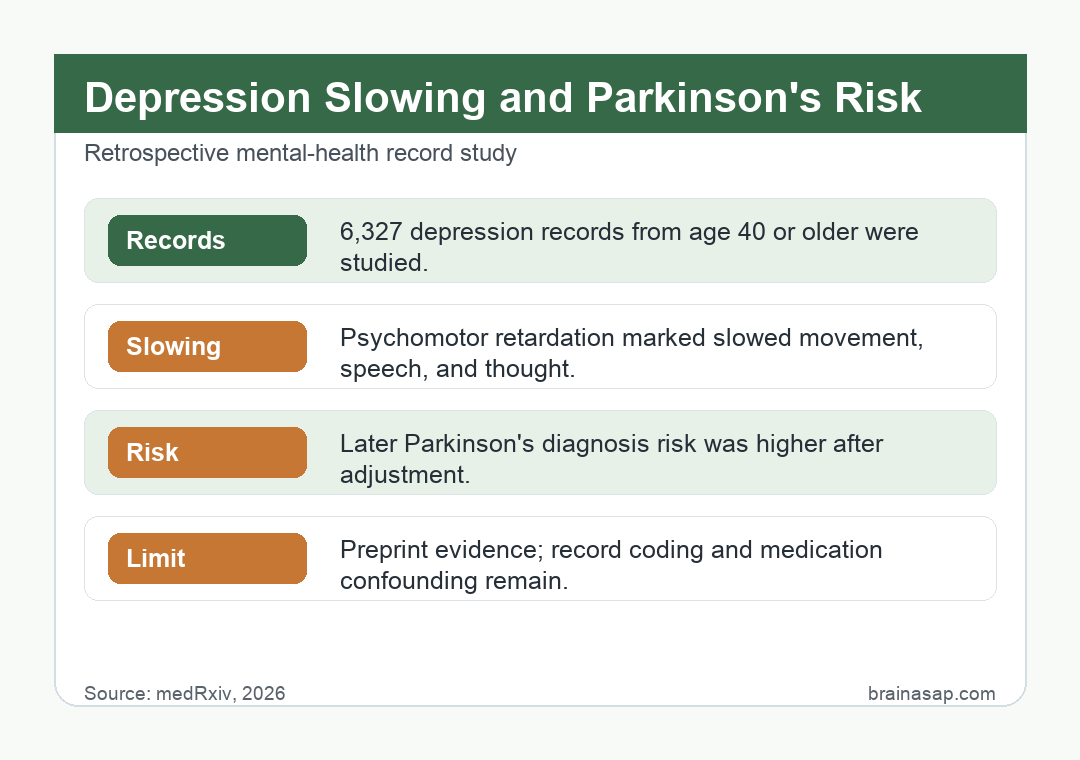
The timing result is clinically important. Researchers found a significant difference in psychomotor-retardation incidence at least 10 years before Parkinson’s diagnosis.
That long lead time weakens the simplest explanation that clinicians were only mislabeling early Parkinson’s motor symptoms as depression. It also fits the idea that some later-life depression with pronounced slowing could overlap with prodromal neurodegeneration.
Antipsychotic Use Keeps the Result Bounded
The study does not turn psychomotor retardation into a Parkinson’s screening test. Several caveats keep the finding narrower.
Antipsychotic use also showed a significant association with later Parkinson’s diagnosis after adjustment. That complicates interpretation for 2 reasons:
- Treatment-resistant depression: antipsychotics can be used as augmentation in more severe or resistant depression.
- Drug-induced parkinsonism: some antipsychotics can cause Parkinson-like motor symptoms, especially first-generation agents.
- Record interpretation: electronic notes may mention a medication that was considered, changed, or stopped, not always a clean exposure dose.
The authors also note that this mental-health-service cohort may include more severe psychopathology and more antipsychotic prescribing than the broader population with depression. That limits how widely the effect size should be generalized.
Preprint status adds another boundary. The paper has not yet been certified by peer review, so the result should be treated as a research signal rather than a settled clinical rule.
The Result Points to Better Clinical Phenotyping
Clinically, the result does not support a Parkinson’s workup for every person with slowed depression. The more useful takeaway is that slowed movement, speech, and thought in later-life depression should be documented carefully, compared with prior notes when possible, and not treated as a generic severity marker.
Psychomotor slowing could sit beside other prodromal Parkinson’s clues, including:
- Reduced smell: anosmia can precede motor diagnosis.
- REM sleep behavior disorder: dream enactment is a known prodromal warning sign.
- Subtle gait change: early motor changes may appear before classic tremor or rigidity.
- Late-life depression with slowing: this study suggests the clinical pattern may deserve follow-up attention.
Because this is a preprint and record-based study, prospective cohorts are still needed. The strongest next version would combine structured depression phenotyping, neurologic examination, medication data, imaging, and biomarkers over time.
A prospective cohort could separate 3 possibilities that electronic records blur together: a depression subtype that increases Parkinson’s risk, early Parkinson’s biology presenting as slowed depression, and treatment or diagnostic factors that make the association appear stronger.
For now, the study gives clinicians a more specific question to ask when later-life depression looks slowed rather than simply sad: is psychomotor retardation part of depression severity, or could it be an early marker of a neurodegenerative trajectory?
Citation: DOI: 10.64898/2026.04.26.26351763. Morrin et al. Psychomotor retardation and risk of Parkinson’s disease in unipolar depression: a retrospective cohort study. medRxiv. 2026.
Study Design: Retrospective electronic-health-record cohort study with hospital-record linkage for Parkinson’s diagnosis.
Sample Size: 6,327 patients with depression at age 40 or older; 2,402 had psychomotor retardation recorded.
Key Statistic: Adjusted hazard ratio for later Parkinson’s diagnosis was 1.43, 95% CI 1.02 to 2.01, p = 0.04.
Caveat: Preprint evidence; residual confounding, antipsychotic exposure, record-coding limits, and possible drug-induced parkinsonism remain important.