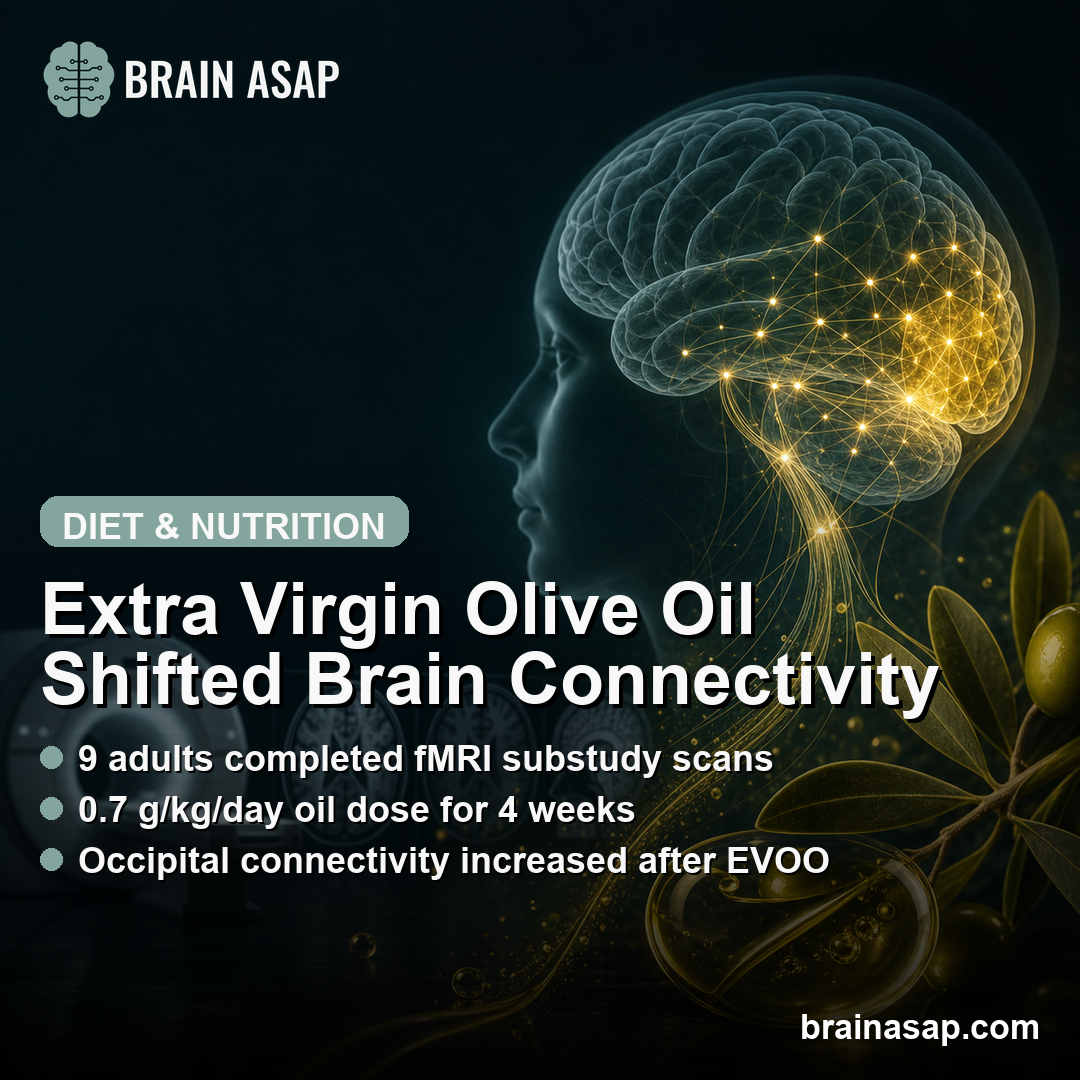
TL;DR: A 2026 pilot study in Food & Function found that one month of extra virgin olive oil intake was associated with higher resting-state occipital functional connectivity than regular olive oil in 9 healthy young adults.
Key Findings
- Occipital connectivity was the imaging endpoint: The 9-person neuroimaging substudy came from a larger randomized crossover trial of 28 healthy adults.
- Oil dose was weight-based: Participants consumed 0.7 g/kg/day of extra virgin olive oil (EVOO) or regular olive oil for 4 weeks per phase.
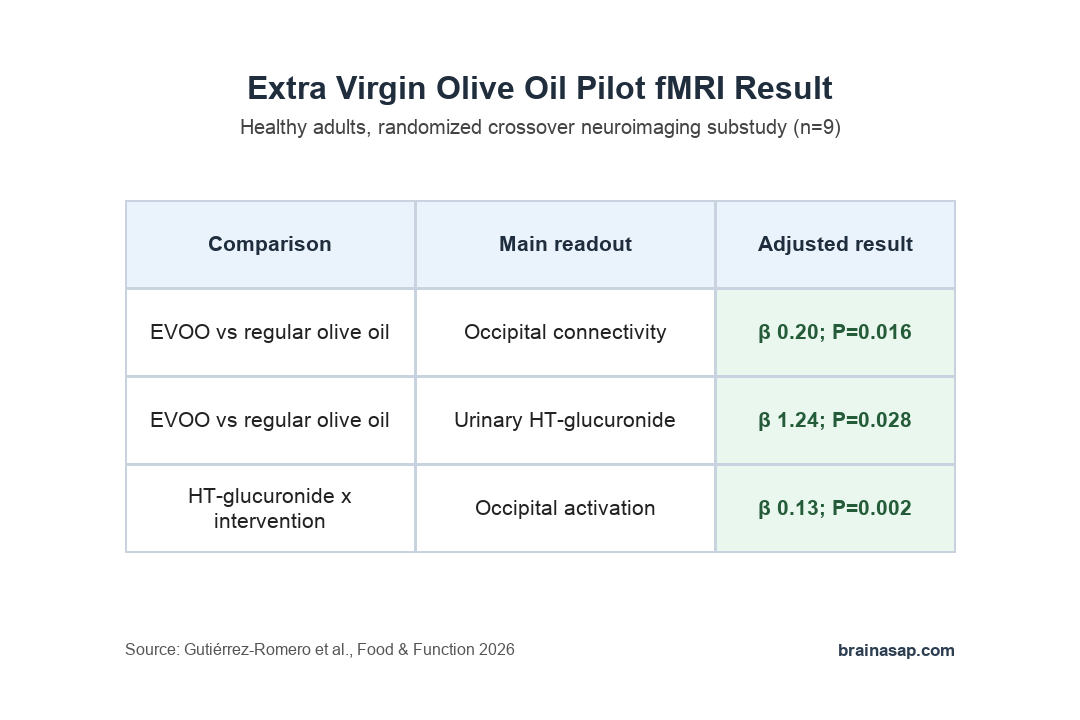
- Occipital connectivity increased: Fully adjusted models showed higher occipital functional connectivity after EVOO than regular olive oil (β = 0.20; P = 0.016).
- Phenolic biomarker increased: Urinary hydroxytyrosol-glucuronide, an EVOO intake biomarker, was higher after EVOO (β = 1.24; P = 0.028).
- Metabolite interaction was significant: The interaction between hydroxytyrosol-glucuronide and intervention on occipital activation was significant (β = 0.13; P = 0.002).
Source: Food & Function (2026) | Gutiérrez-Romero et al.
Extra virgin olive oil (EVOO) is one of the main polyphenol sources in a Mediterranean-style diet. Unlike highly refined olive oil, EVOO retains phenolic compounds such as hydroxytyrosol, oleuropein, and related secoiridoids.
Those compounds are studied because they can influence oxidative stress, inflammation, and vascular biology.
The question for this substudy was whether a short controlled EVOO exposure could be detected in resting-state functional magnetic resonance imaging (rs-fMRI), a scan that measures spontaneous brain network activity while a person is not doing a task.
Healthy Young Adults Completed a Randomized Crossover Olive Oil Trial
The substudy used 9 healthy adults from the HEVOOC randomized crossover trial. Participants were 18 to 35 years old, nonsmokers, free of chronic disease, and had body mass index below 30 kg/m².
Each person completed both oil conditions, separated by a 4-week washout. One phase used EVOO with 227.7 mg/kg total polyphenols; the other used regular olive oil with 12.3 mg/kg total polyphenols.
The imaging work used a 3-tesla Siemens PRISMA scanner. Researchers collected structural MRI and rs-fMRI data, then used independent component analysis and permutation testing to compare brain-network patterns across intervention periods.
- Run-in control: Participants avoided olives, high-polyphenol foods, and most alcohol before the intervention period.
- Diet maintained: Participants were told to keep their usual diet and add the assigned oil raw or cooked.
- Within-person design: The crossover structure meant each participant served as their own comparison.
EVOO Increased Resting-State Occipital Connectivity
The brain imaging result was localized to a visual network in the left occipital cortex. The occipital cortex is involved in visual processing, including visuospatial attention, motion perception, and object recognition.
After EVOO intake, occipital functional connectivity was higher than after regular olive oil. In the fully adjusted linear mixed model, the estimate was β = 0.20 with a 95% confidence interval from 0.03 to 0.37 and P = 0.016.
The voxel-wise effect size inside the significant cluster was reported as Cohen’s d = 1.058. For the extracted mean connectivity outcome, the intervention effect size was Cohen’s d = 1.46.
Models adjusted for intervention type, period, baseline outcome value, total energy intake, Mediterranean diet adherence, and moderate-to-vigorous physical activity. Diet quality and activity could both relate to brain connectivity, so these covariates were relevant.
Urinary Hydroxytyrosol-Glucuronide Confirmed EVOO Exposure
The researchers measured 24-hour urinary metabolites using liquid chromatography and high-resolution mass spectrometry. The target compounds were hydroxytyrosol, hydroxytyrosol-glucuronide, and hydroxytyrosol-sulfate.
Hydroxytyrosol-glucuronide is a validated biomarker of EVOO intake. Its urinary excretion was significantly higher after EVOO than after regular olive oil in the fully adjusted model.
- Biomarker result: Log-transformed hydroxytyrosol-glucuronide was higher after EVOO (β = 1.24; P = 0.028).
- Connectivity association: Changes in the biomarker were positively associated with occipital connectivity, but the fully adjusted result was borderline (P = 0.052).
- Interaction result: The biomarker-by-intervention interaction was significant (P = 0.002), suggesting the metabolite-connectivity relationship differed by oil type.
The Result Does Not Prove Better Cognition
The scan result is about resting-state connectivity, not memory, attention, or visual task performance. Participants were healthy young adults, so the study was not testing dementia prevention or treatment.
Still, the location is biologically reasonable. The left occipital cortex supports visual processing, and previous Mediterranean diet research has linked diet quality with brain connectivity in older adults.
The study also did not identify occipital connectivity as the only EVOO-relevant brain measure. It identified one significant visual-network cluster in a small pilot scan set, so the result should guide replication rather than define the only brain region worth testing.
A narrower interpretation is that high-polyphenol EVOO may alter intrinsic visual-network connectivity over a short period. Whether the connectivity change improves cognitive performance or predicts long-term brain health remains untested here.
The Pilot Sample Keeps the Finding Preliminary
The main limitation is the sample size: only 9 participants had neuroimaging. A sample that small leaves the result vulnerable to instability, even with a crossover design and within-person contrast.
The intervention also lasted only one month. Longer studies would be needed to test whether the connectivity difference persists, grows, disappears, or translates into measurable cognitive effects.
- Small neuroimaging sample: The authors explicitly described the analysis as exploratory and preliminary.
- Young healthy group: The result may not generalize to older adults, people with cognitive impairment, or dementia-risk groups.
- Single imaging domain: The study focused on resting-state connectivity, not a full cognitive or clinical endpoint battery.
The next useful test would replicate the EVOO contrast in a larger sample with prespecified imaging outcomes and cognitive measures. For now, the study provides an early human neuroimaging clue that EVOO’s phenolic compounds may affect brain-network activity.
Citation: DOI: 10.1039/d5fo05016b. Gutiérrez-Romero et al. Resting-state brain connectivity following extra virgin olive oil intake in healthy adults: a randomised crossover pilot neuroimaging substudy. Food & Function. 2026;17:3477-3483.
Study Design: Randomized crossover pilot neuroimaging substudy comparing 4 weeks of extra virgin olive oil with 4 weeks of regular olive oil.
Sample Size: 9 healthy young adults with resting-state functional magnetic resonance imaging and urinary metabolite data.
Key Statistic: EVOO was associated with higher occipital functional connectivity than regular olive oil in the fully adjusted model (β = 0.20; 95% CI 0.03 to 0.37; P = 0.016).
Caveat: The neuroimaging sample was very small and exploratory, so the result needs replication before clinical interpretation.