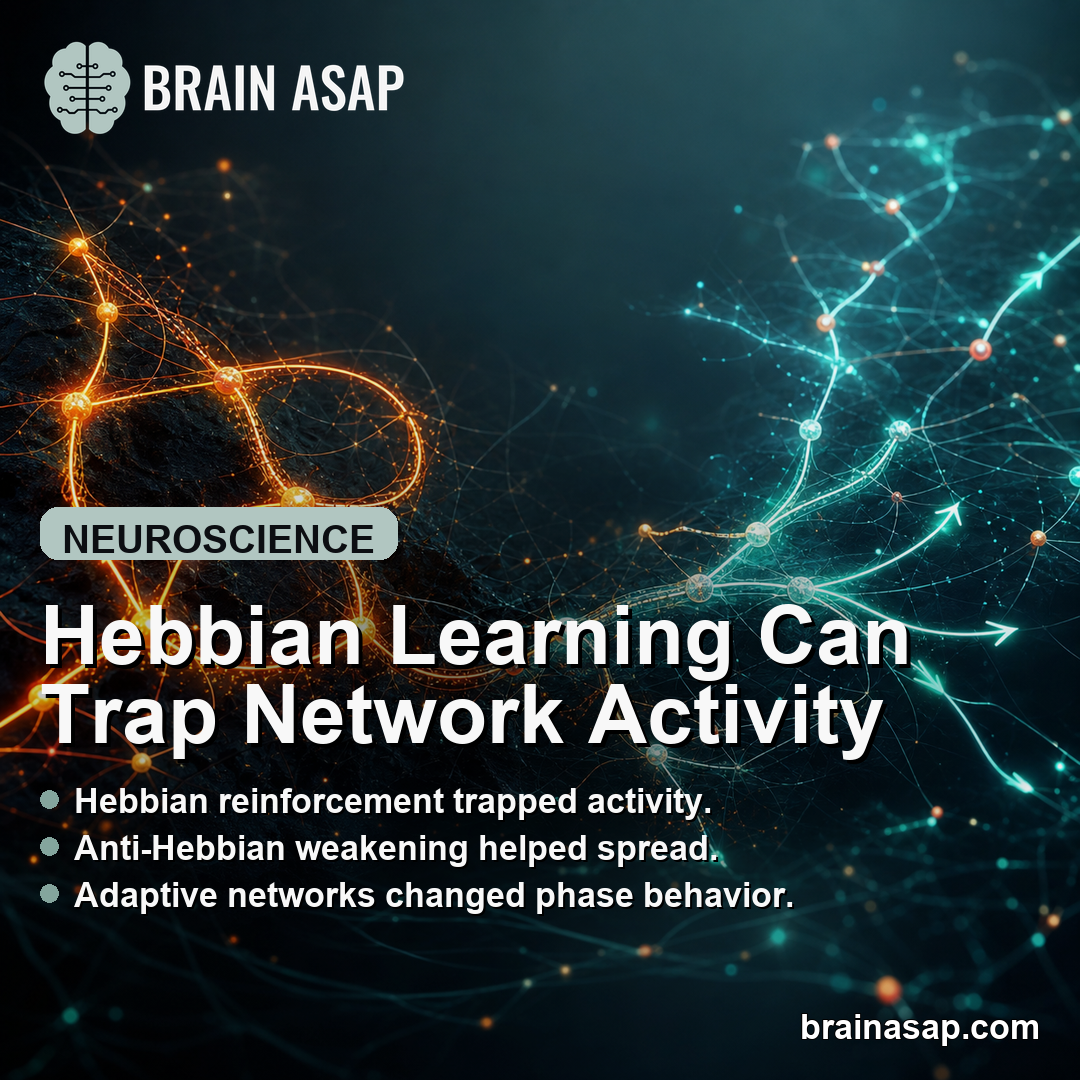
TL;DR: A network model in Communications Physics (2026) found that Hebbian learning, the familiar “fire together, wire together” rule, trapped activity in old routes, while anti-Hebbian weakening helped activity reach new areas.
Key Findings
- Positive reinforcement trapped activity: when successful activation made the same link more likely to be used again, activity tended to circle through familiar paths.
- Negative reinforcement spread activity outward: weakening a recently used link made the model explore alternate routes and could turn an inactive phase into a globally active phase.
- The model separates local learning from global spread: a rule that helps one connection repeat can still reduce total network reach.
- Phase behavior changed with learning: reinforcement rules altered whether activity survived, died out, or spread through the broader network.
- The evidence is theoretical: the work is a mechanism model for adaptive networks, not a direct recording of human or animal brain activity.
Source: Engedal, Juhasz, and Kovacs in Communications Physics, DOI: 10.1038/s42005-026-02638-z.
Hebbian learning is usually introduced as a brain rule: when two units activate together, the connection between them strengthens. That idea helps explain memory, habit formation, and neural plasticity.
The same rule can behave differently when the question is not whether one pair of nodes becomes stronger, but whether activity spreads across a whole network.
Researchers built a theoretical network model to test that difference. In the model, nodes could stand for neurons, people, animals, infected individuals, or other units in a spreading system.
Links carried activity from one node to another. Unlike a static network, the links changed after successful activation events, which means the history of the network changed its future routes.
The central contrast was simple:
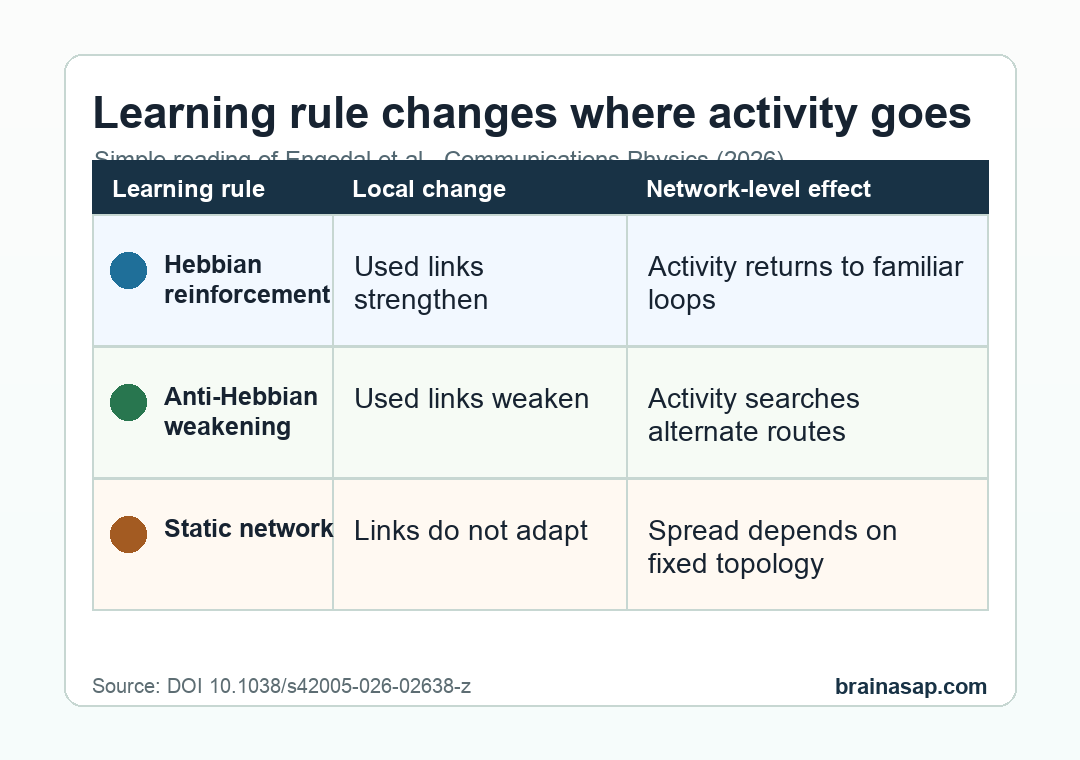
- Hebbian reinforcement: a successful activation strengthened the route that had just been used.
- Anti-Hebbian reinforcement: a successful activation weakened the route that had just been used.
- Static comparison: the network could also be considered without learning, where links did not adapt after use.
A link-level benefit can become a network-level trap. Positive reinforcement makes a familiar connection more likely to fire again.
Locally, that looks efficient. Globally, it can make activity revisit the same neighborhoods and fail to reach parts of the network that require a less familiar route.
For brain models, “stronger connection” is not always the same as “broader communication.” A strengthened synaptic or network route may stabilize a pattern.
Stable patterns can also compete with exploration, switching, and propagation. The model does not claim that real brains should weaken working connections.
It shows why adaptive spreading systems need to be interpreted at more than one scale.
Why Stronger Familiar Links Can Shrink Network Reach
The model starts from a contact-process idea: activity can move from an active site to a neighboring inactive site. Contact-process models are often used for epidemics, neural activity, animal behavior, and other spreading problems.
The new piece is that the activation rate between two sites is no longer fixed. It changes after experience.
Researchers tested whether learning occurred at the source node, the target node, or both. That distinction affects where adaptation sits in the model.
Across those variants, the important result was that local incentives could produce opposite global effects.
With source-side positive reinforcement, activity often returned to the same outgoing routes. The source had just succeeded through one path, so that path became even more likely.
Repeated success then made the same loop more attractive. In network terms, familiar routes gained probability mass, and less-used routes lost chances to carry activity.
The researchers compare this kind of behavior to an “ant mill,” where a trail becomes self-reinforcing. The analogy captures the main mechanism without making the model sound like a literal social experiment.
Once a path is repeatedly rewarded, the system can keep following it even when broader exploration would spread activity farther.
The practical pattern is:
- A route succeeds once: activity moves across one link.
- The route becomes favored: Hebbian reinforcement raises the chance of using that link again.
- The loop deepens: repeated use makes nearby routes dominate future activity.
- Spread narrows: other parts of the network are less likely to be reached.
This is the main counterintuitive point. Positive feedback can strengthen local reliability while reducing global spread.
The result does not require a psychological interpretation. It follows from how adaptive probabilities reshape movement through a network.
Anti-Hebbian Weakening Encouraged New Paths
Negative reinforcement had the opposite effect. When successful activation weakened the recently used connection, the model became less likely to repeat the same path immediately.
That made activity search for alternate neighbors and helped it move into new parts of the network.
In the researchers’ terms, negative reinforcement could turn an inactive phase into a globally active phase. That means a network state that would otherwise fail to sustain spreading could support broader propagation once recently used routes became less dominant.
The finding was not just “weak links are good.” The paper reports a more specific pattern: in two dimensions and above, negative reinforcement both promoted spreading and generated effectively immune regions.
That produced two distinct critical points, meaning the model had more than one threshold-like transition in how activity survived or died out.
That detail is important for neuroscience and behavior because adaptive systems rarely have one clean switch. A rule can improve one feature while creating another constraint.
In this model, anti-Hebbian weakening helped activity explore, but it also created regions that were hard to activate again. The same learning rule changed both the reach of activity and the structure of resistance.
The practical takeaways are bounded:
- For neural activity: the model gives a way to think about spreading signals when connection strengths change after activation.
- For social behavior: the model explains how repeated familiar interactions can trap information without assuming bad intent.
- For disease or contagion models: adaptive contacts can change the phase behavior of spread, so static-network assumptions may miss important thresholds.
What Adaptive Spreading Adds to Brain Models
For brain modeling, the study’s value is the coupling between propagation and plasticity. A signal does not simply travel over a prewritten map.
In the model, the act of traveling changes the map for later signals. That is closer to many biological systems than a fixed graph, even though the model is still far simpler than a living brain.
The result also helps separate two questions that often get merged. One question is whether a connection becomes stronger after coordinated activity.
Another is whether the whole network becomes better at moving activity into new regions. The model shows why those answers can diverge.
The Mechanism Is Not Social Advice
It would be easy to turn the study into a slogan about novelty. That would overstate the evidence.
The work is a theoretical physics model, not a clinical trial, not a brain-recording experiment, and not a direct test of social-media behavior.
Its value is that it isolates one mechanism: how reinforcement of recently successful activation paths changes later propagation.
That mechanism is still relevant. Many brain and behavior systems include both activity and adaptation.
Synapses change after experience. Social ties strengthen after repeated interaction.
Animal groups revisit familiar routes. In each case, the network is not just a map. It is a map that can be rewritten by the events moving through it.
The strongest BrainASAP-relevant point is that local plasticity and global communication can point in different directions. A connection can become stronger because it worked.
The network can become less exploratory because that same connection keeps winning. The model gives researchers a formal way to ask when learning supports propagation and when it traps activity inside familiar loops.
The caveat is equally direct: the model is intentionally abstract. Real neurons have timing rules, excitation and inhibition, cell types, synaptic fatigue, neuromodulators, and anatomical constraints.
Real social systems include memory, incentives, norms, and external inputs. The paper does not replace those details.
It shows that even a simple adaptive rule can change spreading behavior in a way static models would miss.
For future work, the clearest test is whether the same pattern appears in measured networks. Neural recordings, social-contact data, or animal-group tracking could show whether reinforced routes narrow later propagation while weakened recent routes broaden it.
If the same pattern appears in measured systems, the model would become more than a mathematical warning. It would become a practical tool for identifying when familiar-path learning helps a system stabilize and when it blocks new activity from getting through.
Citation: DOI: 10.1038/s42005-026-02638-z. Engedal et al. Activity propagation with Hebbian learning. Communications Physics. 2026.
Study Design: Theoretical and numerical network-modeling study of activity propagation with Hebbian and anti-Hebbian learning rules.
Sample/Model: Contact-process-style adaptive networks, including source, target, and source-target learning variants.
Key Statistic: Positive reinforcement caused loss of the active phase in the model, while negative reinforcement could turn the inactive phase into a globally active phase.
Caveat: The findings come from an abstract model, so they should guide mechanism questions rather than be treated as direct human, animal, or clinical evidence.