TL;DR: A 2026 study in eLife found that infants’ brains responded more strongly to structured children’s music than shuffled music by 3 months, while clearer music-linked movement patterns appeared mainly by 12 months.
Key Findings
- 79 infants tested: Researchers recorded electroencephalography (EEG), a scalp measure of brain electrical activity, and video-based body movement in 3 infant age groups.
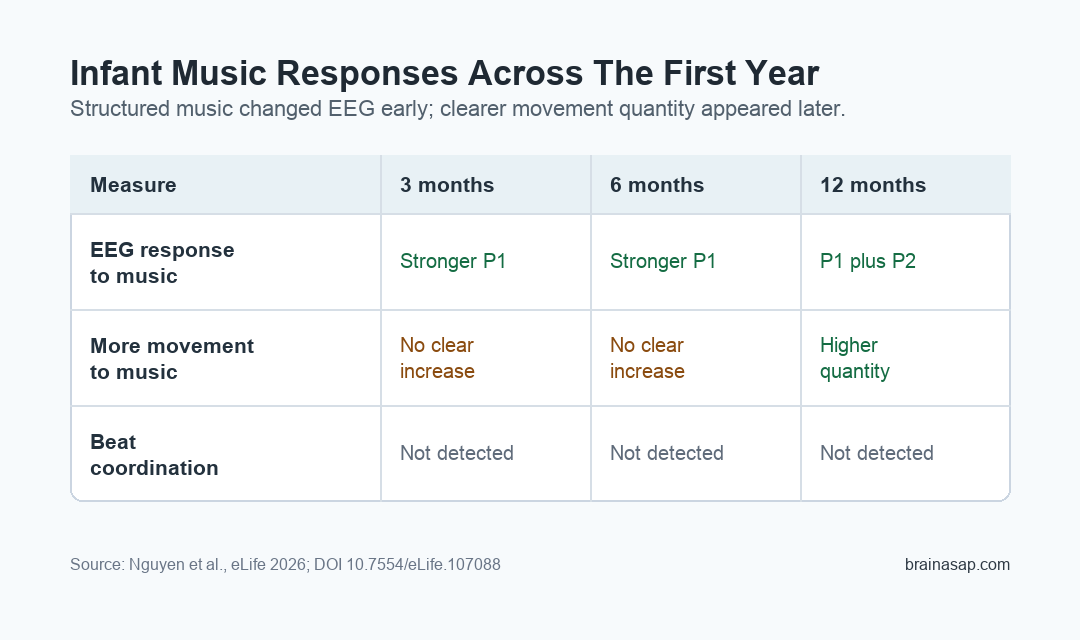
- Early music encoding: All 3 infant age groups showed stronger P1 brain responses to structured music than shuffled versions of the same songs.
- 12-month movement shift: Only 12-month-olds showed higher overall movement quantity to music than shuffled music, with the main contrast at t(69.8)=4.86, p<0.001.
- No beat-matched movement: Periodic movement occurred, but no infant age group showed evidence that spontaneous movements were coordinated with the musical beat.
- High-pitch coupling: High-pitched music predicted movement better than low-pitched music across age groups, with a main condition effect of χ²(1)=47.87, p<0.001.
Source: eLife (2026) | Nguyen et al.
Music can feel tightly linked to movement in adults, but the developmental path into that link is not obvious.
The infant music study tested perception and motion at the same time. A baby can show neural sensitivity to music before showing anything close to dance-like coordination.
Nguyen et al. recorded electroencephalography (EEG), a scalp measure of brain electrical activity, while infants listened to children’s songs.
Video cameras also captured full-body movement so the analysis could ask whether sound structure predicted motion.
EEG Showed Music Encoding by 3 Months
The first result was neural. Compared with shuffled versions of the same songs, structured music produced stronger infant brain responses across all 3 age groups.
The key EEG measure was the P1 response, an early positive brain response to sound. P1 timing became faster with age, moving from a peak around 212 ms in 3-month-olds to 146 ms in 12-month-olds.
The infant brain responses also became more adult-like across the first year. A later P2 response appeared in the 12-month-old group, while the younger groups mainly showed P1.
- 3 months: Music enhanced P1 amplitude between 177 and 305 ms after the sound, with an average peak amplitude of 1.8 µV.
- 6 months: Music enhanced P1 amplitude between 116 and 284 ms, peaking at 165 ms with an average amplitude of 2.8 µV.
- 12 months: Music produced a 2-peak cluster, including P1 from 104 to 227 ms and P2 from 307 to 325 ms.
The music-versus-shuffle contrast narrows the claim: infants were not simply reacting to any sound. Their brains showed stronger responses to the musical structure preserved in the real songs.
Structured Music Increased Movement Mainly at 12 Months
The movement result developed later. Researchers decomposed full-body kinematics into 10 principal movements, including front-back rocking, side sway, proto-clapping, leg kicking, arm pedaling, and whole-body wiggling.
Across those movement dimensions, only the 12-month-old group moved more to music than to shuffled music. The effect was strongest in upper-body and upper-limb patterns rather than a simple whole-body increase at every age.
- Rocking and swaying: Front-back rocking and side sway were higher in 12-month-olds during music than shuffled music.
- Proto-clapping: A clapping-like movement dimension became more common by 12 months and contributed to the music-versus-shuffle difference.
- Arm pedaling: Arm movement also helped separate 12-month responses to structured music from shuffled sound.
The study does not show that 12-month-olds danced to the beat. It shows that structured music, compared with a disrupted control version, was linked to more organized spontaneous movement by the end of the first year.
Music Predicted Movement Before Infants Matched The Beat
Movement quantity was only one layer of the analysis. Researchers also used Granger causality, a time-series method that asks whether changes in the sound envelope predicted later changes in movement velocity.
That analysis found coarse auditory-motor coupling at all ages. Musical stimuli predicted movement better than shuffled stimuli at 160-200 ms in 3-month-olds, 120-240 ms in 6-month-olds, and 160-240 ms in 12-month-olds.
Still, the coupling was not the same as beat synchronization. Autocorrelation analyses found periodic movement, but movement periodicity did not differ between music and shuffled music at the beat-related lag.
- Sound-to-motion timing: Changes in music intensity predicted later movement velocity better than the reverse direction.
- Age-specific movement types: Music best predicted lower-body movements at 3 months, upper-body movements at 6 months, and more whole-body patterns by 12 months.
- No synchronized beat response: Infants moved periodically, but their spontaneous movements were not reliably aligned with the musical beat.
The timing analysis separates coupling from synchronization. Early auditory-motor coupling may be a starting point for later rhythmic coordination, but the study places beat-matched movement beyond the first year rather than inside it.
High-Pitched Music Affected Brain And Movement Differently
The study also compared high- and low-pitched versions of the songs. The EEG pitch result was age-specific: only 6-month-olds showed a stronger P1 response to high-pitched than low-pitched music.
The movement-coupling result was broader. High-pitched music predicted movement better than low-pitched music across principal movements and age groups, even though high pitch did not simply make infants move more overall.
One interpretation is that high-pitched music changed timing or attention rather than raw movement quantity. That would fit infant-directed speech and singing, where higher pitch is common in caregiver communication.
- Neural pitch response: The high-versus-low pitch EEG difference was most evident at 6 months, not uniformly across infancy.
- Movement coupling: High-pitched music predicted subsequent movement more strongly across age groups.
- Quantity limit: Overall movement quantity did not differ reliably between high- and low-pitch conditions.
Seated Testing Limits The Infant Dance Claim
The evidence supports a modest developmental claim. By 3 months, infants’ brains already treated structured music differently from shuffled sound; by 12 months, their bodies showed more differentiated movement responses to music.
The study cannot say when a child begins to dance in the ordinary sense. Infants were seated, caregivers were behind them with noise-cancelling headphones, and the movement analysis was designed for controlled comparison rather than natural parent-infant music play.
The sample also included 79 infants after exclusions, with 19 of 98 excluded because of fussiness or technical issues. That attrition is common in infant EEG work, but it still narrows the evidence to infants who completed usable lab recordings.
The strongest conclusion is developmental: music perception appears earlier than coordinated music-movement behavior. The brain can encode structure before the motor system can turn that structure into organized, beat-matched action.
Citation: DOI: 10.7554/eLife.107088. Nguyen et al. Development of auditory and spontaneous movement responses to music over the first postnatal year. eLife. 2026;14:RP107088.
Study Design: Cross-sectional infant EEG and video-based movement study comparing music, shuffled music, high-pitch music, and low-pitch music.
Sample Size: 79 full-term infants aged 3, 6, and 12-13 months, plus 26 adult EEG controls.
Key Statistic: Only 12-month-olds showed higher movement quantity to music than shuffled music, t(69.8)=4.86, p<0.001.
Caveat: The experiment measured seated spontaneous movement in a lab, not natural caregiver-infant dancing or later toddler coordination.