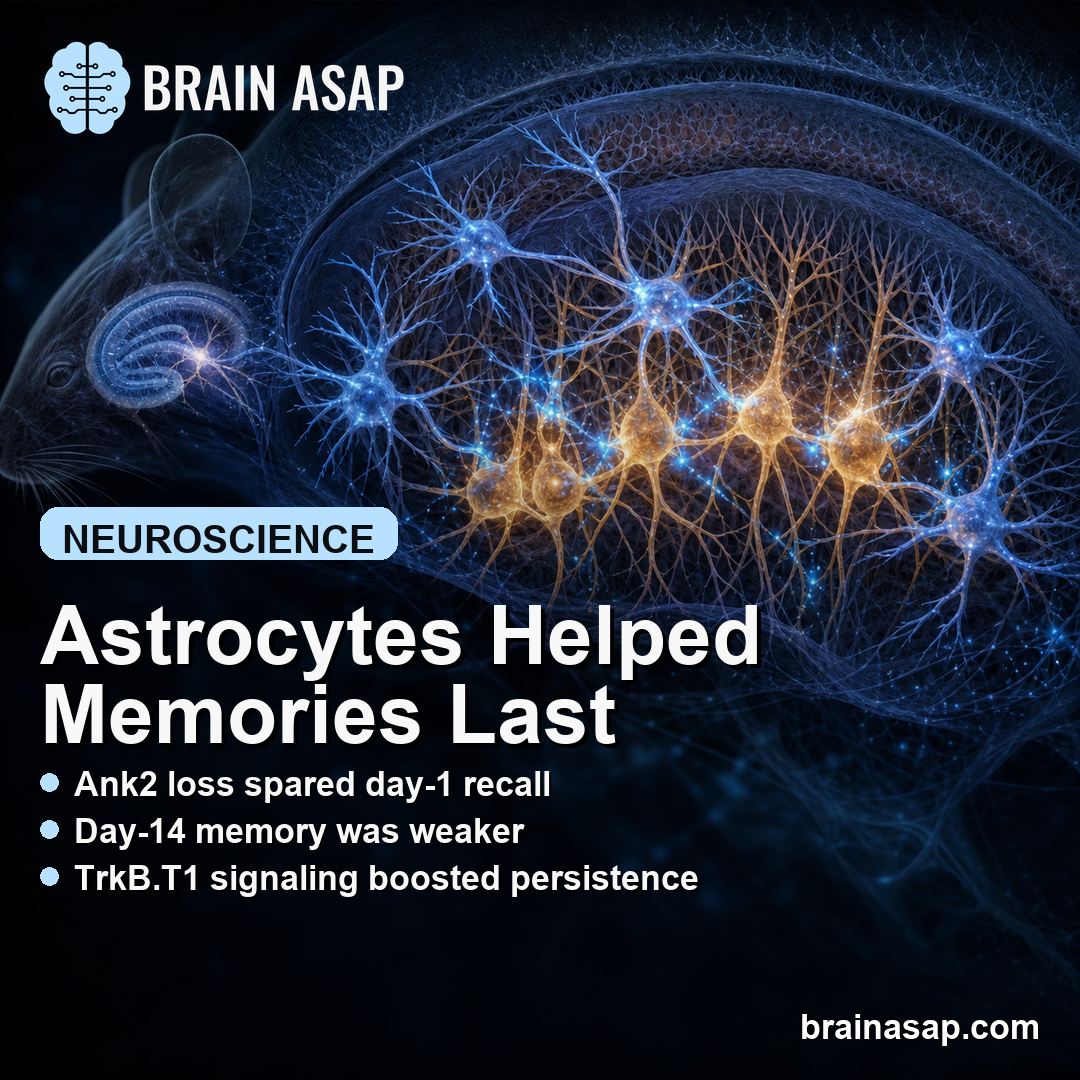
TL;DR: A 2026 mouse study in Nature Communications found that deleting ankyrin-2 (Ank2) from hippocampal astrocytes left recent memory intact but weakened remote memory, pointing to astrocyte structure as part of how memories stay stable over time.
Key Findings
- Recent recall stayed intact: Mice lacking astrocytic Ank2 performed normally in the day-1 contextual fear memory test.
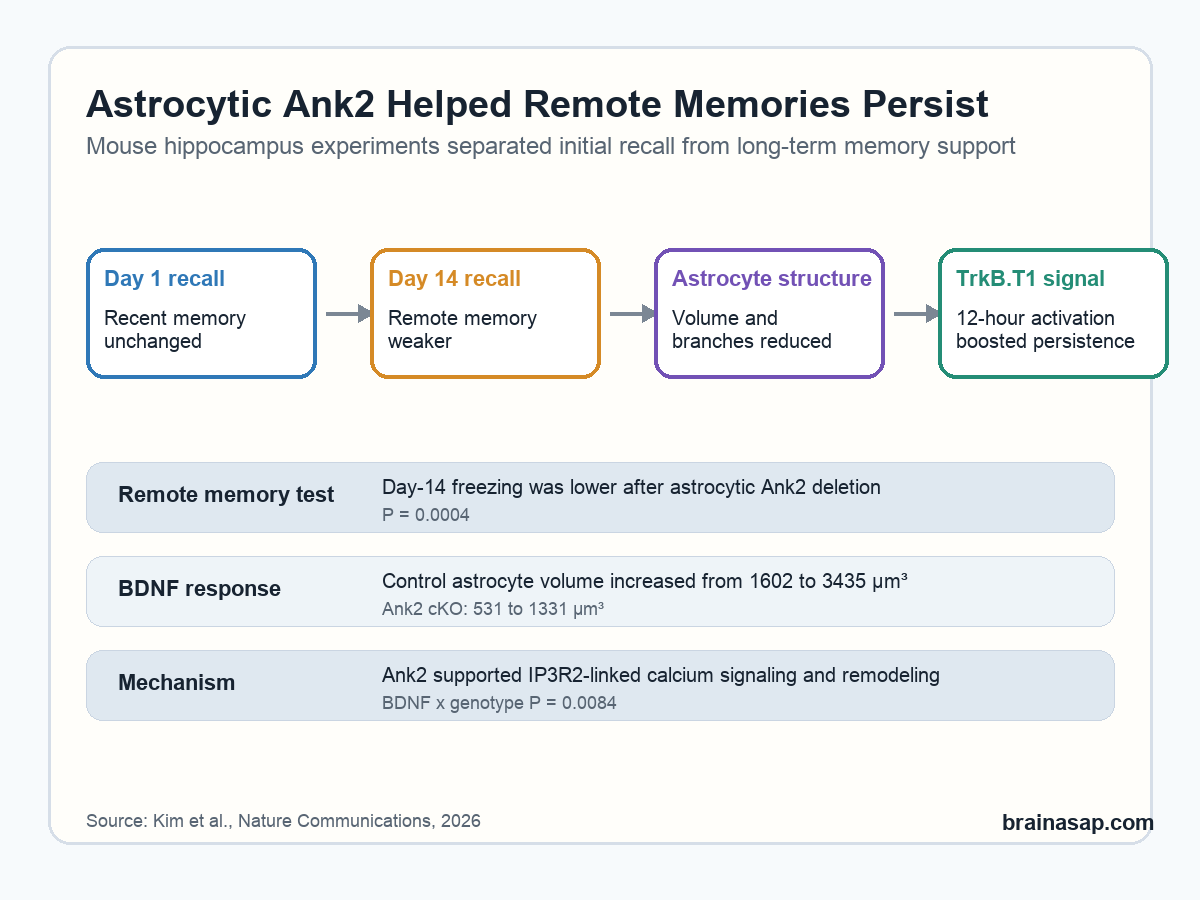
- Remote memory weakened: The same mice showed significantly lower day-14 freezing behavior, with a remote-memory group difference of P = 0.0004.
- Astrocyte structure shrank: Ank2 deletion reduced hippocampal astrocyte volume, branch complexity, and surface area without changing the number of astrocytes.
- BDNF signaling needed Ank2: Brain-derived neurotrophic factor (BDNF) increased astrocyte volume from 1602 to 3435 µm3 in control slices, but the response was smaller when Ank2 was missing.
- Opto-T1 activation was enough: Selective activation of astrocytic TrkB.T1 signaling 12 hours after learning enhanced remote memory and maintained late-phase synaptic potentiation.
Source: Nature Communications (2026) | Kim et al.
Deleting Astrocytic Ank2 Hit Day-14 Memory, Not Day-1 Recall
Ankyrin-2 (Ank2) is a scaffolding protein better known for organizing cellular machinery. This study asked whether its astrocyte version matters for memory persistence, not just for the neurons that store a memory trace.
The researchers deleted Ank2 selectively in adult astrocytes and then tested mice in contextual fear conditioning. The setup separated recent memory, measured one day after learning, from remote memory, measured 14 days after learning.
The split between day-1 and day-14 testing carried the main result. Mice without astrocytic Ank2 showed normal acquisition and normal recent recall, so they could learn the context and retrieve it shortly afterward.
The deficit emerged later: day-14 freezing was lower, and the memory-persistence ratio fell as well.
The same direction appeared when Ank2 was deleted more locally in hippocampal astrocytes. A CA1-targeted viral deletion again spared recent memory but reduced remote recall, supporting the idea that hippocampal astrocytes helped keep the memory stable after the initial learning event.
Astrocytes Became Structurally Simpler When Ank2 Was Missing
Astrocytes are not passive filler around neurons. Their fine processes wrap synapses, regulate chemical signals, and remodel after learning. In this paper, Ank2 loss changed that physical architecture.
GFAP staining and three-dimensional reconstruction showed lower astrocyte volume. Sholl analysis found fewer intersections, shorter total branch length, and fewer branching points.
A separate membrane-GFP approach also showed reduced astrocyte volume and surface area.
The change was not a broad collapse in astrocyte identity. The number of astrocytes did not drop, and passive electrical properties were largely preserved.
Astrocytes stayed present, but their contact-ready structure became less elaborate.
Memory persistence may depend on these tiny astrocytic leaflets continuing to support active synapses after the first learning window has passed.
A memory can look normal at day 1 while its longer-term support system is already weaker.
Ank2 Loss Reduced Astrocyte Contact With Engram Neurons
The study then moved closer to the memory trace itself. Engram neurons are cells recruited during learning and later involved in memory recall.
The researchers used astrocyte-eGRASP, an imaging method that marks astrocyte contact points on those learning-tagged neurons.
After fear conditioning, Ank2-deficient mice had fewer learning-dependent astrocyte contacts with engram neurons.
This happened even though recent recall was still normal, which makes the finding especially useful.
It suggests a separation between forming a memory and keeping it stable.
Neurons may carry the initial trace, while astrocytes help maintain the local synaptic environment that lets the trace persist.
- Basal transmission looked normal: Spontaneous excitatory and inhibitory postsynaptic currents did not show broad disruption.
- Early LTP appeared intact: Early-phase long-term potentiation could still be induced.
- Late LTP maintenance failed: The sustained, BDNF-dependent phase of potentiation weakened when Ank2 was deleted.
The electrophysiology fit the behavior. The short-term readout remained mostly intact, but the maintenance machinery was less reliable.
BDNF Needed the Ank2-IP3R2 Pathway to Remodel Astrocytes
The mechanism centered on brain-derived neurotrophic factor (BDNF), a signaling molecule involved in synaptic plasticity and memory persistence.
BDNF can act through TrkB.T1, a truncated BDNF receptor found in astrocytes, and through IP3R2, a calcium-release channel important in astrocyte signaling.
Biochemical work linked Ank2 with IP3R2. Ank2 deletion also reduced IP3R2 protein in hippocampal astrocytes and lowered spontaneous calcium microdomain activity, giving the authors a route from scaffold protein to astrocyte signaling.
When control brain slices were treated with BDNF, astrocyte volume increased from 1602 to 3435 µm3. In Ank2-deficient slices, BDNF produced a smaller increase, from 531 to 1331 µm3, and the genotype-by-BDNF interaction was significant.
The authors also disrupted the Ank2-IP3R2 interaction with a dominant-negative IP3R2 ankyrin-binding-domain construct. That blocked BDNF-dependent astrocyte morphogenesis in vivo, supporting the pathway rather than leaving the result as a loose correlation.
Activating Astrocytic TrkB.T1 12 Hours After Learning Enhanced Persistence
The strongest causal test came from Opto-T1, an optogenetic tool built to activate astrocytic TrkB.T1 signaling with blue light. This let the researchers stimulate the astrocyte side of the BDNF pathway without broadly adding BDNF everywhere.
In hippocampal slices, Opto-T1 activation after a weaker stimulation protocol maintained late-phase long-term potentiation for at least 3 hours, resembling the effect of BDNF. In mice, noninvasive blue-light stimulation 12 hours after mild conditioning enhanced remote memory and memory persistence.
Importantly, this did not simply make mice freeze everywhere. Freezing in a novel context did not differ, so the effect was tied to the learned context rather than generalized fear.
- Necessary signal: Astrocytic Ank2 was required for BDNF to enhance memory persistence.
- Sufficient signal: Astrocytic TrkB.T1 activation alone could enhance remote memory under the tested conditions.
- Timing mattered: The key intervention window was 12 hours after learning, not during the initial shock experience.
What the Mouse Study Does and Does Not Prove
The findings support a strong astrocyte-memory mechanism in mice, not a direct treatment claim for human memory problems.
Behavioral experiments used male mice, and the manipulations were specific genetic, viral, and optogenetic tools that are not clinical interventions.
The study also does not show that Ank2 is the only astrocyte molecule involved in remote memory. The authors focused mainly on the BDNF-IP3R2 pathway, while other calcium sources, metabolic support routes, and brain regions may also contribute.
Still, the paper sharpens the memory model. Remote memory persistence was not explained only by neurons firing together.
It also depended on astrocytes keeping the right structural contacts and BDNF-responsive signaling around memory-linked synapses.
Citation: DOI: 10.1038/s41467-026-75009-5. Kim et al. Astrocytic ankyrin-2 enables memory persistence in the mouse hippocampus. Nature Communications. 2026;17:5730.
Study Design: Mouse genetic, viral, imaging, electrophysiology, BDNF-infusion, and optogenetic experiments focused on hippocampal astrocytes.
Sample/Model: Adult C57BL/6J mice with astrocyte-specific Ank2 deletion; behavioral experiments used male mice.
Key Statistic: Astrocytic Ank2 deletion reduced day-14 contextual fear recall while sparing day-1 recall; the remote-memory group difference was P = 0.0004.
Caveat: The work identifies a mouse mechanism for memory persistence and does not establish a human therapy or diagnostic test.