TL;DR: A 2026 study in Nature Communications used deep learning, yeast screening, and human brain organoids to identify talarozole and sertaconazole as preclinical candidates that rescued several SURF1-related Leigh syndrome cell and organoid phenotypes.
Key Findings
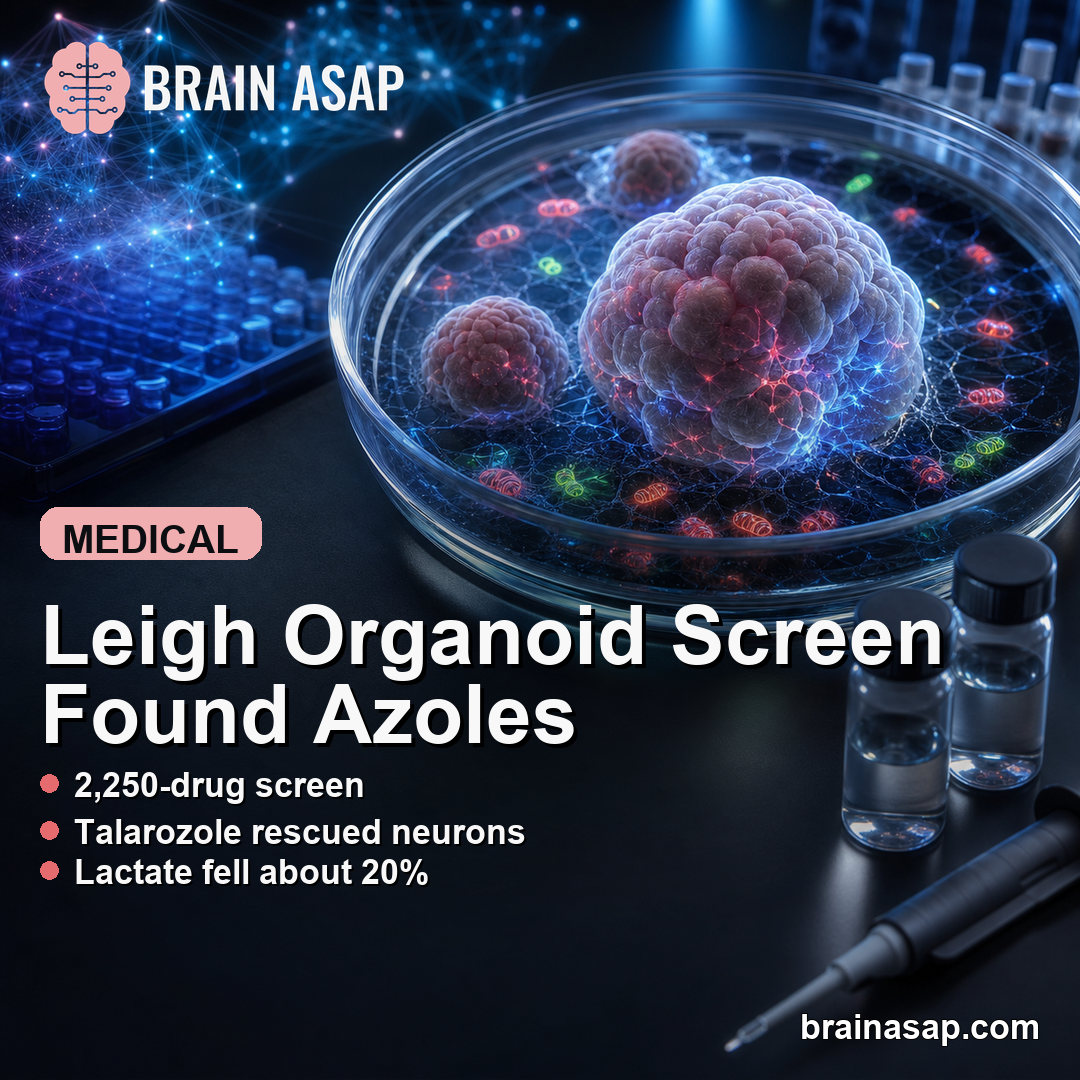
- 2,250-drug yeast screen: Researchers screened a repurposable-drug library in a yeast model carrying a SURF1-homologue defect and selected top rescue hits for follow-up.
- Top 2.5% AI cutoff: A deep-learning drug-ranking workflow selected compounds in the top 2.5% Bayesian enrichment score range from Leigh cerebral-organoid transcriptomic data.
- 9 candidate compounds: The two screening strategies converged on 9 repurposable candidates, including azole compounds.
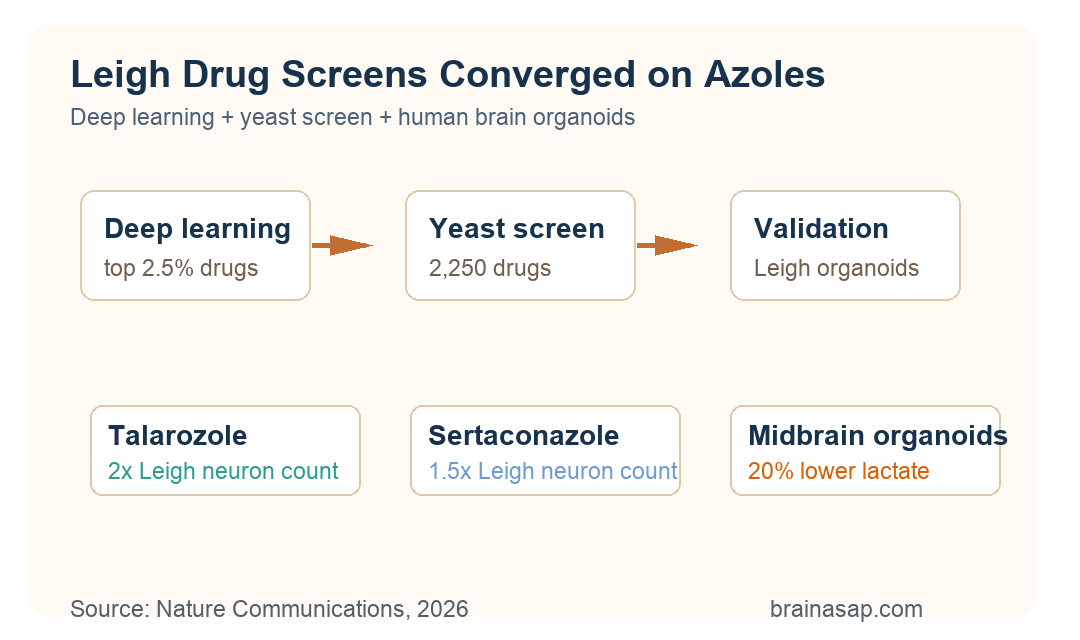
- Talarozole neuron rescue: Talarozole produced the strongest induced-neuron result, roughly doubling the number of neurons in Leigh induced-neuron cultures at 10 micromolar.
- 20% lower lactate: In Leigh midbrain organoids, sertaconazole and talarozole lowered media lactate by about 20% and improved growth-rate defects.
Source: Nature Communications (2026) | Menacho et al.
Leigh syndrome is a severe mitochondrial disorder that often affects the basal ganglia and midbrain, causing neurodevelopmental regression, lactic acidosis, motor impairment, and early death.
Menacho et al. focused on Leigh syndrome linked to SURF1, a gene involved in cytochrome c oxidase assembly.
The study did not test a drug in patients. It built a preclinical pipeline that used patient-derived and engineered human cell models, brain organoids, and a yeast survival assay to narrow drug-repurposing candidates.
Deep Learning Ranked Drugs From Leigh Organoid Biology
The computational arm started from single-cell RNA sequencing data from Leigh cerebral organoids. Those organoids had already shown impaired neuronal morphogenesis, so the researchers looked for drugs predicted to push disease-relevant cells toward a healthier developmental state.
The model generated a Bayesian enrichment score for candidate compounds. Drugs ranked in the top 2.5% were considered deep-learning candidates for validation.
- Input biology: Leigh cerebral-organoid transcriptomic signatures separated radial glia, intermediate progenitors, and neuronal populations.
- Drug ranking: The algorithm combined predicted targets, network propagation, enrichment, and model-confidence weighting.
- Candidate cutoff: The team selected high-scoring drugs rather than treating the algorithm as a final answer.
The AI screen worked as a triage system. Biological validation determined whether any predicted compound actually improved Leigh model phenotypes.
A 2,250-Drug Yeast Screen Independently Pointed to Azoles
In parallel, researchers ran a survival screen in yeast lacking SHY1, the yeast homologue of SURF1. The screen tested a library of 2,250 repurposable drugs under conditions that stressed the mutant yeast model.
Among the top 2% of yeast rescue hits, the team selected compounds for comparison with the deep-learning list. The two approaches converged on 9 candidate repurposable compounds.
- Different model systems: The deep-learning screen used human organoid transcriptomics, while the yeast screen used survival rescue.
- Independent convergence: Both routes highlighted azole compounds rather than only unrelated hits.
- Validation priority: Talarozole and sertaconazole became the main compounds carried forward into human neural models.
Overlap across screens strengthened the pipeline. A compound that looks promising in one model can fail in another; matching signals from different models raised the chance that the signal reflected Leigh-relevant biology.
Talarozole and Sertaconazole Improved Leigh Neuron Measures
The first human-cell validation used induced neurons made from Leigh neural progenitor cells. Compared with isogenic controls, Leigh induced-neuron cultures had reduced neuronal amount and neurite measures.
Talarozole produced the most pronounced deep-learning-hit effect: at 10 micromolar, it roughly doubled the number of neurons in Leigh induced-neuron cultures and increased mean neurite length.
Sertaconazole, the strongest yeast-screen candidate, also improved the model at the same dose, increasing neuronal amount by about 1.5-fold and increasing mean neurite length.
- Dose limit: The 50-micromolar treatments were toxic in Leigh induced-neuron cultures.
- Yeast validation: Both compounds improved mutant yeast survival in concentration-dependent follow-up assays.
- Preclinical scope: These results support model rescue, not established treatment efficacy in children with Leigh syndrome.
Midbrain Organoids Recapitulated Leigh Energy Stress
The team then built midbrain organoids because Leigh syndrome commonly affects midbrain and basal ganglia regions. The organoids carried SURF1 variants and showed transcriptomic and metabolic features aligned with Leigh pathology.
Leigh midbrain organoids released more lactate than controls, matching the role of lactate as a clinical marker in mitochondrial dysfunction. They also showed abnormal growth-rate responses and altered calcium signaling during metabolic stress.
- Growth phenotype: Leigh midbrain organoids had abnormal growth trajectories compared with controls.
- Lactate phenotype: The disease organoids released more lactate into the medium.
- Stress response: Calcium imaging showed an altered response when organoids were exposed to metabolic stress.
The midbrain organoids created a stronger validation stage than a single two-dimensional cell assay. The compounds had to show effects in a three-dimensional human neural model that captured several disease-relevant features.
Azoles Lowered Lactate and Improved Growth in Leigh Organoids
For long-term organoid treatment, researchers used 0.1 micromolar sertaconazole or 1 micromolar talarozole. Both compounds improved growth-rate defects in Leigh midbrain organoids and reduced lactate release by about 20%.
Talarozole showed stronger effects on several neuronal and bioenergetic readouts, including active-cell calcium responses and AMP/ATP ratio recovery. Sertaconazole showed stronger effects on lipid and membrane-associated measures.
- Talarozole profile: Stronger rescue of mitochondrial bioenergetic measures and retinoic-acid-pathway activity.
- Sertaconazole profile: Stronger modulation of lipid metabolism and membrane-bound cholesterol measures.
- Shared organoid effect: Both azoles reduced abnormal lactate release and improved growth-rate defects.
The authors also investigated retinoic acid and PPAR-gamma signaling as possible mechanistic routes. Those pathway results are useful for follow-up work, but they do not yet establish a dosing strategy or safety profile for patients.
The Leigh Drug-Screen Result Remains Preclinical
The main claim is methodological and preclinical: combining AI ranking, yeast screening, human neural cells, and organoids can narrow repurposable candidates for a rare mitochondrial disorder.
Several limits keep the interpretation focused. The models centered on SURF1-related Leigh biology, the organoid assays cannot reproduce a whole child with multisystem mitochondrial disease, and no clinical trial tested talarozole or sertaconazole in Leigh syndrome.
- Variant scope: Future work needs to test whether the compounds help models with other Leigh-causing variants.
- In vivo gap: Animal or other systems are still needed to assess distribution, safety, and organ-level effects.
- Clinical gap: A model rescue does not prove benefit, dosing, or tolerability in patients.
The workflow is the practical advance. For rare neurodevelopmental mitochondrial disorders, an integrated screen can move from thousands of compounds to a small set of biologically testable candidates without relying on a single imperfect model.
Citation: DOI: 10.1038/s41467-026-71391-2. Menacho et al. Accelerating Leigh syndrome drug discovery through deep learning screening in brain organoids. Nature Communications. 2026;17:3570.
Study Design: Drug-repurposing pipeline combining deep-learning screening, yeast survival screening, induced-neuron validation, and SURF1-mutant human midbrain organoids.
Sample/Model: Leigh cerebral-organoid transcriptomic data, a 2,250-drug yeast screen, SURF1-mutant induced neurons, and midbrain organoids treated with talarozole or sertaconazole.
Key Statistic: Talarozole roughly doubled Leigh induced-neuron count, sertaconazole increased it about 1.5-fold, and both azoles lowered lactate release in Leigh midbrain organoids by about 20%.
Caveat: The work is preclinical and model-based; it does not show that either drug treats Leigh syndrome in patients.