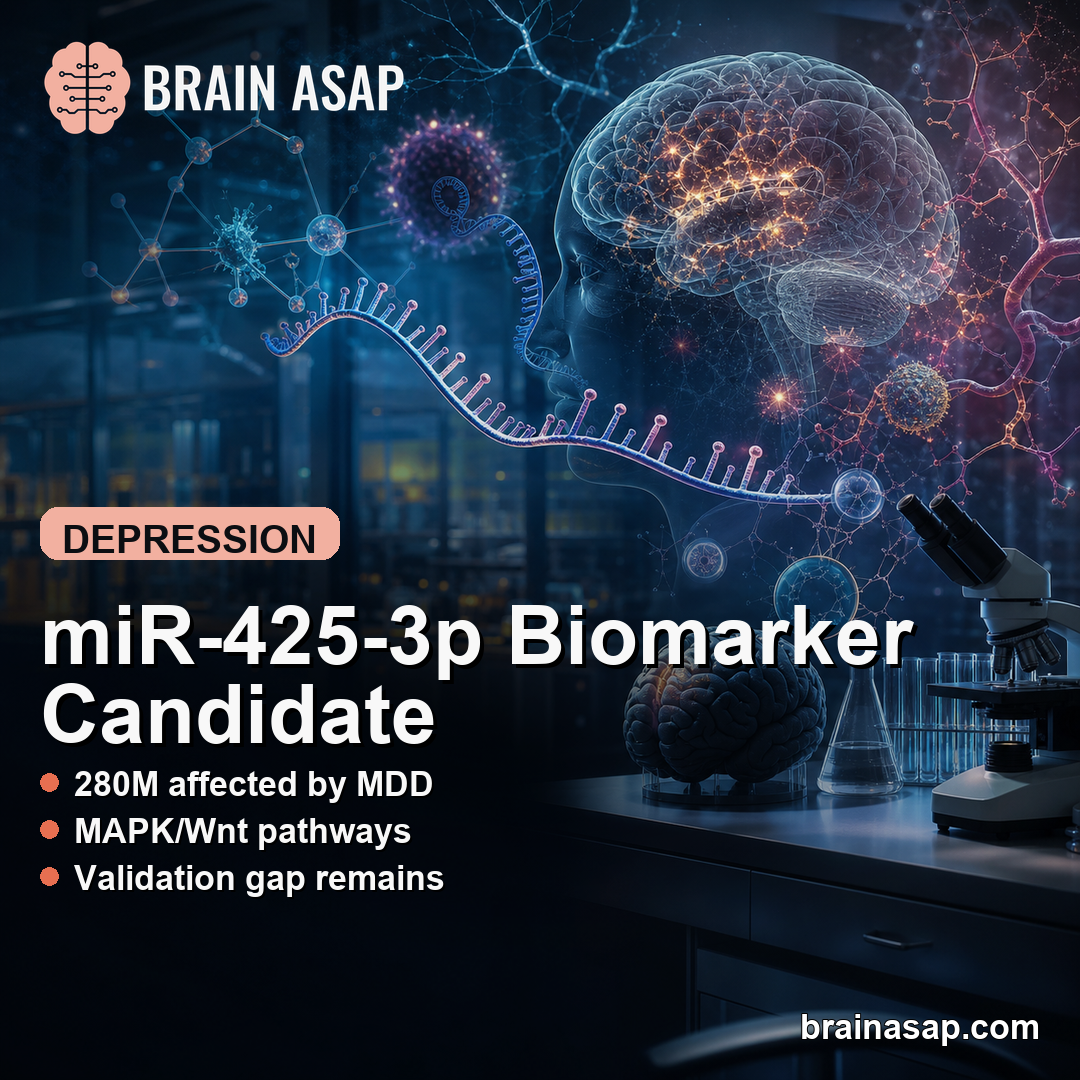
TL;DR: A 2026 review in Neuropsychiatric Disease and Treatment argues that miR-425-3p is a candidate depression biomarker because it connects stress biology, MAPK/Wnt signaling, inflammation, and antidepressant response evidence.
Key Findings
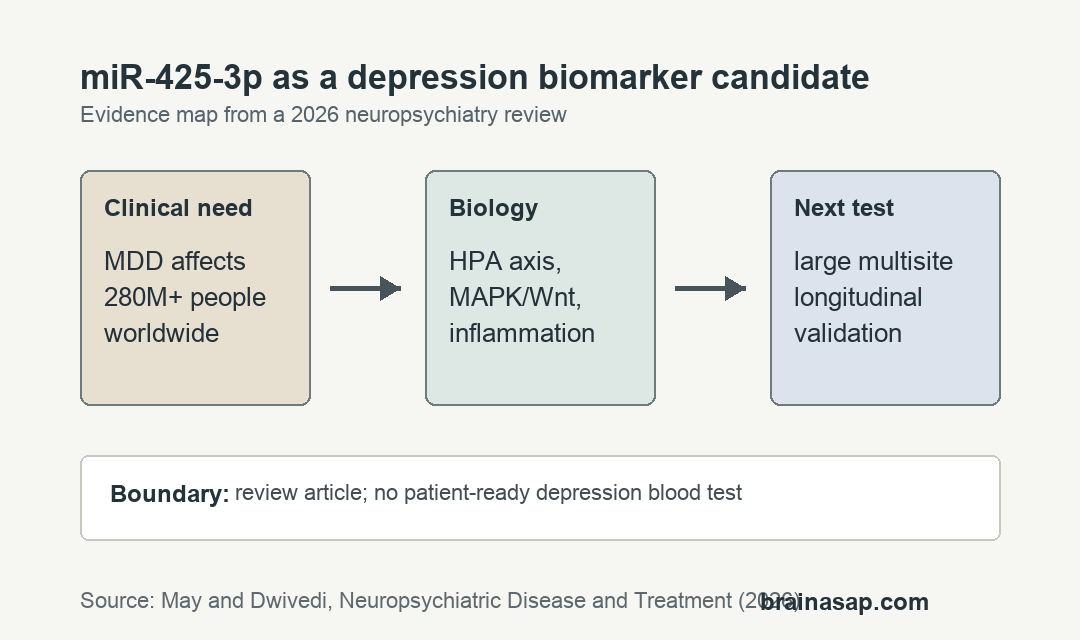
- 280 million MDD burden: The review opens from the scale of major depressive disorder, which affects more than 280 million people worldwide.
- About 20-fold suicide risk: It cites evidence that people with MDD are about 20 times more likely to die by suicide than the general population.
- 70% brain miRNAs: Roughly 70% of known microRNAs are expressed in the brain, where they help regulate synapses, stress response, and neuronal survival.
- One direct stress model: The authors note that only one study from their laboratory has directly examined miR-425-3p in a rat chronic-stress model.
- Validation gap remains: The review says biomarker use needs large, standardized, multisite, longitudinal studies with imaging, proteomics, and clinical phenotyping.
Source: Neuropsychiatric Disease and Treatment (2026) | May and Dwivedi
miR-425-3p Was Framed as a Depression Biomarker Candidate
miR-425-3p is a microRNA, a short noncoding RNA that helps regulate how efficiently messenger RNAs are translated into proteins. The review places it inside the broader epigenetic biology of major depressive disorder (MDD).
The broader frame is important because MDD is not explained by one neurotransmitter or one gene. May and Dwivedi describe depression as a condition shaped by genetic vulnerability, life stress, inflammation, endocrine signaling, and long-lasting gene-expression changes.
MicroRNAs are relevant because they sit between environmental stress and protein-level biology. A single microRNA can influence many messenger RNA targets, and one messenger RNA can be controlled by several microRNAs.
- Review type: a narrative review of miR-425-3p biology, depression relevance, and translational gaps.
- Main condition: major depressive disorder, with additional discussion of neuropsychiatric and neurodegenerative conditions.
- Main claim: miR-425-3p deserves more study as a biomarker and possible treatment target, not that it is ready for clinical use.
Stress Biology, HPA Axis Signaling, and MAPK/Wnt Pathways Converged
The review connects miR-425-3p with several systems that already matter in depression biology. These include the hypothalamic-pituitary-adrenal (HPA) axis, the hormonal stress-response system, and pathways tied to neuronal plasticity.
Two named pathway families are central: MAPK signaling, a group of cascades involved in cell growth and stress responses, and Wnt signaling, a pathway involved in development, synaptic remodeling, and neuronal survival.
The authors also discuss neuroinflammation, neuronal cell death, synaptic plasticity, and antidepressant treatment response. Those domains are not separate silos; they overlap in the way stress changes brain-cell function over time.
- Endocrine pathway: miR-425-3p is discussed in relation to HPA-axis regulation and stress responsivity.
- Plasticity pathways: MAPK and Wnt signaling are highlighted because they have links to mood regulation and antidepressant response.
- Cell-survival pathways: the review connects miR-425-3p with apoptosis, neuronal repair, neuroinflammation, and neuroimmune activity.
Antidepressant Response Evidence Came From Blood and Model Studies
The most clinically direct section concerns antidepressant response. The review describes small-RNA sequencing work using paired peripheral blood samples collected before and after antidepressant treatment.
In that evidence stream, miR-425-3p expression was associated with clinical response in MDD. The differential expression pattern was reported in treatment responders, replicated across independent patient cohorts, and supported by a complementary mouse model.
That evidence does not make miR-425-3p a treatment-response test yet. It does mean the marker has appeared in a clinically relevant sampling context, not only in isolated cell or animal experiments.
- Biofluid advantage: peripheral blood sampling could make repeated measurement easier than brain-tissue sampling.
- Biological bridge: pathway analyses linked miR-425-3p to MAPK and Wnt networks involved in neuronal plasticity.
- Clinical gap: standardized timing, medication context, symptom scales, and replication cohorts are still needed.
Brain-Enriched microRNAs Are Useful but Hard to Validate
The review notes that roughly 70% of known microRNAs are expressed in the brain. That gives microRNAs a strong biological rationale for psychiatric research, but it also creates complexity.
Brain expression alone is not enough. A clinically credible biomarker must show that its measured level predicts diagnosis, treatment response, progression, or a meaningful biological subtype better than existing clinical information.
A strong validation study would need fixed blood-collection timing, defined antidepressant exposure, consistent symptom scales, and a prespecified response threshold. Without those controls, miR-425-3p differences could reflect medication timing, cell-mixture changes, illness severity, or other biology that travels with depression but does not guide care.
May and Dwivedi are explicit about the remaining work. The functions of miR-425 within specific cell types and neural circuits are still not well defined, and much of the evidence comes from rodent studies.
- Cell-type problem: a blood result may not reveal which brain cell type changed.
- Circuit problem: mood symptoms depend on distributed circuits, not one molecular pathway.
- Delivery problem: miRNA-based therapeutics would need safe, targeted, cell-type-specific delivery methods.
miR-425-3p Is Not Ready as a Depression Test
The review keeps the translational promise and the evidence gap in the same frame. miR-425-3p may help connect stress exposure, neuronal signaling, inflammatory biology, and antidepressant response.
Clinical use would require much more than a molecular map. May and Dwivedi call for large, standardized, multisite, longitudinal studies that combine neuroimaging, proteomics, and detailed clinical phenotyping.
For now, miR-425-3p is best treated as a candidate marker for research stratification. It is not a diagnostic blood test for depression and not a validated target for patient-ready miRNA therapy.
Citation: DOI: 10.2147/NDT.S611548. May and Dwivedi. MicroRNA-425-3p: A Promising Biomarker and Candidate for Pharmacological Intervention in Neuropsychiatric Disabilities with Relevance to Major Depressive Disorder. Neuropsychiatric Disease and Treatment. 2026;22:611548.
Study Design: Narrative review of miR-425-3p biology, depression relevance, biomarker evidence, and treatment-target gaps.
Sample/Model: Review article drawing on human, blood-based, rodent chronic-stress, and bioinformatic evidence rather than one new participant cohort.
Key Statistic: Major depressive disorder affects more than 280 million people worldwide, and roughly 70% of known microRNAs are expressed in the brain.
Caveat: miR-425-3p is a candidate marker; clinical use needs larger standardized longitudinal validation and safe targeted delivery work.