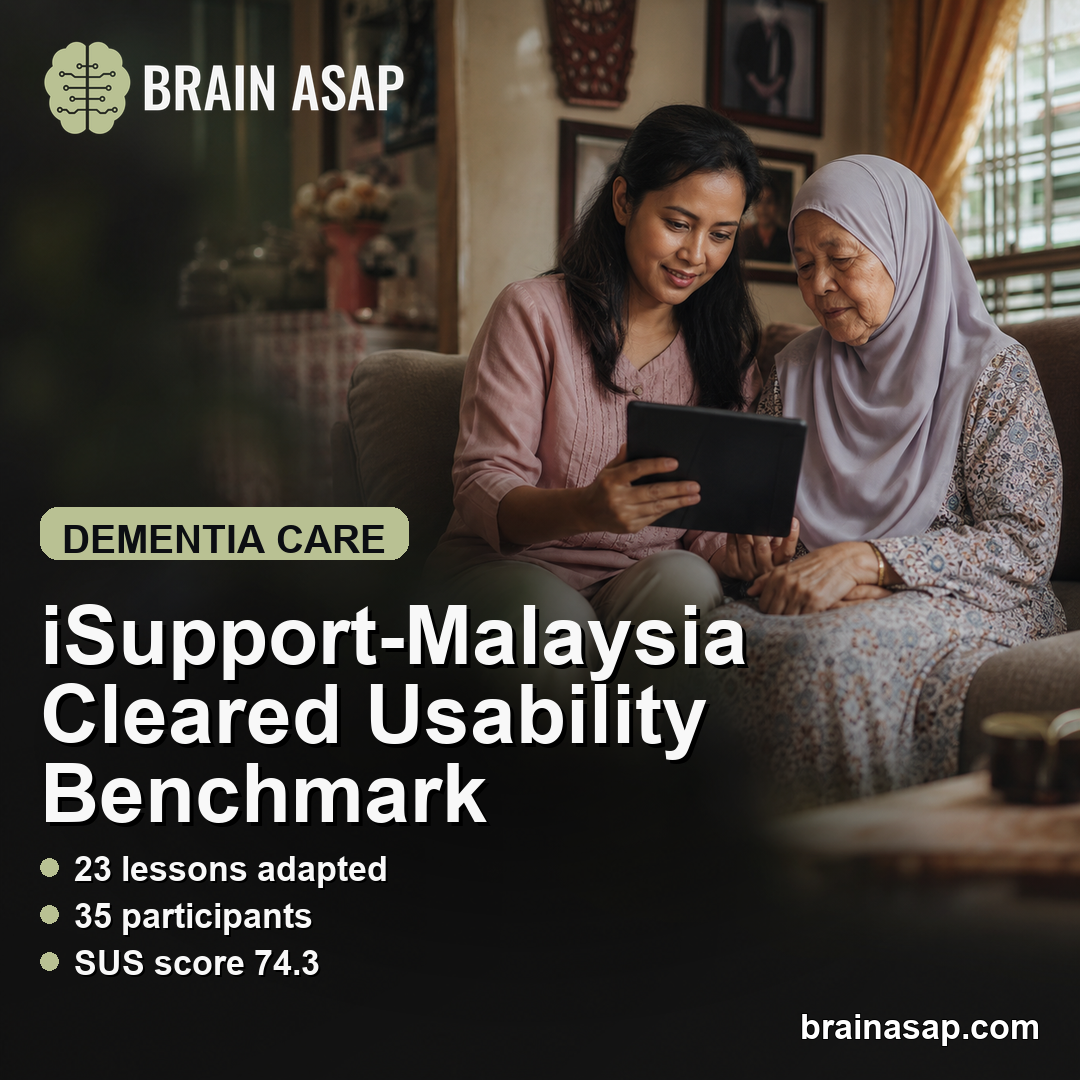
TL;DR: A 2026 preprint posted on medRxiv found that iSupport-Malaysia, a culturally adapted multimedia dementia-caregiver platform, scored above the usual usability benchmark and was viewed as culturally appropriate by caregivers and healthcare professionals.
Key Findings
- Four-phase adaptation: The WHO iSupport dementia program was translated into Bahasa Malaysia, culturally adapted, and rebuilt as multimedia e-learning.
- 23 lessons: The platform retained the WHO program’s lesson structure while adding local examples, video, audio, interactive activities, and discussion features.
- Caregiver usability testing: Focus groups and usability testing included 35 informal caregivers and healthcare professionals across stages.
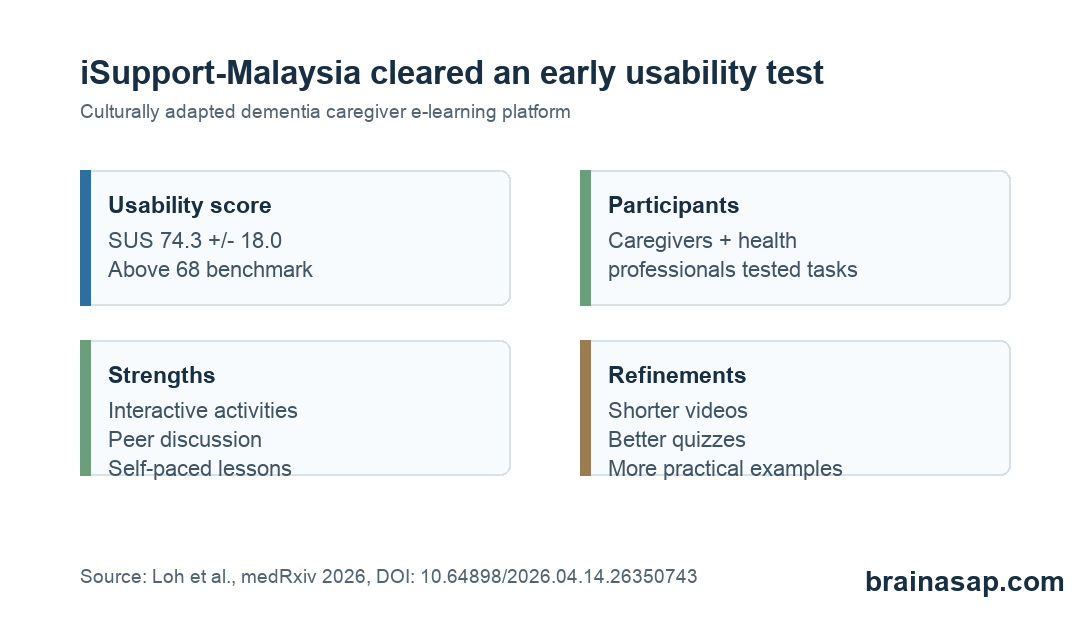
- SUS 74.3: The mean System Usability Scale score was 74.3 with a standard deviation of 18.0, above the common 68 usability benchmark.
- Refinements needed: Feedback called for better visual aesthetics, shorter videos, improved quizzes, and more practical caregiving examples.
Source: medRxiv (2026) | Loh et al.
Dementia caregiver support often depends on family members who receive little training while managing behavior changes, daily-care needs, and emotional strain. Malaysia’s aging population makes that support gap more urgent.
This study developed and tested iSupport-Malaysia, a local multimedia version of the World Health Organization’s iSupport for Dementia caregiver education program.
The source context was practical. The paper notes that informal caregivers in Malaysian Alzheimer care can spend hours each day on supervision, basic daily activities, and instrumental daily activities, while dementia-care education and respite access remain limited.
iSupport-Malaysia Adapted WHO Dementia Lessons for Local Caregivers
The project started with the WHO iSupport content, which provides dementia education in an e-learning format. The Malaysian version translated the material into Bahasa Malaysia, adapted it to local customs, and changed the delivery from mostly text-based learning to multimedia lessons.
The platform was designed around 23 lessons across five modules. It added videos, audio, interactive learning activities, peer discussion features, and flexible self-paced learning.
- Language adaptation: Content was translated and checked for local meaning rather than simply copied into another language.
- Cultural adaptation: Examples were adjusted for Malaysian family roles, caregiving expectations, and dementia-care context.
- Format adaptation: Multimedia lessons were used to make the training more engaging than a text-only manual.
The paper frames this as more than a website redesign. Dementia caregiving is shaped by culture, family duty, health literacy, and access to services, so the intervention had to fit local caregiving realities.
Caregivers and Healthcare Professionals Tested the Platform
The evaluation used focus groups and individual usability testing. Focus groups included 9 informal caregivers and 11 healthcare professionals.
Usability testing included 9 caregivers and 6 healthcare professionals. Participants completed think-aloud tasks, post-test questionnaires, and brief interviews.
The focus groups examined aesthetics, ease of use, clarity, cultural relevance, comprehensiveness, and satisfaction. The usability sessions tested whether people could actually move through the platform and complete tasks.
- Focus groups: Participants reviewed content and design from user and professional perspectives.
- Think-aloud tasks: Usability sessions captured where participants understood, hesitated, or needed help.
- Post-test survey: The System Usability Scale converted experience into a 0-100 usability score.
SUS 74.3 Put iSupport-Malaysia Above the Usability Benchmark
The main quantitative result was the System Usability Scale score. iSupport-Malaysia averaged 74.3 with a standard deviation of 18.0.
The paper used 68 as the usual threshold for above-average usability. By that standard, the platform was usable, although the wide standard deviation suggests some users had a much smoother experience than others.
Most tasks were completed without assistance. Participants also identified specific strengths: interactive activities, peer discussion, flexible pacing, credibility, and cultural fit.
- Usability strength: Most task flows were manageable without outside help.
- Learning strength: Self-paced multimedia lessons may reduce the burden of attending in-person training.
- Community strength: Peer discussion features could reduce caregiver isolation if they are moderated and used consistently.
Caregivers Wanted Shorter Videos and More Practical Examples
The feedback was not a simple pass. Participants asked for stronger visual design, shorter videos, better quizzes, and content with more direct caregiving application.
Those suggestions are important because caregiver education has to survive real-world constraints. A family caregiver may be tired, distracted, working, or caring for someone with behavioral symptoms while trying to learn.
The study therefore treated the usability work as a refinement step before a pilot feasibility study. The platform was acceptable enough to keep developing, but not finished enough to claim clinical impact.
For a caregiver platform, those details can determine whether an intervention is ever used. A long video, confusing quiz, or example that does not fit local family life can lower completion before any mental-health benefit has a chance to appear.
Dementia Caregiver Platforms Need Outcome Trials After Usability Work
The main limitation is that this was a development and usability study. It did not test whether iSupport-Malaysia reduced caregiver burden, depression, anxiety, behavioral-crisis frequency, or care-recipient outcomes.
The preprint status also matters. The study had not completed peer review at the time of posting, and the manuscript was under consideration elsewhere.
Still, the study provides a necessary early step. A caregiver intervention cannot improve stress or dementia-care skills if people cannot understand it, navigate it, or see their own caregiving context in the lessons.
The strongest immediate implication is therefore design-focused. iSupport-Malaysia appears ready for refinement and feasibility testing, not for claims about reducing caregiver depression, anxiety, or burden.
- Current claim: iSupport-Malaysia was usable and culturally acceptable in early user testing.
- Next test: A pilot feasibility study should examine recruitment, adherence, completion, and user retention.
- Clinical endpoint: Later trials need caregiver burden, mental-health symptoms, dementia knowledge, and care-management outcomes.
Citation: DOI: 10.64898/2026.04.14.26350743. Loh et al. Development and Evaluation of iSupport-Malaysia: A Multimedia Web-Based Psychoeducational Intervention for Dementia Caregivers. medRxiv. 2026.
Study Design: Mixed-methods cultural adaptation and usability evaluation of a dementia caregiver e-learning platform.
Sample Size: Focus groups and usability testing included informal caregivers and healthcare professionals, with 15 individual usability test sessions.
Key Statistic: Mean System Usability Scale score was 74.3 +/- 18.0, above the common 68 benchmark for above-average usability.
Caveat: The preprint evaluated usability and cultural fit, not clinical effectiveness for caregiver burden or dementia outcomes.